Garden Blog - Top Tropicals

Date: 18 Aug 2025

🌟Repotting FAQ
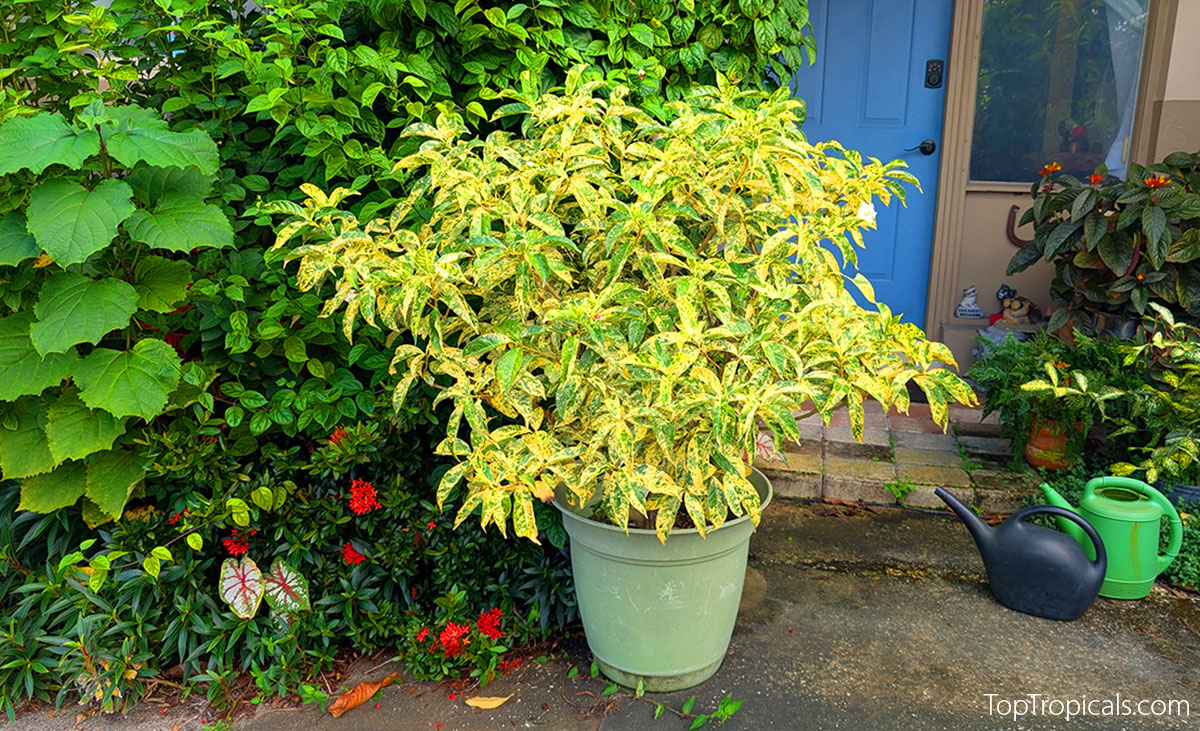
Tabernaemontana  variegated  in  container

Q: How big should the new pot be?

A: Only a few inches larger than the old one. Oversized pots hold too much moisture and may cause root rot.

Q: Why are plastic pots better than ceramic?

A: Plastic pots are lighter, easier to handle, and you can cut them if a root-bound plant is stuck. Ceramic pots are heavy, breakable, and often lack drainage.

Q: How do I safely remove a plant from its pot?

A: Turn the pot upside down and let gravity help. Never pull by the stems or leaves. If stuck, lay the pot on its side and squeeze or tap it. Cut the pot if needed.

Q: Should I remove old soil from the roots?

A: No. Roots have tiny hairs that absorb water and nutrients. Shaking off soil damages them and sets the plant back.

Q: Why must the plant sit at the same soil level?

A: Planting too deep suffocates the stem, and planting too high exposes roots. Keeping the same level protects the root crown.

Q: How soon should I water again after repotting?

A: Water thoroughly right after repotting, then wait until the top inch of soil dries before watering again.

🌱 Done! Your plant now has room to grow stronger before fall.

Shop Garden Supplies

Date: 28 Dec 2025

🎉 2026 Gardening Resolution That Actually Works

According to our experts: Smokey and Sunshine. When we say experts, we do not mean consultants or trend writers. We mean two real gardeners. Smokey watches patterns. Sunshine notices when people rush. Together, they explain what actually works.

Smokey  the  tuxedo  cat  writes  gardening  plans  for  2026  at  a  table  while 
 Sunshine  the  ginger  cat  rides  a  hobby  horse  holding  coffee,  with  donuts, 
 plants,  and  a  fireplace  in  a  winter 
 room.
Sunshine: Smokey, thank you for the Christmas present. I am riding this hobby horse straight into the Year of the Horse!
Smokey: I am making the plans for 2026. Planning makes gardening successful.
Sunshine: Coffee and donuts help too, so please include them in your plan.

Smokey: Hello gardeners. 2026 is the Year of the Horse.

Sunshine: Horses do not garden.

Smokey: Please do not interrupt me. No, they do not. That is just the calendar. What matters is what gardeners do at the start of every new year. They often rush and repeat the same mistakes.

Sunshine: The biggest one is rushing the garden before morning coffee.

Smokey: Correct. Rushing looks like effort, but it is usually just impatience. Gardens punish impatience very reliably.

Most early-season problems come from doing things too soon:
- watering before roots are active
- fertilizing before growth begins
- planting before conditions settle
- poking plants daily to check how the roots are growing

Sunshine: If you are poking the roots, the plant was fine until you started poking it.

Smokey: Good gardening is not constant action. It is knowing when to act and when to stop interfering.
- Plant when the timing is right.
- Let roots work quietly.
- Leave resting plants alone.

Sunshine: Coffee first. Donuts optional, but highly recommended.

Smokey: One last thing, while you are not rushing.

Our gift cards are still on promotion. They do not need planting, watering, or timing decisions today.

A gift card is a symbol of patience. Buy it now. Use it when the moment is right.

Smokey and Sunshine:
Our resolution for 2026 is simple: stop rushing the garden. Wishing you a calm, steady, coffee-fueled 2026 garden 🐾🌿

Date: 12 Dec 2025

PeopleCats Garden Tours

🎉 PeopleCats Garden Tours


🎄 It is almost here! December 13, 2025 - Holiday Plant Market, proudly hosted by the #PeopleCats of TopTropicals.
Our big end-of-season Plant Day. All year we grow the rare and unusual plants that will be featured at this event, and Saturday is the day they finally meet their new homes. The garden turns into a small holiday escape: fresh air, bright colors, music, snacks, and the PeopleCats greeting everyone like they have known you for years.

📱 Event discounts and specials valid at both locations:


Ft Myers Garden Center: 13890 Orange River, Ft Myers, FL
Sebring Farm: 9100 McRoy Rd, Sebring, FL

🎁 Learn more about this Event, Holiday deals and extras

#PeopleCats

🟢 Join 👉 TopTropicals

Date: 18 Oct 2016

Checklist - preparing for winter in subtropical areas.
Watering. Start reducing the amount you water your plants in early fall, once the temperature drops below 65 °F. Avoid watering your plants during cool nights, as this may cause serious root rot.
Mulch. When a plant is protected by a thick layer of mulch, the root system stays healthy.
No Pruning. Avoid pruning, trimming, or pinching branch tips altogether during the fall and winter which encourages new shoots that are soft, tender, and very cold sensitive.
No Fertilizer. Avoid fertilizers during the winter. The main reason being the same as above for pruning: fertilizing promotes growth of the upper plant parts which should be avoided during the winter months.

Time to clean your yard!
In the South. It's getting cooler in subtropical areas, and garden work becomes even more enjoyable. Your garden now is in the most perfect shape after summer vigorous growth. It is the best time now to run the last trim before winter, as well as last fertilizer application. Clean up your yard without sweating off, add mulch to help plants to survive through possible winter chills. Don't forget to start reducing watering! Remember once temperatures drop below 65F, tropical plants slow down or stop growing and go into winter dormancy sleep.

Up North. When temperatures drop below 45 °F, start bringing sensitive plants indoors or into protected areas. Prepare/cover greenhouse, check availability of covers (sheets, plastic) and condition of heaters. Plants indoors will experience environment change, may drop leaves, and need different care than out in the sun. Reduce watering, check for insects once a week, and stop fertilizing until spring. Remember to pick the brightest spots for overwintering your tropical plants!

Enjoy cooler weather, fresh air, and thank yourself for a wonderful work you have done in your yard!

Date: 19 Aug 2016

Growing Mexican Flame Vine as an annual

Q: While down in Fort Myers a few years ago, I saw this plant - Senecio confusus or Mexican Flame Vine, growing over chain-link fencing. At any rate, I fell in love with the plant then and there, only to later see it up here in Wisconsin, albeit down in Madison at The Centennial House, a noted botanical garden. This has led me to believe it may be possible to use this plant up here in the north as an annual. I could really use the orange coloration in mixed containers, etc. What I would like to try to find out is, will it grow and flower sufficiently within one of our growing seasons up here to make the choice worthwhile? Again, seeing it at Centennial House at least leads me to believe it may be possible. China where the flower was admired for its beauty and believed to have medicinal properties that promoted good health and long life. The Japanese Emperor was so smitten with the kiku flower that he adopted it as his personal crest, and it remains the insignia of the imperial family today. The art of growing and displaying Kiku for the Emperor's garden represented by amazing Imperial styles: Ozukuri, Ogiku, Kengai... Imagine growing out of one stem a single chrysanthemum trained to produce hundreds of simultaneous blossoms in a massive, dome-shaped array.

A: Mexican Flame vine is a good candidate to be grown as annual, thanks to these features:
- extremely fast growing
- it flowers in small size and young age
- long flowering period (2-3 months depending on conditions), throughout early Spring into Summer, sometimes it has a second blooming season by end of Summer.
- we keep large mature plants in stock year round, so you can have blooming size specimen as early as spring once your temperatures reach 65F so the plant will feel comfortable and develop quickly.
- easy to propagate - more plants can be made for next year season.

In winter, a potted plant can be cut back and kept in semi-dormant state indoors - garage, enclosed patio, with temperatures around 50F and above. Some gardeners from North prefer to plant a tropical specimen with a pot into the ground (make sure to add extra drainage holes), and when winter comes, it makes it easier to dig it out and save till warm season.