Spring has arrived, and plants are coming back to life. New shoots are
appearing, fresh leaves are unfolding, and roots are beginning to grow
actively again. As plants enter this important stage of the season, they
need more than just water to support their growth. Proper nutrition is
essential for strong development and healthy
plants. SUNSHINE
Boosters provide the balanced nutrition plants need to start the growing
season strong.
A simple rule we follow in our nursery: new growth responds best to foliar
feeding.
When nutrients are sprayed directly on the leaves, plants can absorb them
quickly and efficiently.
Immediate action – nutrients are absorbed through the
leaves and start working right away.
No delay traveling through soil – plants do not need to
wait for nutrients to move down to the roots.
Avoids soil lockout – micronutrients can become unavailable
in high pH soils, but foliar feeding bypasses this problem.
Supports stressed plants – when roots are cold, damaged, or
newly transplanted, foliar feeding helps
plants recover faster.
However, sometimes plants begin to show visible nutrient deficiencies.
Yellow leaves, slow growth, brown leaf edges, or distorted new leaves are
often early signs that the plant is missing essential elements needed for
healthy development.
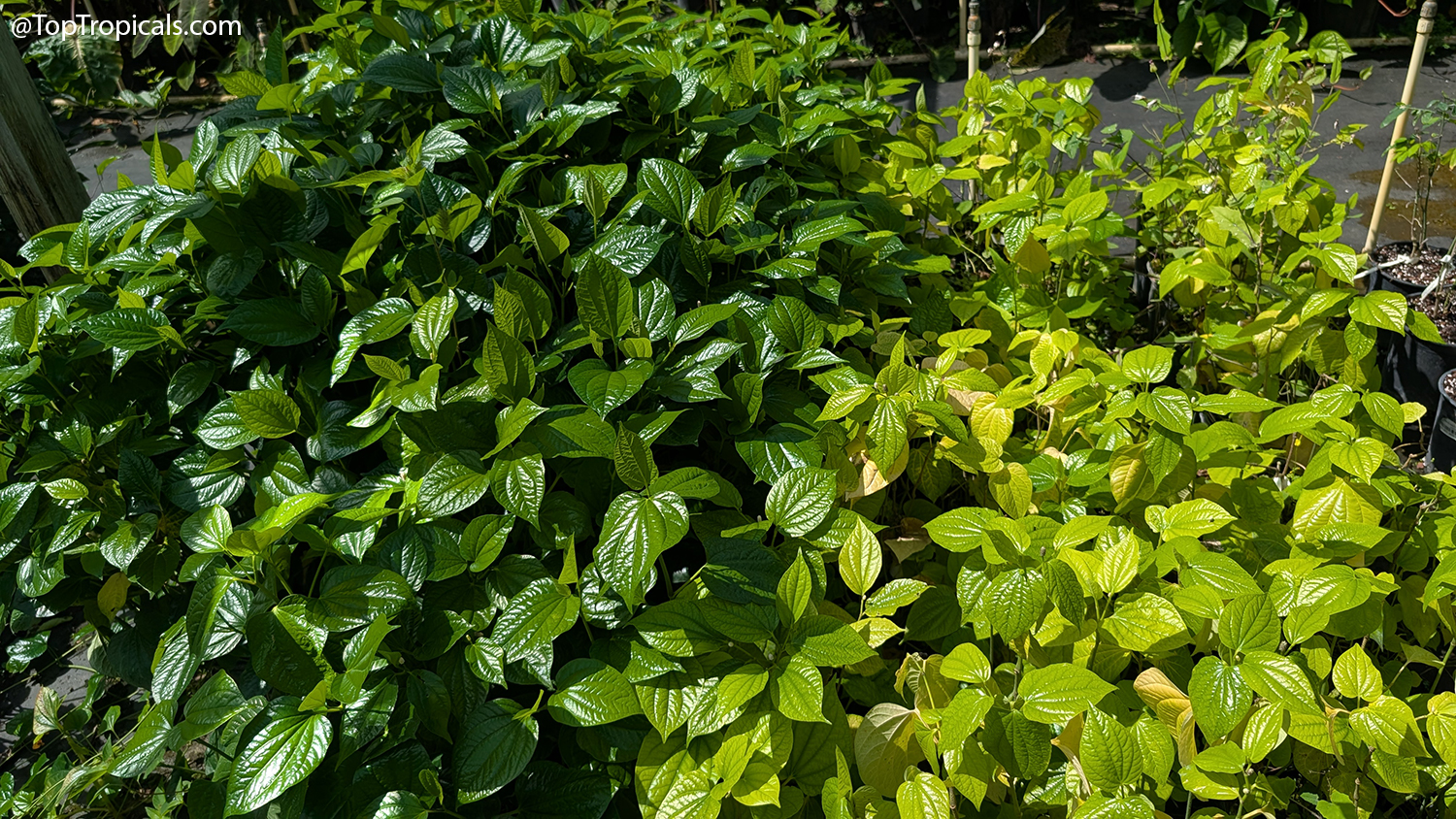
Piper sarmentosum - Vietnamese Pepper - with
fertilizer (left) and without (right)
These symptoms are especially common in container plants, where nutrients
can be quickly depleted or become
unavailable due to soil pH and watering conditions.
Use the quick reference table below to identify common nutrient-related
symptoms and the recommended SUNSHINE solution to correct them.
Symptom you see
What to do
Pale leaves, slow growth, weak new shoots
(often nitrogen related)
For most plants, foliar feeding works best when applied lightly and
regularly during active growth.
Regular feeding (maintenance): Mix with tap water according to
the ratio on the label. For SUNSHINE Robusta use 25 ml (5 tsp)per gallon
of water and spray leaves every 5-7
days during active growth.
Correction feeding ("medicine" dose): if plants show visible
nutrient deficiencies, combine SUNSHINE Robusta with SUNSHINE Superfood and
spray every 5–7 days until new growth appears healthy. All SUNSHINE
Boosters
products are compatible and can be mixed with water in the same sprayer.
Best time to spray: early morning or evening when temperatures
are cooler and leaves can absorb nutrients efficiently.
Important: spray both the top and underside of leaves for
maximum absorption.
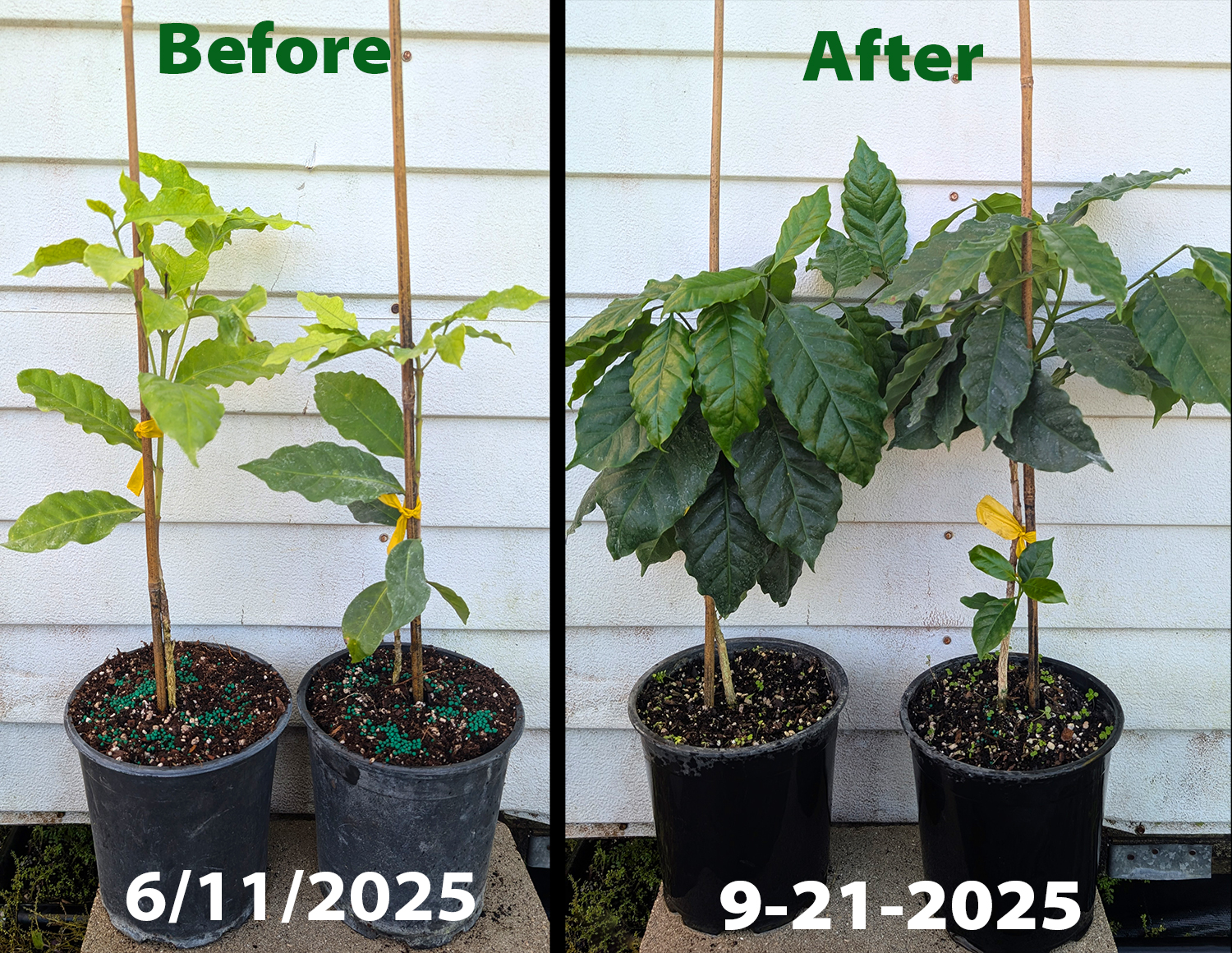
Coffee plants before and after regular Sunshine
Robusta applications
By Tatiana Anderson, Horticulture Expert at Top
Tropicals with
Smokey & Sunshine help
Sunshine Boosters for different types of plants
Here is why SUNSHINE Boosters are the smart choice for your garden this
spring:
Amino Acid Stability: Unlike traditional fertilizers that
use synthetic EDTA chelators, our formulas are amino-acid based. This means
100% of the nutrients are bioavailable and consumed by the plant, leaving
zero
toxic residues or salt build-up in your soil.
Safe for Every Watering: Because our concentrations are
scientifically balanced and mild, they are safe for daily use. This
eliminates the "feast or famine" cycle of dry fertilizers and prevents
accidental root burn.
Pure Taste for Edibles: Our delicate formulas do not
contain excess salts, urea, or ammonium salts that can ruin the flavor of
your harvest. Your fruit and vegetables will retain their pure, natural
taste.
Pollinator Friendly: Our boosters are designed to be safe
for honeybees and other beneficial insects, making them the responsible
choice for an organic-style garden.
🌿For Potted Plants: Breaking the "Foodless" Cycle
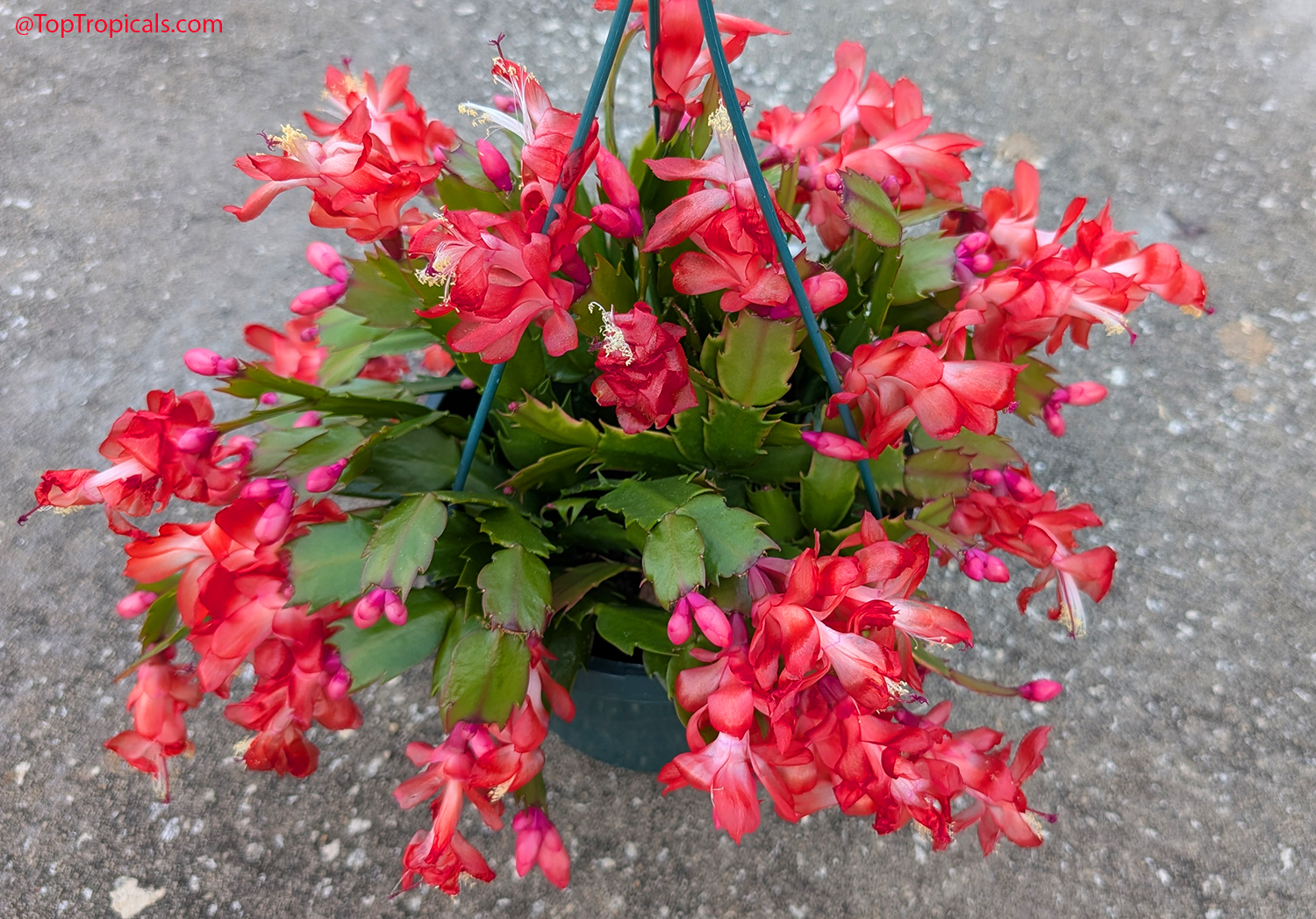
Schlumbergera - Christmas cactus - after boosting
flowers with Sunshine
Megaflor
Container-grown plants are trapped in soilless mixes (peat, bark,
perlite) that are structurally great but naturally nutrient-deficient.
Total Nutrition: Since pots lack the natural "buffet"
of the ground, SUNSHINE Boosters™ provide every
essential mineral the plant cannot find on its own.
No Salt Build-up: Our amino-acid based formulas are
consumed entirely by the plant, leaving zero toxic residue or root-burning
salts behind.
Daily Safety: Our mild concentrations eliminate the
"feast
or famine" cycle of dry fertilizers, making them safe for use with every
single watering.
Even in the ground, plants often struggle to absorb what they need
because soil compounds can "lock up" nutrients.
Enhanced Solubility: SUNSHINE Boosters create a
slightly acidic environment that helps dissolve stubborn salts in the soil,
making them accessible to roots again.
Precision Delivery: We provide mobile elements like
Nitrogen precisely when the plant needs to push new spring growth.
🌿The Foliar Advantage: Direct-to-Leaf Delivery
Did you know a plant leaf can absorb nutrients even more efficiently than
the roots? Foliar feeding is your "emergency button" for instant results.
Quick Fix: Foliar applications with Sunshine
Superfood are the fastest way to correct yellowing leaves or visible
deficiencies.
Metabolism Boost: Sprays like SUNSHINE-Epi act
as a bio-regulator, helping plants recover from the stress of spring
temperature swings.
Better Fruit:SUNSHINE Honey is applied to
leaves to naturally move sugars to the fruit, increasing sweetness and
flavor.
🌿The Calcium Problem: Solved
As your plants wake up this Spring, they need structural strength. Think
of Calcium as the "cement" that holds plant cells
together. Without it, new spring growth is doomed to fail.
Signs Your Plant is Starving for Calcium:
Deformed Leaves: New growth looks twisted, hooked, or
curled.
Blackened Tips: The very edges of young leaves turn white,
then quickly blacken and die.
The Industry Secret: The "Missing" Mineral
Most fertilizers, both dry and liquid, completely skip Calcium. Why?
Because it’s a chemical nightmare to keep stable in a concentrated
solution. Most manufacturers rely on your irrigation water to deliver
Calcium, but tap water is inconsistent and often fails to provide what a
hungry, growing plant needs.
The SUNSHINE Boosters: Stable Calcium in Every Bottle
We have successfully stabilized Calcium directly into every single
Sunshine Booster formula.
Whether you are using Bombino, Robusta, or Megaflor, you are delivering a
precise, stable dose of Calcium with every watering. No lockout, no
sediment, and no relying on the "luck" of your tap water. Just strong,
healthy cell walls and perfect spring growth.
🌿SUNSHINE-Epi: The Year-Round Bio-Regulator
Whether it’s the transition of spring, the extreme heat of summer,
or the dry air of indoor wintering, SUNSHINE-Epi is your
plant’s primary defense. This natural Brassinosteroid acts as a
powerful immune booster, helping plants navigate stress wherever it comes
from.
Universal Stress Shield: Protects against temperature
swings (both heat and cold), drought, and transplant shock.
Vigorous Development: Dramatically improves root growth
and speeds up the metabolism of young seedlings and cuttings.
Eco-Safe: 100% non-toxic to humans, pets, and
pollinators.
Note: While Epi is highly effective, it is a
performance booster, not a substitute for proper care. It works best when
paired with the right light, water, and a consistent feeding program. It
won't bring a dead plant back to life, but it will help a struggling one
find its footing.
Don't
let your garden wake up to an empty nutrition plate.
Smokey: Save your gas money for donuts. We're
shipping the boosters for free. Sunshine: Agreed. My charm covers the delivery
cost.
No coupon code required: The free shipping is automatically applied
at checkout.
Complete Nutrition: Stock up on Robusta, Superfood, and Epi for the Spring
growth push.
Offer
valid through 03/14/2026. Free shipping offer is valid on
SUNSHINE Boosters liquid products only. Not valid on previous purchases and
cannot be combined with any other offers, coupons, or discounts. Offer
subject to change or cancellation without notice.
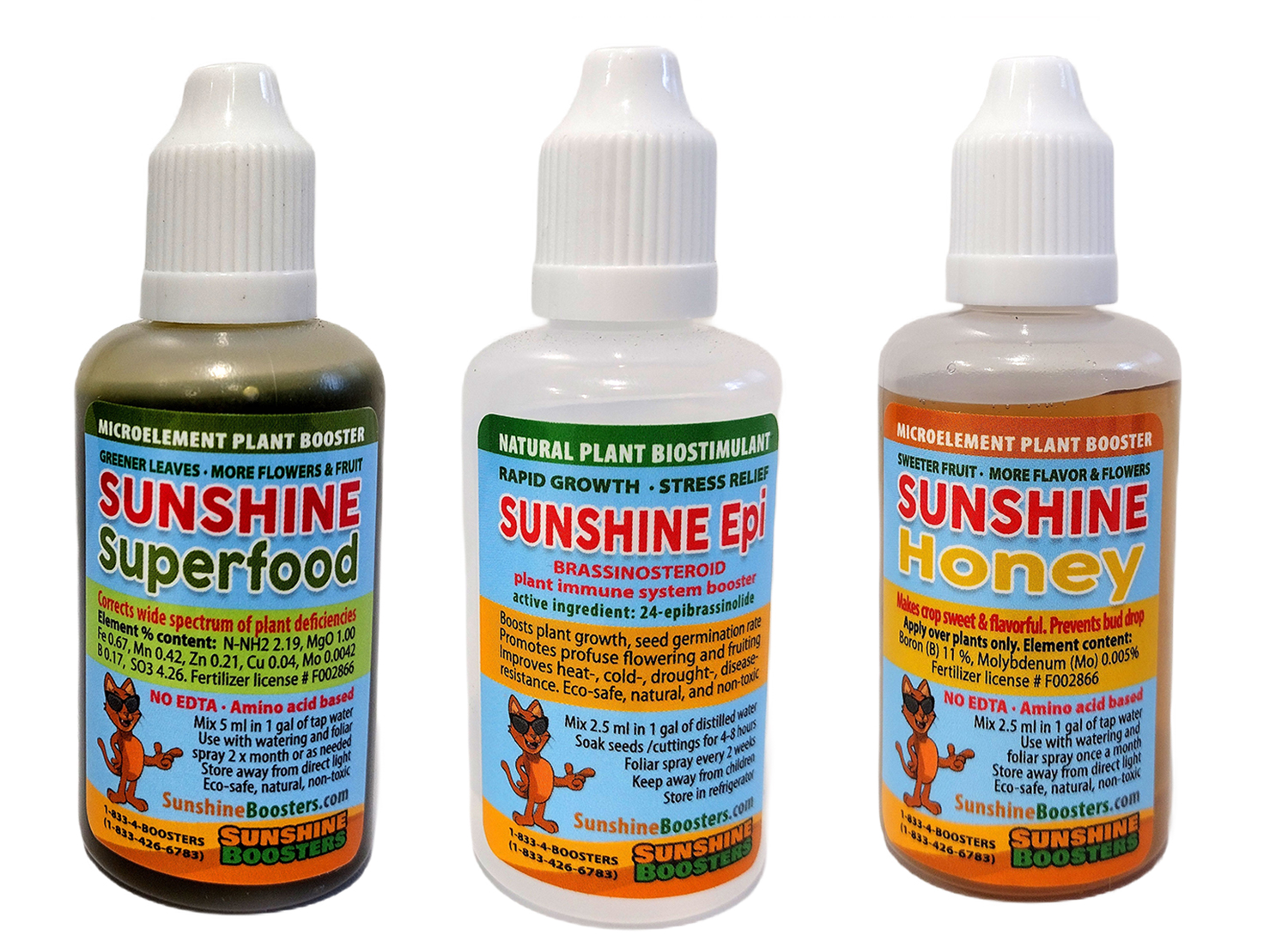
Sunshine Boosters micro
elements and supplements - Superfood micro-element complex, Sunshine Epi
biostimulant and Sunshine Honey supplement for better fruit
❓Frequently Asked Questions: SUNSHINE Boosters™
What water should I use for foliar spraying?
Tap water works perfectly for most. However, if your water is very "hard"
(leaving white mineral spots on leaves), switch to distilled water for a
cleaner finish and better absorption.
How long does a diluted solution last?
For maximum potency and to avoid nutrient degradation, try to use your
diluted mixture
within a few hours of preparation. Keep away from direct sun. Fresh is
always best!
Can I use SUNSHINE Boosters as a daily foliar spray?
Yes! You can mist your plants daily to maintain high vigor, but you must
reduce the dosage (use half the recommended strength) to avoid over-feeding.
Can I mix boosters with pesticides or fungicides?
It is best to apply them separately. Mixing fertilizers with chemical
pesticides in one tank can trigger reactions that "lock out" nutrients or
reduce the efficacy of the treatment.
Will the liquid stain my patio or hands?
No. Unlike traditional fertilizers with heavy blue or pink dyes, our
solutions are clear or very light-colored. If you spill it, simply rinse
with water—no stains, no mess.
Can I mix different SUNSHINE Boosters together in one sprayer?
Yes. All SUNSHINE Boosters are chemically compatible. You can combine a
"growth" booster like Robusta with a "micro-element" complex like Superfood
in the same water to save time.
Are these products safe to use around my pets?
Absolutely. Our formulas are 100% non-toxic and amino-acid based. Just ask
Smokey and Sunshine—they are perfectly safe for households with
curious cats, dogs, and children.
Can I use these boosters on indoor plants?
Yes. They are ideal for indoor use because they don't produce a "fertilizer
smell" and won't cause salt crusting on your decorative pots or furniture.
Is it safe to use on fruit and vegetables I plan to eat?
Yes. Because our formulas contain no urea, nitrates, or harsh salts, they
don't leave a "chemical" aftertaste. They actually help improve the natural
sugars and flavor profile
of your harvest.
What is the best temperature for foliar spraying?
Apply when temperatures are below 85°F. Early morning or late evening
is best; this allows the leaves to remain wet longer, giving the plant more
time to absorb the nutrients.
What Fertilizer to Use and How?
Green
Magic controlled release fertilizer keeps plants green during active
growth season - apply only once in 6 months.
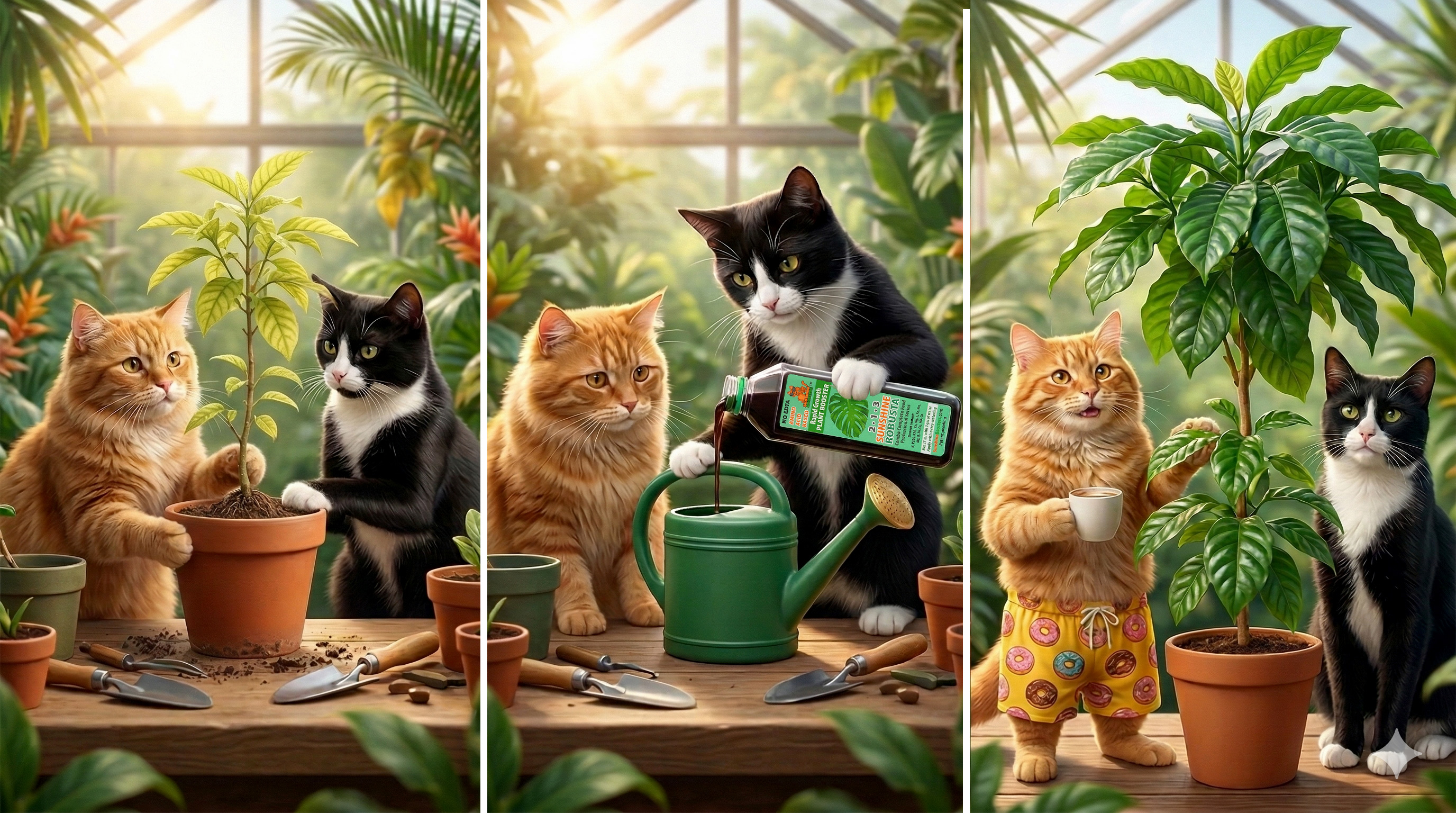
Sunshine: Smokey, you saved my coffee tree. But what do I
do now so it stays happy?
Smokey: Simple. Spray Sunshine Robusta every five days
during active growth.
Sunshine: Five days? Smokey, I barely remember where I left
my coffee
mug five minutes ago.
Smokey: That is exactly why we use Green Magic.
Sunshine: Fertilizer for forgetful gardeners?
Smokey: Controlled release. Sprinkle once and it feeds the
plant for six months.
Sunshine: Six months? I can have a very good nap in that
time.
Smokey: Exactly. The plant keeps eating slowly while you
keep napping.
Sunshine: Perfect. Remember, I will bring the coffee. You
bring the donuts.
Smokey: And next week we will show you exactly how Green
Magic works and why plants love it. Stay tuned.
Move Over, Paddy: Why March 17th is Actually the International Day of the Cat Lady
March 17th - International Day of the Cat Lady, Gertrude with cats
Move Over, Paddy: Why March 17th is Actually the "International Day of the Cat Lady" ☘️ 🐈
When you think of March 17th, you probably think of green beer, shamrocks, and parades. But while everyone else is toasted to St. Patrick, a subset of gardeners and feline enthusiasts are celebrating a different icon: St. Gertrude of Nivelles. She 's the 7th-century abbess who skipped the noble marriage proposals to become the unofficial Patron Saint of Cats, Gardeners, and anyone who really, really hates mice.
🐾 From Noblewoman to Monastery Boss
Born in 626 AD (modern-day Belgium), Gertrude wasn't your average medieval teenager. When her family tried to marry her off to a rich duke, she famously told them she’d rather be a bride of Christ than any man on Earth.
She eventually ran the Nivelles monastery like a pro, turning it into a 5-star medieval hub for travelers, scholars, and pilgrims. But it isn't her hospitality that made her an internet icon 1,300 years later - it’s her "pest control" skills.
🐾 The Mouse-Hater’s Hero
Look at any medieval painting of Gertrude, and you’ll notice something weird: mice are literally climbing up her staff. In the Middle Ages, mice weren't "cute Disney sidekicks." They were grain-destroying, plague-spreading menaces. Gertrude became the go-to saint for:
Protecting the harvest from rodents.
Keeping the pantry mouse-free.
Calming the nerves of people with a serious case of musophobia (fear of mice).
The Logic: If you’re the saint of mice, you’re naturally the BFF of the creature that eats them.
🐾 How She Became the "Cat Lady Saint"
Interestingly, Gertrude wasn't "officially" the saint of cats for most of history. That title actually went viral in the late 20th century.
A 1981 Metropolitan Museum of Art catalog highlighted her rodent-fighting reputation, and the world’s cat lovers basically said, "Hold my catnip". The association stuck instantly. Today, she’s the patron saint of the "Original Cat Lady" aesthetic, celebrated by anyone who knows that a home isn't a home without a feline supervisor.
🐾 A Big Day for Green Thumbs
If you’re a gardener, March 17th is your "Green Flag" day. In European folklore, St. Gertrude’s feast day is the traditional start of the planting season.
👉 Pro-Tip from the Middle Ages: If the sun is out on March 17th, it’s a sign that your garden will thrive all year. If it’s raining? Well, maybe stay inside and pet the cat.
🐾 The Perfect Trio: Cats, Gardens, and Gertrude
There’s a reason plant people and cat people are often the same people. Cats love a good garden patrol - they nap in the mulch, stalk the butterflies, and ensure no chipmunk dares to touch your tomatoes.
At TopTropicals, we take this tradition seriously. Our PeopleCats are more than just pets; they are the furry CEOs of the nursery, supervising every seed we plant and every leaf we prune.
New
article by Jane Jordan.
"...The famous quote is often used to imply that the names
of things do not affect what they really are, in the case
of The Desert Rose (Adenium obesum) it is not a rose at
all, rather a succulent that thrives in hot, dry and sunny
conditions. These spectacular plants have no relation to
the rose family, they are a species of flowering plant
from the dogbane family, Apocynaceae. The naming of this
plant is partly correct as they originate in sub-Saharan
Africa and the Arabian Peninsula, where they can grow into
large trees with huge swollen trunks..." Continue reading...
Date: 24 Jun 2018
Cold hardy tropical fruit trees for Luisiana
Q: I've
just moved to Louisiana and have been wondering whether it
would make sense to plant some tropical fruit trees in our
garden. Average lows in New Orleans are 41 deg F in
January and February, although we did hit 25 once with the
Arctic vortex. I'm interested in litchi, longan,
rambutans, and persimmons. Do you have varieties that can
tolerate Louisiana's temperature range? I'd love
mangosteen but I don't suppose they will survive. Do you
have any suggestions on tropical fruit trees that I could
try?
A:
Average temperatures are for statistics only; it is actual
temperatures that may hurt your cold sensitive plant. This
is what you should keep in mind when starting your
tropical fruit collection:
1) Ultra-tropical plants like Rambutan can not survive
winters below 45-50F. However, they can be successfully
grown in containers in a greenhouse or moved indoors into
a sun room during cold periods.
2) Tropical plants like Litchi and Longan may take some light
frost once established. Still, for areas with freeze our
advice is - keep them in pots and move inside in case of
cold.
3) There is a number of subtropical fruit trees that are
hardy enough to take some freeze. Persimmon, Feijoa, Fig, Cattley Guava, Jujube, Kiwi, some Eugenias and others. Please
refer to our Tropical Fruit Sensitivity Chart.
4) Remember that plant's ability to survive winter depends
on several factors, not only temperature itself. Important
factors are: wind protection (chill wind kills rather than
low temperature itself), exposure, how close the tree is
planted to the house, plant maturity and its overall
strength and health. If a plant had received good
nutrients during summer, has well established root system,
planted in enclosed area protected from winds and has
plenty of bright sunlight - it has better chances to
survive than a weak plant in warmer conditions.
5) Use SUNSHINE plant boosters for
improving cold tolerance of your tropical plant. It only
takes a few drops, and only costs $5!