Garden Blog - Top Tropicals
Date: 20 Nov 2026
Why grow a boring hedge when you can eat it? Creating privacy with Surinam cherry
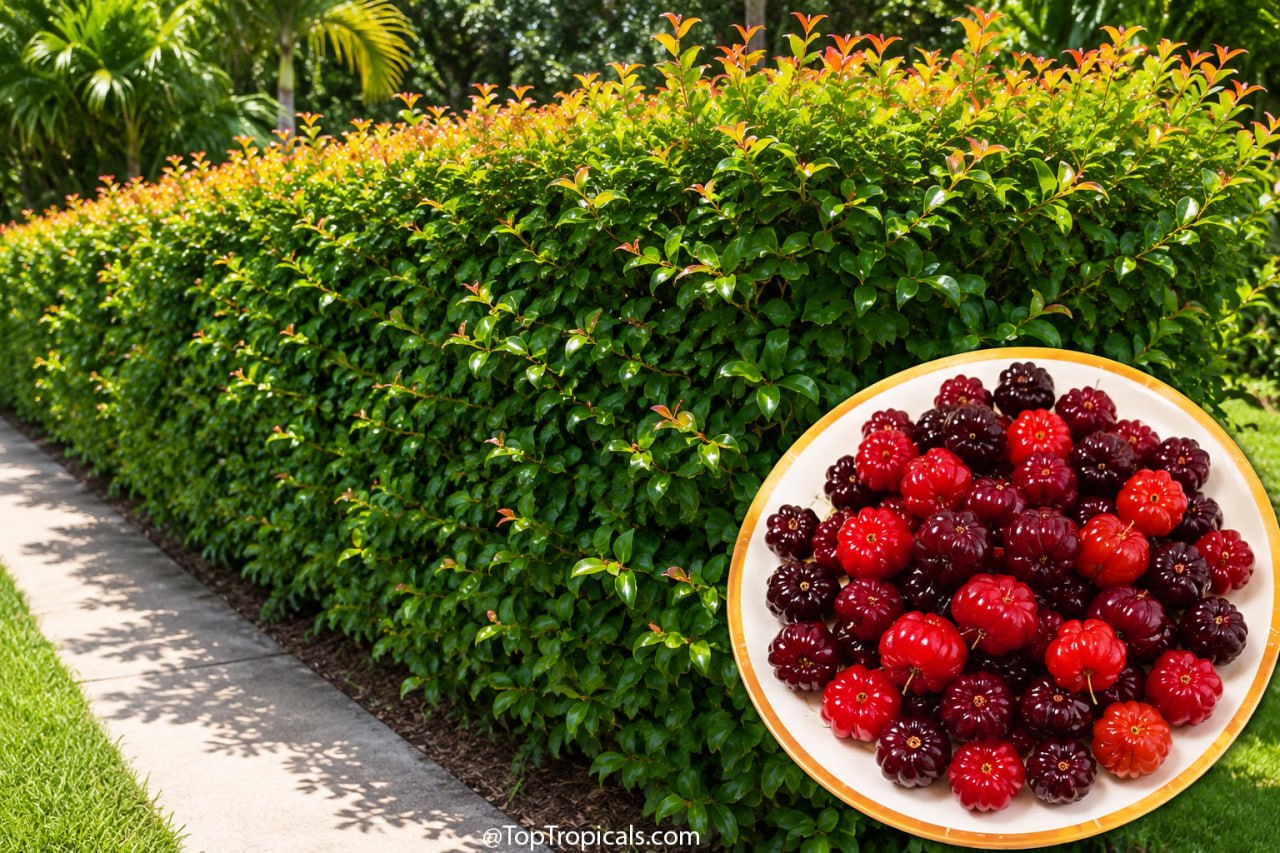
🍒 Why grow a boring hedge when you can eat it? Creating privacy with Surinam cherry.
Why plant another boring Ficus hedge when you could grow something beautiful, evergreen, and delicious?
Imagine a dense green privacy screen that produces hundreds of colorful little cherries! That's exactly what Surinam Cherry (Eugenia uniflora) can do.
This tropical fruit tree is one of our favorite choices for an edible hedge, especially in Florida gardens.
🍒 A hedge that works for you
Surinam Cherry grows naturally into a dense, bushy shrub with small, glossy leaves. New growth emerges in beautiful bronze and reddish shades, adding color even when the plant isn't fruiting.
It's fast-growing, tolerates heat and occasional drought once established, and is surprisingly cold-hardy for a tropical fruit plant. Mature shrubs can survive brief freezes, although severe cold may damage some branches.
Best of all, it loves pruning! Shape it into a formal hedge, a privacy screen, or let it grow naturally.
🍒 How to plant and maintain your edible hedge
For a thick, continuous hedge, space plants 3-4 feet apart, measuring from trunk to trunk. For a tighter, faster-filling screen, plant about 2.5-3 feet apart.
Choose full sun for maximum fruit production, although partial shade works too. Water regularly during establishment.
Start pruning while plants are young! Pinch or trim growing tips to encourage branching from the bottom. Keep the hedge slightly wider at the base than at the top so sunlight reaches lower branches.
Once established, trim lightly to maintain your desired height and shape, typically 4–8 feet.
🍒 Will pruning reduce fruit production?
Here's the secret: Surinam Cherry flowers and fruits on young growth. Pruning stimulates new branches that can produce future crops.
But constant shearing removes flowering shoots and developing fruit. For the best harvest, prune after fruiting, then allow fresh growth to mature and bloom. Avoid heavy trimming during flowering and fruit development.
🍒 Little pumpkins with a cherry surprise
The fruit looks like a miniature pumpkin, with deep ribs and brilliant colors ranging from orange-red to dark crimson and almost black.
And the flavor? Nothing like an ordinary cherry!
It's sweet-tart, juicy, intensely aromatic, and sometimes slightly resinous. Darker selections often have richer, sweeter flavor.
Let the fruit ripen completely before picking. Fully ripe cherries are softer, sweeter, and practically fall into your hand.
🍒 From hedge to kitchen
Enjoy Surinam Cherries fresh, or turn your harvest into delicious jams, jellies, syrups, smoothies, sorbets, and tropical desserts.
Explore our favorite Surinam Cherry recipes below!
Why settle for privacy when you can have privacy AND dessert?
🛒 Grow Your Own Edible Hedge
📚 Learn more:


• Eugenia uniflora - in Plant Encyclopedia
• Which Eugenia should you plant? 7 tropical cherries compared
• Why you should grow a Pitanga tree. Health benefits of Surinam Cherry
• 7 delicious ways to use Surinam Cherry: quick-n-fun exotic recipes
• Surinam cherry skillet glaze: quick-n-fun exotic recipes
• Surinam cherry salsa: quick-n-fun exotic recipes
• How to make a jam with Surinam Cherry
#Food_Forest #Discover #How_to
🟢 Join 👉 TopTropicals