...Who doesn't like tropical beauty? Everyone wants tropical plants. But not everyone lives in a warm climate. Is it possible to grow tropicals outside of Tropics?
Top Tropicals horticulturist Mark Hooten, who is well known to many
gardeners as the Garden Doc with his
Saturday Plant Clinic, is answering gardeners' questions about how to prepare and protect tropical plants during winter...
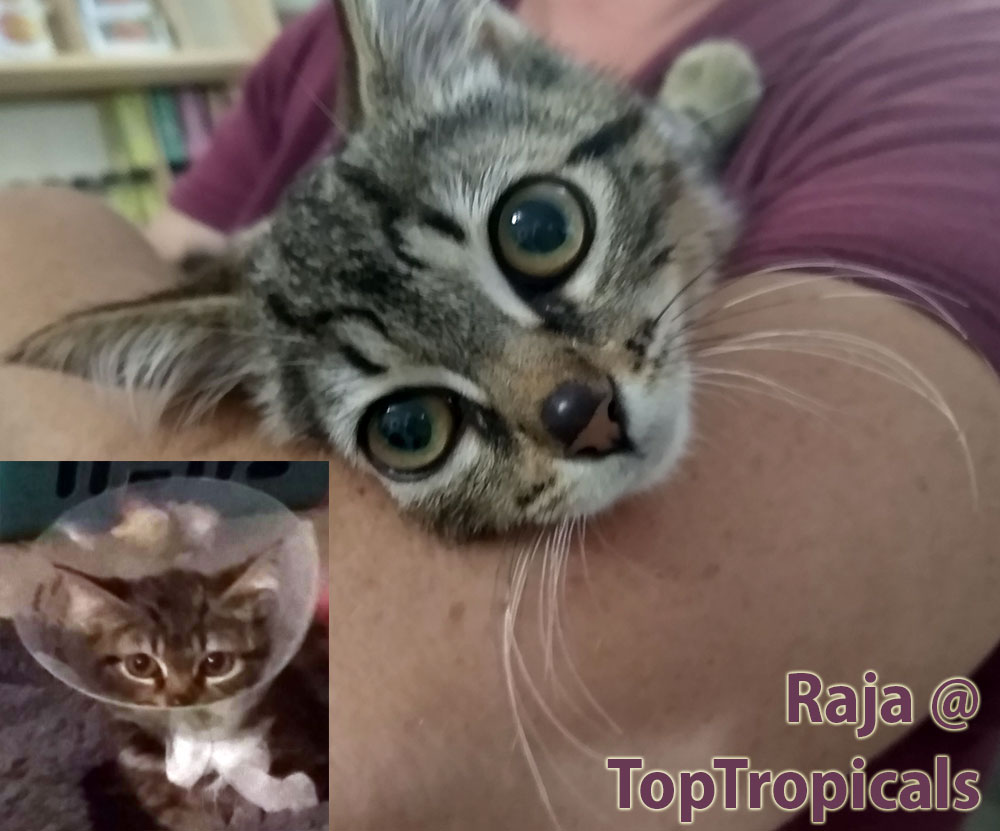
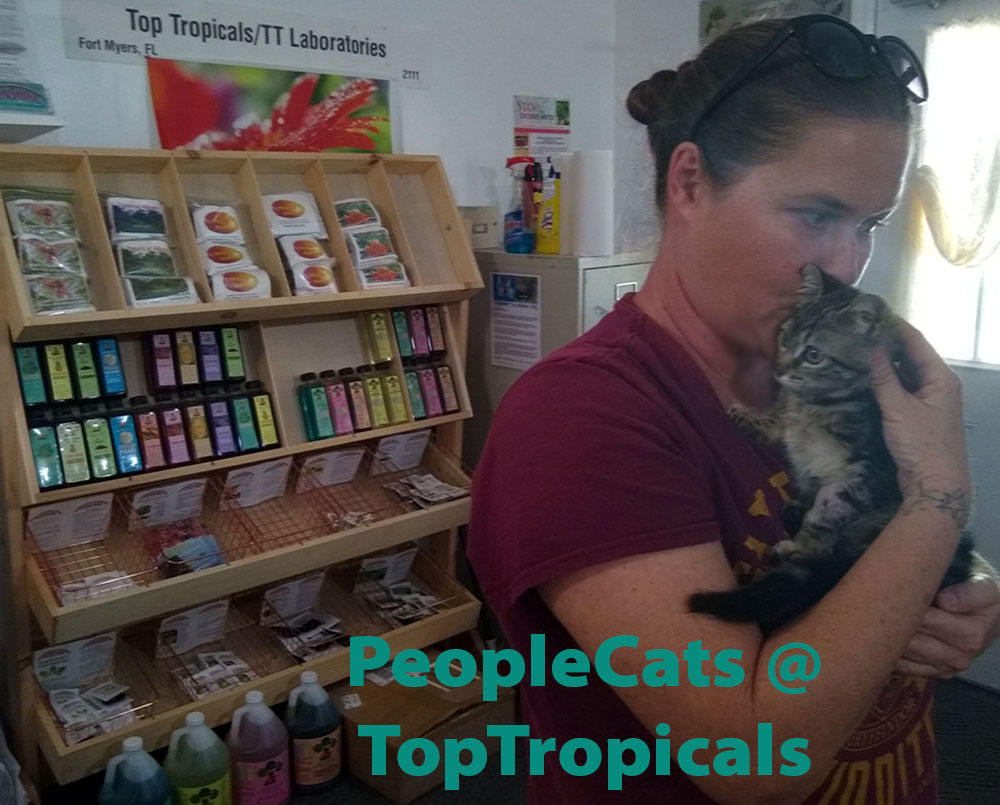
PeopleCats of TopTropicals. Cats of the day: Biggy's Cat Hospital
Biggy checking on patient Abu when he couldn't walk
During these challenging times for the whole planet, we receive kind
letters from our customers checking on how our PeopleCats are doing, especially those that previously were ill. And
since we promised to follow up on everyone, including heart-breaking story of
Raja and Abu, today's report is about everybody's progress!
As we mentioned in our previous newsletter, several cats in TopTropicals
Cat Sanctuary had a coronavirus (we call it COVID-Cat-20), or simply a cat respiratory infection. Chiefy, Snitch, Marco and Biggy had it really bad, but some other PeopleCats surprisingly didn't
get it! Just like with humans. Lucky King didn't have a single sneeze!
Finally, everybody has recovered by now, but it has been a very stressful
couple of weeks for us, considering limited vet availability at this stay-home
time. On top of that, Lil S had an abscess and was also contained in a home hospital, away
from flu-quarantined PeopleCats. Our homes become real cat hospitals!
We are thankful to our customers support, especially Silvia who made
several donations for our PeopleCats, and also recommended antiseptic pads - those worked great for Lil S! Abu and Raja's adventures were not over... After 2 weeks of seeing a
vet treating their infections and injuries, they got worse... Then after a
couple of weeks in another hospital (and a couple thousand more in bills) we were
suggested to put them down as hopeless since they would never walk again...
But Kristi did not want to believe it, she did not give up! The kittens heard
her. They won. Today, they are all better, walking, jumping and playing!
Thank you Kristi!
Never give up hope!
Stay safe and healthy with your PeoplePets!
TopTropicals PeopleCat Club
Thank you everybody for supporting us in helping PeopleCat Community! Make
your kind donation today and receive a surprise gift from us. Every little
bit helps! Thank you and God bless you and your pets!
Date: 28 Sep 2025
Guava: The Healthiest Fruit You Can Grow
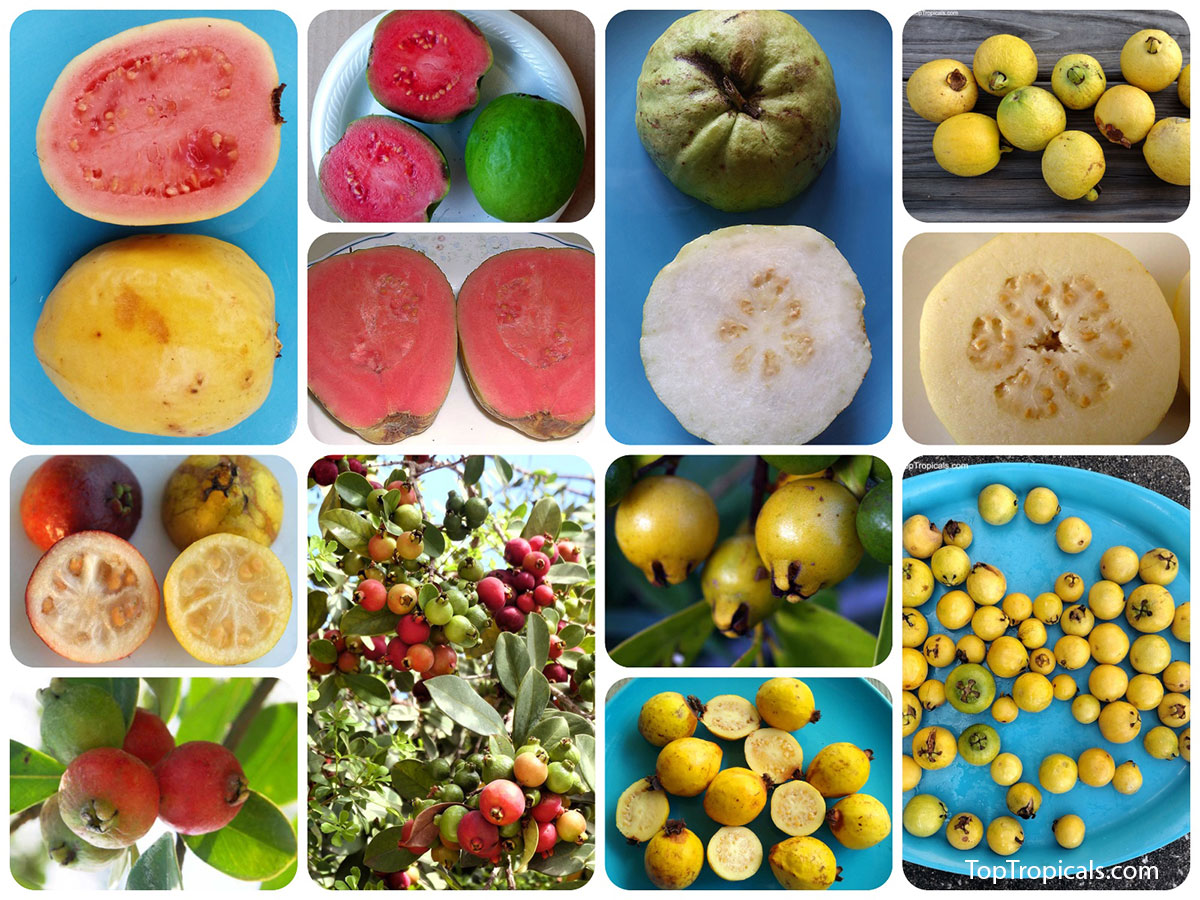
Guava varieties: Pink flesh (upper left quarter), White flesh and Cas
(upper right quarter), Red Cattley Guava (bottom left quarter) and Golden
Cattley (bottom right quarter).
Let’s talk Guava. Few fruits check as many boxes: flavor,
productivity, health, and adaptability. We’ve grown guava trees at Top
Tropicals for years here in Florida, and it never fails to surprise people
with how
easy it is — and how quickly it rewards you.
🌿 Health Benefits
We know the first question: "Why guava in addition to all the other
fruit trees I could plant?" Because guava is one of the healthiest tropical
fruits you can eat and grow — and it produces faster than almost
anything
else.
Vitamin C powerhouse — guava has four times more vitamin C than
oranges. One fruit covers your daily needs and then some.
Potassium and fiber — good for balancing blood pressure and
keeping your heart strong.
Antioxidants like lycopene and vitamin C — these keep your skin
glowing and help protect your cells from damage.
Dietary fiber — aids digestion and helps keep blood sugar
steady.
Guava is a true "food as medicine" tree you can plant right in your
backyard or in pot.
♥️ Our Favorite Varieties are Available Now
We currently have a DOZEN excellent guava varieties in stock selected by
our plant expert Tatiana Anderson — something special for every
garden. Our top picks are:
Pink Guavas
Barbie Pink
– Yellow pear-shaped fruit with thick pink flesh, sweet and juicy.
Cold
hardy for a tropical fruit. The best seller.
Hong Kong
– Large, round, smooth pink fruit. Sweet flavor, very few seeds, and
very
productive.
Tikal
– Our top pick. Fast-growing, disease-resistant, and produces the
sweetest
pink guavas with very few seeds.
White Guavas
Indonesian White
– Aromatic, classic white-fleshed guava with an excellent
tropical flavor.
Kilo White
– Giant fruit up to 2 lbs (1 kilo) each! Few seeds, creamy white
flesh,
and fruits even in containers.
Brazilian Araca
Pera – Rare hybrid used for Guava Wine in Brazil. Tart,
concentrated juice makes excellent wine, sorbet, or jelly. Learn more...
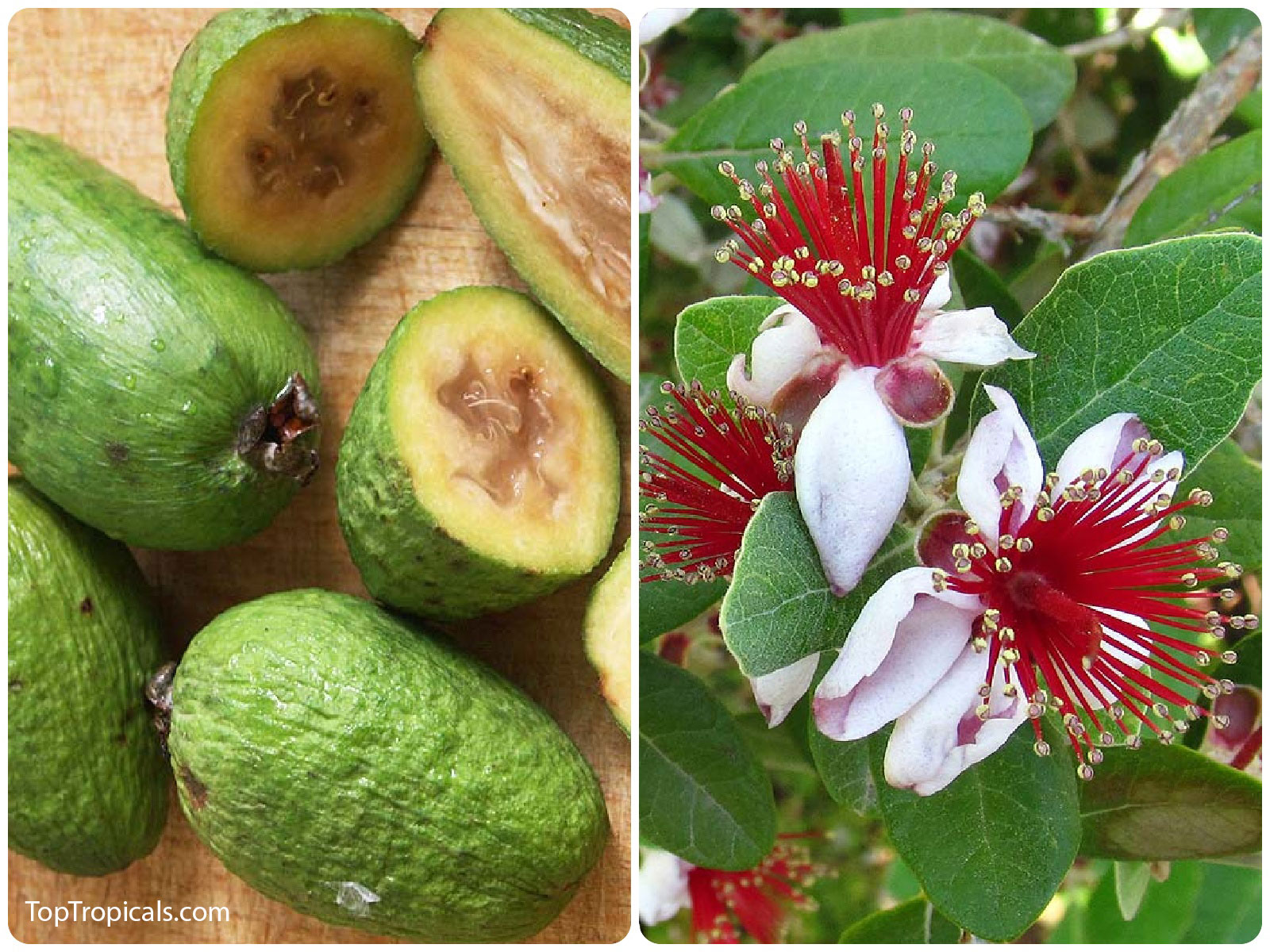
Pineapple Guava,
Guavasteen – Feijoa sellowiana. Strongly perfumed fruit, best
enjoyed when the pulp is mixed with sugar – like forest strawberries.
Cold-hardy, tolerates freeze, and doubles as a great windbreak. Learn more...
Meet PeopleCats of TopTropicals. Charlie, the Indoor Hunter
Carlie was a kitty drop off with LadyBug, Rickie, and Purry.
Charlie is Jamie's baby. She has an attitude of a teenager, one minute she
loves you and the next - wants nothing to do with you. Carlie stays with the
inside PeopleCats, she says it's too big in the outside world for her and she
gets scared. Carlie has a fun game (fun to her): she plays around 2:00 am in
the morning, she loves to drag random items down the hall (socks, toys,
shirts, even blankets) in her mouth MEOOOWWWING as loud as she can. She then sets
the items down on her human's bedroom rug and waits for her human to say
thank you. We're pretty sure her hunting instinct is off...
2019, from Top to Bottom: Moe, Charlie, Bagheera, and Snitch. 2016: Charlie
From left to right: Purry, LadyBug, Charlie, and Ricki - 2016
Date: 29 Nov 2020
Cold protection of tropical container plants
Q: I am long time customer of yours, I live in San Diego
California and while the summer and Fall temperatures are warm to mild, the winter
temperatures dip to a point where some tropicals die off. We are experimenting
with different variations of way to heat and insulate the pots we have the
tropicals planted in as a way to keep them alive during the colder winter
months. I was wondering if you knew of the ideal soil temperature for these
tropical in order to look their best year round. All of the heaters we have
installed have thermostats and temperature adjustments so we can now keep the soil
anywhere between a range of between 65-75 degrees. Any advise you can provide
would be greatly appreciated.
A: This is a very interesting concept you are working with.
Indeed, keeping pots/roots warm, may help a lot! We've been experimenting with
cold protection for a long time - for the above-ground plant parts. For sure
keeping roots protected (even with a thick layer of mulch) will benefit tropical
plants during winter. In case with container plants, this may help
dramatically.
The guideline is, tropical plants slow down or stop their metabolism at
65F. As long as you can keep soil above that temperature - this should work
great. Of course, the higher the better.
Optimum temperature for growing tropical plants in general - 70-85F.
Above 90F, metabolism stops too, unless it's a heat tolerant, desert
plant.
More information on winter cold protection of tropical plants and
zone pushing:
PeopleCats of TopTropicals. Cat of the Month: Moishe, the Google Intern with a Sweet Tooth
Just a few months ago we introduced our new Little Purrrson Jim II that we got as a "toy" for intellectual
Google the Cat, to cheer him up after he lost his friend Jim I... Jim II, the fluffy goofball, grew up in no time and in his turn,
requested entertainment, since Google bored him with his technical lectures... So
we got a toy for Jim-the-toy... and he turned out to be - another
mini-Google!
Moishe is very busy young individual, spending his day solving math
equations and discovering laws of physics... Google appreciates the new generation's input. Jim II is simply glued to the little guy. He follows Moishe everywhere, including boring seminars by Google. Jim loves his new little brother with all his heart!
Moishe's favorite things are - gravity experiments, reading scientific manuscripts, and eating JAM for breakfast! No toast required.
TopTropicals PeopleCat Club and Zoo
Thank you for supporting us in helping PeopleCat Community! Make
your kind donation today and receive a surprise gift from us! Every little
bit helps. Thank you and God bless you and your pets!
In the photo: Moishe the Scientist and Jim the
Hopeless Romantic
Date: 25 Feb 2021
Container mango - Condo varieties
Q: What are the good varieties of mango trees available for container grow? Can you please share the
details?
A: There are some great varieties of Mango selected specifically
for container culture, they even have a nick-name - "condo mangoes". They
have compact growth habit and respond well to pruning to keep them in small
size. Here are a few of our favorites that we currently have in stock:
Glenn Ice
Cream Cotton
Candy
Mallika
Manilita Pram
Kai Mai Mun
Kun Si Maha
Chinook
You can see more condo mangoes on this page.
Q: Has anyone ever tried using heat packs under frost blankets to
protect tropical plants from frost?
A: The reality is, the heat packs used for shipping do not have enough heat capacity to create
efficient warming effect. From our own experience, the best way is to use
small 25W incandescent bulbs which produce lots of heat (considering observing
all safety precautions and fire safety). Some gardeners use Christmas lights.
See picture of our plants in the ground during a cold night. We called them
Ghost Cold Protection! ;)
Q: I was
always wondering how you guys manage to grow true tropical trees in Florida? I
live in Puerto Rico and we have Breadfruit trees growing here in a wild... but my sister lives not far
away from you, in Orlando, which is much colder, and I wonder if I can get
her a
Breadfruit tree for Christmas?
A: Your
sister can grow a Breadfruit tree in Orlando either in a pot (and bring it indoors during
cold periods) or in the ground inside a structure (an elclosed conservatory
with heating system). See our customer's Greenhouse in Virginia. Cold protection of tropical plants is a lengthy
subject and we have many interesting publications about it in our managine
Tropical
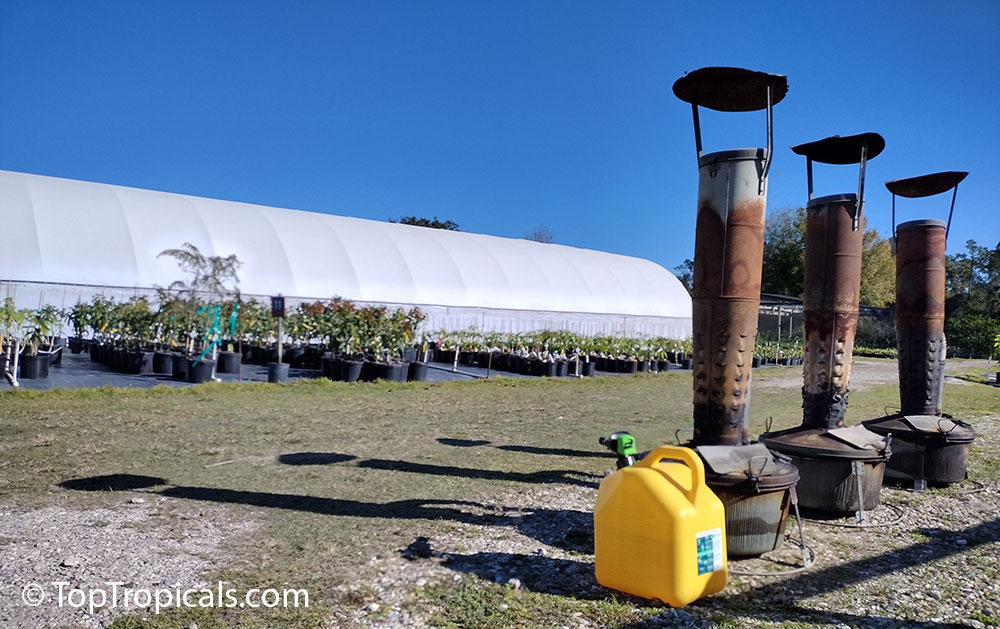
Treasures and on the website. In a nutshell, when growing tropicals outside of
tropical climate, you need to follow these 7 rules:
1. Cut watering to a minimum. Cold+wet kills tropical roots.
2. Water thirsty plants before a cold night. Jucy leaves have fewer
chances to be cold-zapped.
3. Wind protection is more important than a temperature drop. Plant
tropicals close to a house or surrounded by other trees.
4. Duration of a cold period is more critical than the cold itself. If
expecting long cold hours, bring up all available protection resources.
Christmas lights or propane heaters - as long as there is a heat source,
everything helps!
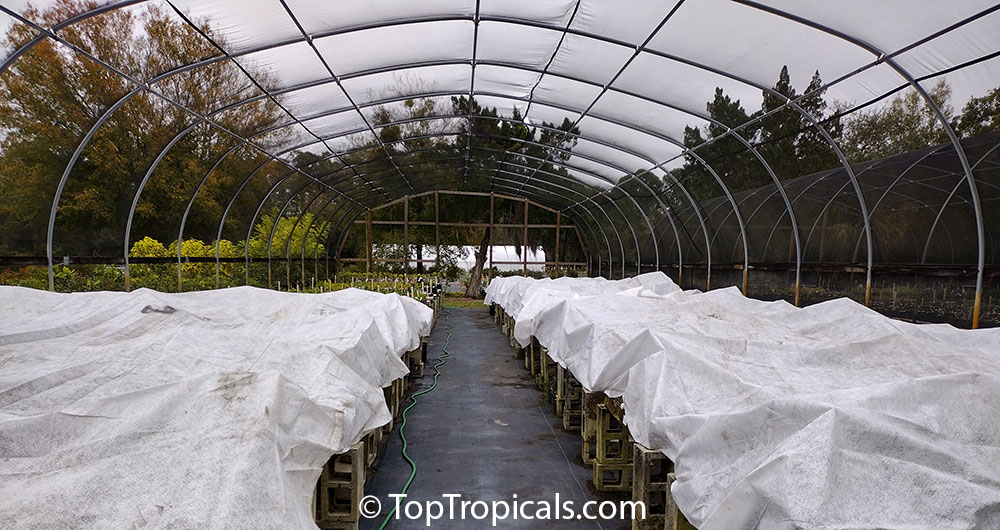
5. Remove plastic covers during the daytime so plants don't get
"cooked" in the sun. Fabric covers are better than plastic.
6. Grow ultra-tropicals in containers and bring them inside the garage
or even indoors during the cold.
7. Use SUNSHINE plant boosters and feed your plants well during Summer to improve cold hardiness.
Q: I am looking forward to my three desert roses I just ordered from you and I am wondering how to take
care of them, especially during winter time. Should I put the pots in full sun
or shade? What kind of soil do they like? How often should I water them? When
it gets cooler, should I bring them inside? We do have occasional frost here
during winter.
A: Here are a few tips for your desert roses:
1. When received Adenium from mail-order, unpack carefully; branches are
fragile. Plant in well-drained potting mix. Cactus mix will do, but we
recommend special Adenium mix. If using regular acidic peat-based potting mix, you may
add sea-shells on top of soil to neutralize acidity: adeniums prefer alkaline
soils. Using clay pots is beneficial. Water once and do not water again until
soil gets dry. Place in bright shade until new leaves sprout, then the plant
can be moved to full sun.
2. Adenium is a succulent, but not a cactus. It needs watering, however
let soil dry before waterings. Reduce watering during cool season and
discontinue when plant gets dormant (drops all leaves in winter).
3. Bright light is the best for profuse flowering. However, adeniums
look much healthier in slightly filtered light rather than in all-day full
sun.
4. Fertilize and spray leaves with liquid fertilizer SUNSHINE Megaflor - Nutrition Bloom Booster. Phosphorous is responsible
both for flowering and caudex development. Avoid caudex, spray over foliage
only. Dry fertilizer can be used only during hot months.
5. Watch for spider mites during hot and dry season.
6. Give plants a break during winter dormant season. Keep in bright
shade and reduce watering to 1-2 per month or stop watering if temperature is
below 65F.