Garden Blog - Top Tropicals

Date: 10 Mar 2016

Do-It-Yourself Support Structure for Dragon Fruit
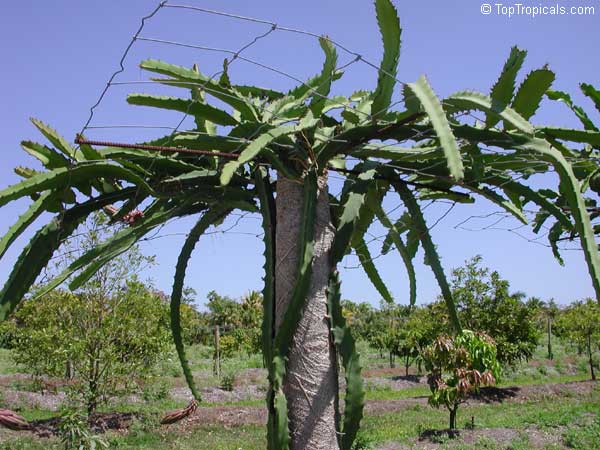
This interesting do-it yourself project was sent to us by our customer from South Florida. Many tropical gardeners want to grow fascinating Dragon Fruit, and their most common question is - what kind of support I should use for this amazing fruiting cactus? We hope you find this information very useful. Happy Gardening!

Dragon fruit is a terrestrial/epiphytic fruit baring cactus, which may grow fleshy stems up to 30 ft high, given sturdy support. However, downward hanging or horizontal branches stimulate production of flowers at the tips of the branches. Commercial groves in different parts of the world use different method to achieve this. The traditional Vietnamese way is to train the plant into a “fountain”, which consists of a vertical central trunk about 8ft tall and a horizontal structure, such as a wagon wheel on top of it to support the horizontal branches (see picture on the right).

This picture served as my inspiration to build my own structure. I used five 4”x4” 10ft wood beams as the trunk, shaped as a cross. I attached the beams to each other with 10” long screws.

I dug a 2 ft deep 12”x12” hole in the ground and positioned the trunk inside, such that about 8ft are above ground. I covered it with several layers of burlap top to bottom.

The horizontal structure on top is made of four 4ft long 2”x2” wood beams and two 12”x12” wood plates to hold them together. I attached this structure to the top of the trunk.

I used old watering pipe to form two rings around the trunk to support the branches. Here is the result!... See step-by-step full size pictures and the rest of the article...

Date: 22 Oct 2016

Plant Horoscope. Scorpio Zodiac lucky plants: Nearly indestructible plants

Scorpio - 10/23-11/21. A WATER sign ruled by both Mars and Pluto.
Scorpio's plants are often found in remote places or on poor ground. They will likely have thorns, can be red in color, and grow under adversity. The good news is, most of these plants are nearly indestructible! This makes them desirable for every gardener.
The reproductive organs are ruled by Scorpio, so these are plants that balance the hormones, regulate the menstrual cycle, help with childbirth and pregnancy. Until this century, Scorpio was ruled by Mars, and the herbs associated with it had to do with the urogenital system and the colon. Many of the herbs related to Scorpio are cleansing and revitalizing. Now, astrologers assign Scorpio to Pluto, discovered in 1930 (Pluto is said by astrologers to be a higher octave of Mars). Physiologically, Scorpio involves the processes of catabolism and anabolism, the death and regeneration of body cells. Diseases of Scorpio are often involved with the slow buildup of toxic substances in the body (carcinogens, etc) or in the mind (anger, jealousy). Scorpio loves a spice with depth and complexity. Camphor Basil adds rich flavor to every dish it seasons, and its own aphrodisiac tendencies appeal to Scorpio's lusty nature.

Scorpio Zodiac lucky plants: Ceiba,  Baobab,  Pistachio,  Nutmeg, Black-eyed Susan Thunbergia, Combretums,  Dragon fruit,  Medinilla,  Camphor Basil,  Cuban Oregano, Vanilla orchid,  Hibiscus, Various  cacti and succulents,  Adenium, Honeysuckle,  Peppers,  Cordyline,  Spider plant,  Jasmine,  Gooseberries, Wild indigo,  Bougainvillea,  Aloe vera,  Raspberry,  Palmetto,  Horseradish tree,  Camphor,  Allspice and Bay Rum, Jujube,  Sweet Mimosa,  Agave, Milkweed,  Hong Kong Orchid Tree,  Pony Tail,  Dwarf Poinciana, Bottlebrushes,  Clusias,  Crocosmia,  Zig-Zag Cactus,  Dracaena,  Fire Bush,  Hoyas,  Jatropha,  Kalanchoe,  Sausage tree,  Devils Backbone, Pereskia, Red Plumeria,  Firecracker,  Rattlebox,  Rhoeo, Calendula, Geranium, Thistles, Mint, Sage, Catnip, Coriander, Sandalwood, Ginseng, Euphorbias, Acacias.

For other signs information, see full Plant Horoscope.

Date: 22 Mar 2016

Plant Horoscope. Aries Zodiac lucky plants: Aloe and Erythrina

Aries - 3/21-4/19. Aries is a FIRE sign ruled by the planet Mars. Plants associated with this element and planet very often have thorns or prickles. They can be also spicy or bitter in flavor, or red in color.

Because Aries rules the head, eyes and face, the plants for Aries purify the blood, stimulate the adrenal glands, and/or are high in iron (Mars rules the mineral iron). Mars-ruled Aries is assertive, energetic and fearless. Mars rules the red blood cells, the muscles, and metabolic processes, as well as the motor nerves and the head. These plants help you when you want more get-up-and-go and the courage to take on the world.

Aries Zodiac lucky plants - Governors plum, Hibiscus Karkade, Tapioca, Mamey Sapote, Ruda, Baobab, Euphorbia, Acanthus, Aloe, Caesalpinia, Erythrina, Opuntia, Dragon Fruit, Pachypodium, Pomegranate, Chilli peppers, Syngonium, Begonia, Geranium, Red Sandalwood, Jamiaca pepper (Pimenta, Allspice), Camphor, Jujube, Anise, Red Roses, Tiger Lily, Impatiens, Calendula, Tarragon, Ginger, Coriander, Basil, Ruda, Amaryllis, Wild Indigo, Gooseberries, Sesbania, Campsis, Red Oleander, Maple, Schotia brachypetala, Momordica, Coffee, Amla , Ephedra, Red Kapok.

For other signs information, see full Plant Horoscope.

Date: 7 Jul 2016

Growing fruit trees in containers

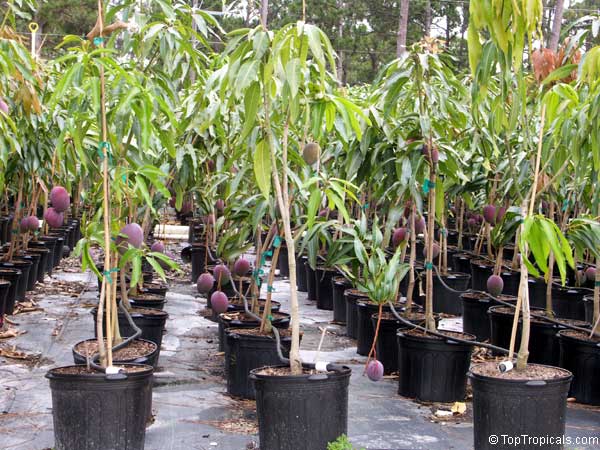
Will it fruit in a pot? YES! Many tropical fruit trees can be grown in a pot. We get many calls from customers in cooler climates asking if our tropical trees can grow and fruit in a pot. The answer is yes!

Several plants fruit well in pots. Blackberries and raspberries, barbados cherries, blueberries and many more start fruiting even in their 1 gallon containers. We are especially excited about our new Pixie grapes, which are heavily laden with grapes even at only a foot long!

While some plants are small and will fruit easily in a container, others are large trees. For the tree type fruits, we recommend growing only non-seedling plants for pot culture. We have cuttings, air layers and grafted plants that are great options. These have the ability to fruit right away, as they are the same age as the parent tree. Some horticulturists recommend removing the first year fruit to allow the plant to focus on growth and establishing. If the plant is being kept in a pot, this is not necessary.

We also have several dwarf varieties of fruit trees that will thrive in a pot. For avocados, we carry the Wurtz variety which is a dwarf tree... read more...

Date: 22 Mar 2017

Condo Mango

Q: I was curious about indoor fruiting mango trees. I live in upstate New York and was thinking about trying to grow an indoor tree for fruit. I have a small heated greenhouse. Is there a variety that can be grown from seed that would suit my purposes and if not what is the most economical way I could obtain a cutting or small grafted plant? I keep my greenhouse around 60F in the winter and have no supplemental lighting. Are there any varieties that may work in a sunroom or other well lit indoor location?

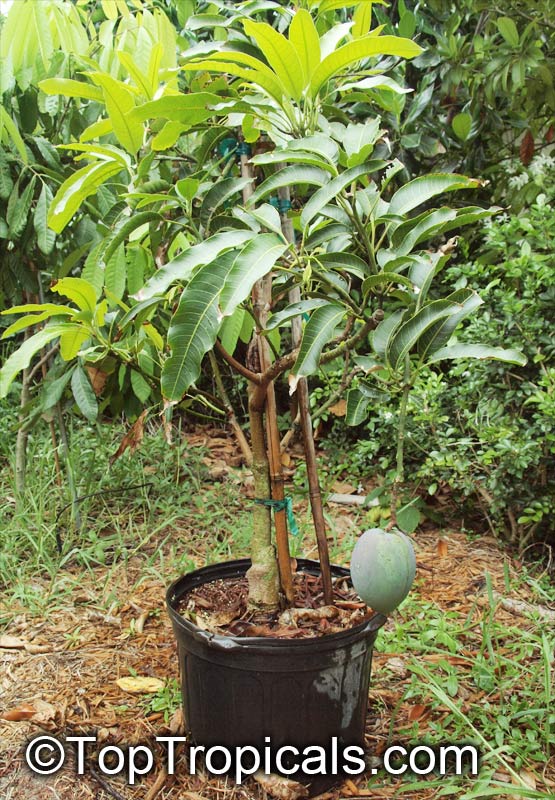
A: There are many dwarf varieties of mango suitable for container culture. They are called "condo mangoes".
The most popular condo varieties are: Carrie, Cogshall, Cushman, Fairchild, Graham, Ice Cream, Julie , Mallika, Nam Doc Mai, Pickering. You may read more about them in our online catalog. You may also look into variety Lancetilla which is also a compact tree, and produces one of the biggest size fruit, up to 5 pounds. If you want some rare variety that hardly anyone else has - try Baptiste, an exotic Haitian dessert mango.

Your greenhouse should work for the winter time. Mango trees can take as low as mid 40s during winter and even lower as long as that cold is occasional. If you keep the temperature around 60, this should work well for over wintering. Just make sure to reduce watering to a minimum, because cool temperatures, low light and wet soil - is a bad combination for tropical plants, especially for mango trees which prefer to be kept on a dry side.

Many indoor gardeners have fruiting mango trees in their collection. However, keep in mind that the most important requirement for a mango is full sun. While you may over winter the plant for a few months in a low light conditions, in order for it to flower and produce fruit it needs lots of light. If moving the tree into full sun your yard during the summer is possible, this would be the best solution.

We always recommend SUNSHINE boosters for both over wintering tropical plants in colder climates, and for indoor gardening. SUNSHINE applications will help your tree to cope with cool temperatures and low light conditions. This will also dramatically increase flowering and fruiting performance. Another important factor for keeping your container plant healthy is quality of your potting soil. We offer a special professional mix that contains lots of good stuff: coconut fiber, peat moss, pine bark, and perlite. Fertilizing potted plants is also very important during the warm season, because this is the only way for them to get nutrients (which in the ground can be reached by spreading root system).

As far as seedlings vs. grafting - the only way to have a nicely fruiting mango tree is to plant a grafted variety. Seedlings start producing only after 8-15 years, and the quality of such fruit may be questionable. Only grafted plants can guarantee the desired taste of a variety. Besides, grafted mangoes start producing immediately - you may see fruit forming on plants as small as 3 ft, in 3 gal containers. However, during the first 1-2 years you will need to remove extra fruit and leave only 1-2 fruit so the plant doesn't get exhausted and has enough energy to establish strong root system.

For fun stories about growing mango, check out our Radio Show recording YO Tango Mango!