Garden Blog - Top Tropicals

Date: 29 Jun 2026

😾 When Orange Isn't a Good Thing

Smokey,  a  tuxedo  cat  dressed  as  a  rust  detective,  examines  a  plumeria 
 leaf  with  a  magnifying  glass  while  Sunshine,  a  relaxed  orange  tabby,  lounges
    with  a  coffee  mug  inside  a  greenhouse  filled  with  healthy  blooming 
 plumerias.  Outside  the  greenhouse,  rain  falls  on  rust-infected  plumeria 
 leaves,  illustrating  how  wet  foliage  promotes  plumeria 
 rust.
Smokey: Those orange spots are plumeria rust.
Sunshine: Orange is an excellent color.
Smokey: On cats, yes. On plumeria leaves, no.
Sunshine: I represent the good kind of orange.

🌸 Plumeria Rust in Humid Climates:
What Finally Worked for Us

By Tatiana Anderson, Plant Expert, Top Tropicals

Side-by-side  photos  of  healthy  plumeria  plants  with  lush  green  foliage 
 and  no  signs  of  rust,  growing  in  pots  inside  a  greenhouse  and  outdoors  at  a 
 tropical 
 nursery.

Healthy plumerias with clean, vibrant foliage after successful rust management. Good airflow, bright conditions, and effective fungicide treatment help keep plants growing strong through Florida's rainy season.

If you grow plumerias in Florida, you probably know what comes next. Around June, when the rainy season begins and afternoon thunderstorms become part of the daily routine, orange-yellow spots start appearing on the undersides of plumeria leaves. Plumeria rust arrives almost like clockwork. If you have ever tried to fight it, you know how frustrating that battle can be.
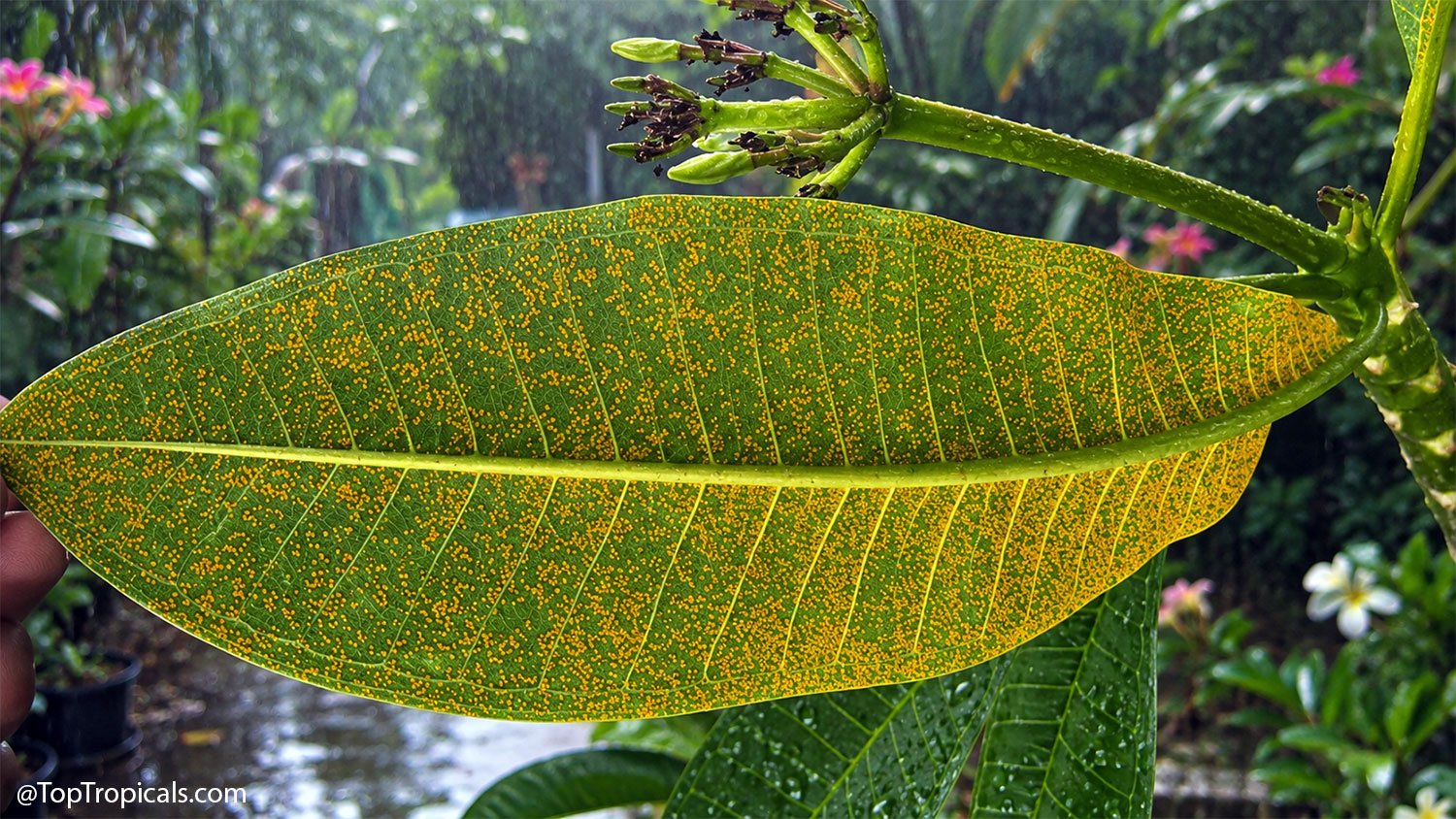
Close-up  of  the  underside  of  a  plumeria  leaf  covered  with  bright  orange
    plumeria  rust  spores  during  rainy  weather,  with  a  lush  tropical  garden 
 blurred  in  the 
 background.

Plumeria rust appears as bright orange powdery spores on the underside of leaves. Warm, humid, rainy conditions allow the fungus to spread quickly, making it a common sight in tropical and subtropical gardens.

Let me be clear about something right away: Plumeria rust is rarely fatal to an otherwise healthy plant.

In our experience, we have never lost a healthy plumeria to rust alone. The disease is mostly cosmetic, but it causes significant yellowing, triggers premature leaf drop, and can turn a beautiful specimen into something that looks ragged throughout the best months of the growing season. For a plant grown as much for its attractive foliage as its spectacular flowers, that matters.

At Top Tropicals, we have grown plumerias for many years and have tried most of the approaches gardeners typically recommend: sulfur-based fungicides, neem oil, copper sprays, improving drainage, and removing infected leaves before they hit the ground. Some of those things helped to varying degrees. None of them felt like a real breakthrough until recently.

The Fungicide That Actually Did Something

Comparison  image  showing  healthy  plumeria  leaves  after  treatment  with 
 Southern  Ag  Garden  Friendly  Fungicide,  alongside  an  inset  photo  of  a  leaf 
 covered  with  orange  plumeria  rust  spores  before  treatment.

Real-world results after treating plumeria rust with Southern Ag Garden Friendly Fungicide. The inset shows a leaf heavily infected with orange rust spores before treatment, while the main image shows clean, healthy new foliage after the fungus was brought under control.

A few seasons ago, on the recommendation of another grower, we tried Southern Ag Garden Friendly Fungicide . This biological fungicide contains the beneficial bacterium Bacillus sp, and I want to be careful here: I am not suggesting it is the best product for everyone or that it will produce the same results in every situation. What I can say is that, in our experience, it was the first fungicide that consistently produced visible improvement when applied according to the label directions.

We applied it at the first sign of rust, repeated applications according to the label, and actually saw the progression slow down while new infections became less severe. Whether that was the product, the timing, or some combination of factors, I cannot say with certainty. But after cycling through several options over the years, it was the one that felt like it was doing something real. If you are looking for a starting point, it is worth trying.

But the fungicide wasn't our main discovery. That came this past season, and it changed how we think about this disease.

☔️ What This Season Taught Us About Leaf Wetness

Healthy  plumeria  plants  with  lush,  dry  green  leaves  growing  inside  a 
 greenhouse.  The  foliage  is  clean  and  free  of  rust,  showing  vigorous  new 
 growth  under  bright  filtered  light.

Healthy, dry plumeria foliage is one of the best defenses against plumeria rust. Good airflow, bright light, and keeping leaves dry whenever possible help prevent the fungus from taking hold during the rainy season.

This season we moved our prized container plumerias under a covered growing area with a clear plastic roof and approximately 30 percent shade cloth overhead. The structure provides excellent light, warm temperatures, and very good air circulation while protecting the plants from Florida's frequent summer rains. It is not a climate-controlled greenhouse, but rather a protected outdoor growing area.

Here is the important part: these plants were still irrigated regularly, every two to four days, with overhead watering. The leaves did get wet. But because they were not sitting outside during Florida's daily summer downpours, the foliage dried within a reasonable amount of time instead of remaining wet for hours, which is common after a heavy rain followed by cloudy skies and still air.

The result? Not a single case of rust developed on those plants throughout the season. Considering how consistently plumeria rust appears each summer in our nursery, that result immediately caught our attention. The most significant difference was how long the foliage remained wet after watering or rain. Meanwhile, plumerias growing in the ground nearby, fully exposed to the weather, showed rust infection at the usual time.

💦 Ambient Humidity vs. Standing Water

That observation made us rethink what we believed was driving the disease. We had always assumed Florida's high humidity was the primary factor. Humidity certainly plays a role. But this experience suggested that prolonged leaf wetness may be a much more significant factor than ambient humidity by itself.

There is a real difference between air that feels humid and leaves that stay wet for four, six, or eight hours after a rain. Humid air means the moisture content of the atmosphere is high. Wet leaves means there is standing water on the leaf surface. Both conditions can occur together, but they are not the same thing. A leaf in a humid but breezy location can dry within an hour. A leaf in still, wet conditions after a heavy rain may stay wet most of the day. That difference may be far more important than many gardeners realize.

We are not plant pathologists, and we do not want to overstate what we learned from one growing season. But after many years of growing plumerias in Florida, the results were convincing enough that we now protect our best container specimens from prolonged summer rainfall whenever possible.

👉 What We Recommend

Based on many years of growing plumerias in Florida, here are the practices that have worked best for us:

  • Grow plumerias in full sun whenever conditions allow. Good light means faster drying after rain or irrigation, and plants grown in low light often seem to show rust symptoms more readily.
  • Keep your plumerias well-fed. Healthy, vigorously growing plants recover from stress and disease much better than weak ones. We apply Green Magic controlled-release fertilizer every six months for a steady supply of nutrients, and supplement with Sunshine Boosters Megaflor during the growing season. Because Megaflor is gentle, it can be safely applied with every watering, all year long.
  • During extended rainy periods, consider moving valuable container plants under cover if possible. Even a covered patio can make a difference if it keeps the leaves from remaining wet for most of the day.
  • Provide air circulation. Plants crowded together stay wet longer. Space them properly and position them where they receive good airflow.
  • Remove infected fallen leaves. They can continue serving as a source of spores. Pick them up and dispose of them rather than leaving them beneath the plants.
  • If rust begins to appear, start fungicide applications early. Slowing an infection at the beginning is much easier than trying to control one that is already well established.

💡 A Realistic Conclusion

Five  healthy  potted  plumeria  varieties  displaying  white,  pink,  yellow, 
 magenta,  and  multicolored  blooms,  arranged  in  a  row  with  lush  green  foliage 
 and  clean,  rust-free 
 leaves.

A parade of healthy plumerias in full color. Clean foliage, bright blooms, and vigorous growth show what plumerias can look like when rust is kept under control, letting each variety shine in its own unique colors.

Plumeria rust is mostly a cosmetic problem rather than a life-threatening one. Healthy plants usually recover well, but yellowing foliage and premature leaf drop can take much of the beauty out of an otherwise beautiful blooming season.

We cannot promise these methods will eliminate rust in every garden. Every growing environment is different. However, after years of battling this disease, reducing how long the leaves remain wet made a bigger difference than any other single change we have tried. If you grow plumerias in a humid climate and continue struggling with rust, it may be worth focusing not only on humidity itself, but also on how quickly the foliage dries after the rain stops.

📚 Plumerias in Top Tropicals Garden Blog

👉 Start your Plumeria collection
Plumeria Special
Buy 2 or More Plumerias, Save 25%
Mix and match your favorite varieties! Purchase 2 or more plumerias and receive 25% off all plumerias in your order. No coupon code required. Discount is applied automatically when qualifying items are added to your cart.
Valid through July 3, 2026
Offer applies to new orders only. Not valid on previous purchases, pending orders, gift certificates, shipping charges, or combined with other discounts or promotional offers.

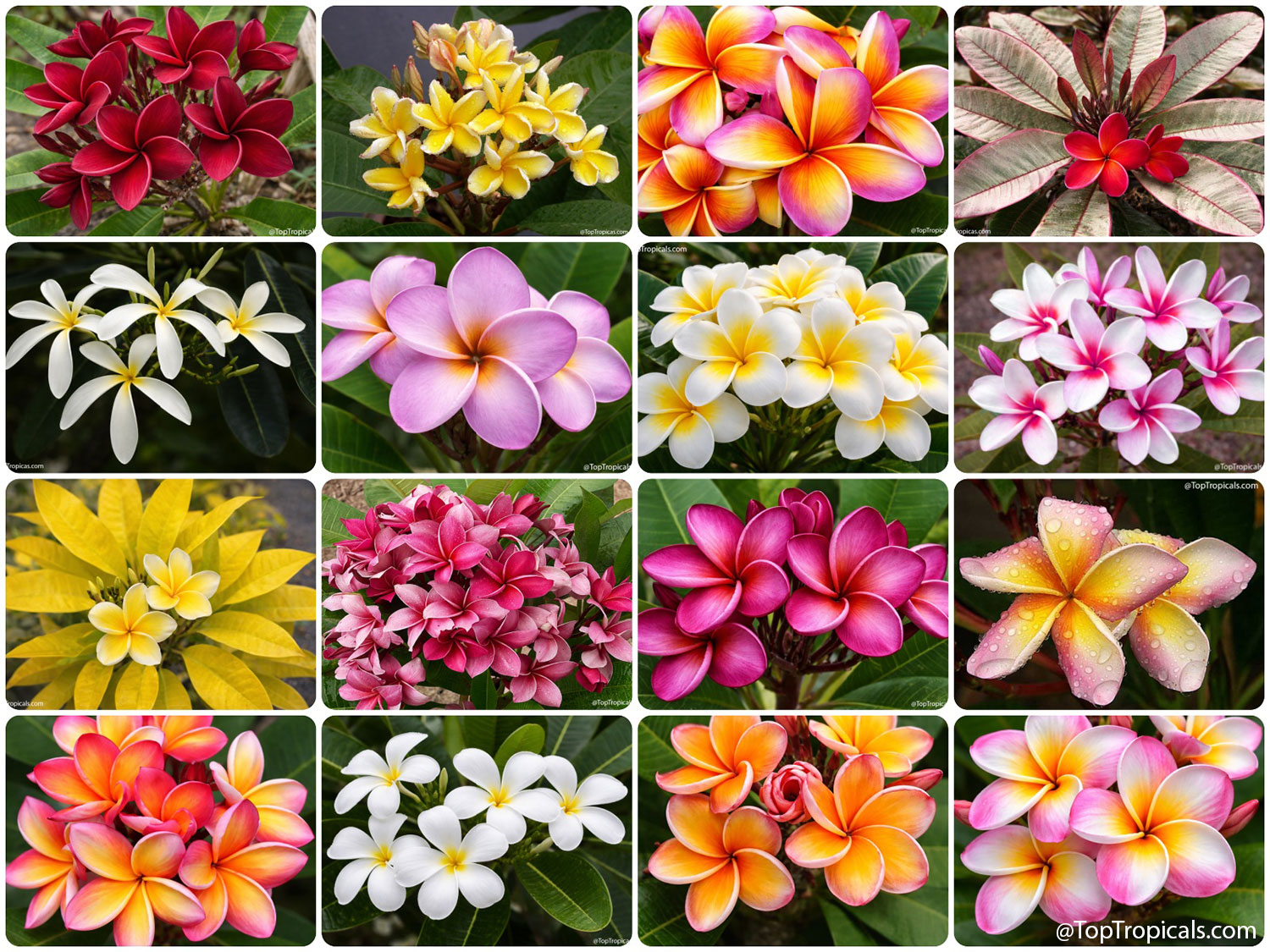
Collage  of  sixteen  plumeria  varieties  showcasing  an  extraordinary  range
    of  flower  colors,  including  white,  yellow,  pink,  red,  orange,  multicolored,
    and  variegated  foliage,  highlighting  the  remarkable  diversity  of  plumeria 
 blooms.

Plumerias come in an amazing spectrum of colors and forms. From pure white and buttery yellow to fiery reds, soft pinks, rainbow blends, and even variegated foliage, there is a plumeria to match every tropical garden and collector's taste.

Sunshine: Healthy plumerias need sunshine... that's me... good airflow, and dry leaves.
Smokey: That's a surprisingly accurate summary.
Sunshine:We can help with all of that. Donut worry. Coffee first.


Date: 21 Jun 2026

🍓The Strawberry Moon Rises: A Gardener's Excuse to Go Outside

Sunshine,  an  orange  tabby  cat,  compares  a  strawberry-glazed  donut  to 
 the  Strawberry  Moon  while  Smokey,  a  tuxedo  cat  wearing  glasses,  inspects 
 Strawberry  Tree  and  Strawberry  Guava  plants  at  Top 
 Tropicals.
Sunshine: Look at my strawberry-glazed donut. Same as the Strawberry Moon. I have been waiting for this all month. They say moon gardening is useful. Let's go planting!
Smokey: Science hasn't found much evidence for it.
Sunshine: Then what's the point?
Smokey: If the moon gets people into the garden, that's good enough for me.

On the evening of Monday, June 29, 2026, the full Strawberry Moon will rise low in the southeastern sky. Whether you follow a lunar calendar or not, it's a good excuse to spend a little time outside on a summer evening.

🌛 What Is the Strawberry Moon, Exactly?

Many of the familiar full moon names come from Native American traditions and reflect seasonal events in nature. June's full moon was named for the season when wild strawberries ripen across much of North America, not for any color in the sky. Despite the name, the moon won't glow pink or red. If it looks warm or golden, that's simply because any full moon takes on an amber tint when it hangs low near the horizon, the same atmospheric effect that paints sunsets orange. The "strawberry" is about the harvest, not the hue.

This year, the Strawberry Moon rises on the evening of June 29 and will appear low in the southeastern sky, making it a particularly beautiful moon to watch as dusk settles in.

🌓 Moon Gardening, an Old and Honest Tradition

For generations, gardeners across Europe and beyond timed their planting, pruning, and harvesting to the phases of the moon. Plant root crops during a waning moon, some traditions say, and leafy crops during a waxing one. Prune during certain phases to slow regrowth, harvest herbs at others for better potency. These calendars were passed down through generations of careful observers who paid close attention to their land and their results, and many still follow them today.

Modern science has found little evidence that lunar gravity or moonlight significantly affects plant growth. Yet the tradition persists, and plenty of growers still find real value in the rhythm it brings to the gardening year.

💡What We Know For Sure

Here's the practical truth, and it's the same one Smokey arrived at after thinking it over. Whether or not the moon influences your plants, the act of walking through your garden definitely does. A moon-phase calendar that gets you outside to check on your plants, pull a few weeds, prune back something leggy, top off the mulch, or water a thirsty pot is helping your garden, regardless of what's happening overhead.

The benefit isn't necessarily lunar. It's attention.

A garden rarely thrives because of a single grand effort. It thrives because of dozens of small ones: a little pruning, a little watering, a few weeds pulled before they become many.

Gardens reward the gardeners who show up, and if a full moon is your reminder to show up, that's a perfectly good reason to keep watching the sky.

📅 Beyond the Harvest

Not everything in a garden needs to produce a yield to be worthwhile. Marking the seasons the way our ancestors did, a strawberry moon in June, a harvest moon in fall, a snow moon in February, gives us small, recurring reasons to notice what's changing around us. It's a rhythm, not a requirement.

Think of the Strawberry Moon as a good excuse to take a walk through the garden.

The Strawberry Moon doesn't have to improve anything to be worth celebrating. It only needs to get you outside on a warm June evening, which, honestly, isn't a high bar to clear.

A Strawberry Moon Collection, Just for Fun

Sunshine immediately concluded that any moon named after strawberries deserved a few strawberry-themed plants. We couldn't argue with that logic, so we pulled together a few Top Tropicals favorites that fit the theme.

🍓 Strawberry Tree

Close-up  of  ripe  red  Strawberry  Tree  fruit  (Muntingia  calabura) 
 arranged  on  fresh  green  leaves  with  several  white  five-petaled  flowers  and 
 flower  buds,  displayed  on  a  rustic  wooden 
 surface.

The Strawberry Tree (Muntingia calabura) often carries flowers and fruit at the same time. Sweet red berries, delicate white blossoms, and lush foliage make this fast-growing tropical tree both ornamental and productive throughout much of the year.

Close-up  of  the  rare  yellow-fruited  Strawberry  Tree  (Muntingia 
 calabura)  showing  ripe  golden-yellow  berries  alongside  white  five-petaled 
 flowers  and  green  developing  fruit  among  textured  green 
 leaves.

A rare yellow-fruited form of Muntingia calabura (Strawberry Tree), displaying sweet golden berries, delicate white flowers, and immature green fruit all at the same time. This unusual selection offers the same fast growth and continuous fruiting as the red type, but with attractive yellow fruit that is seldom seen in cultivation.

Strawberry Tree (Muntingia calabura), also known as Jamaican Cherry, grows quickly and produces dainty white flowers resembling strawberry flowers, followed by an abundance of small cotton-candy-sweet berries that birds, wildlife, gardeners and their kids all appreciate.

📚 Learn more from Top Tropicals Garden Blog

🍓 Strawberry Guava

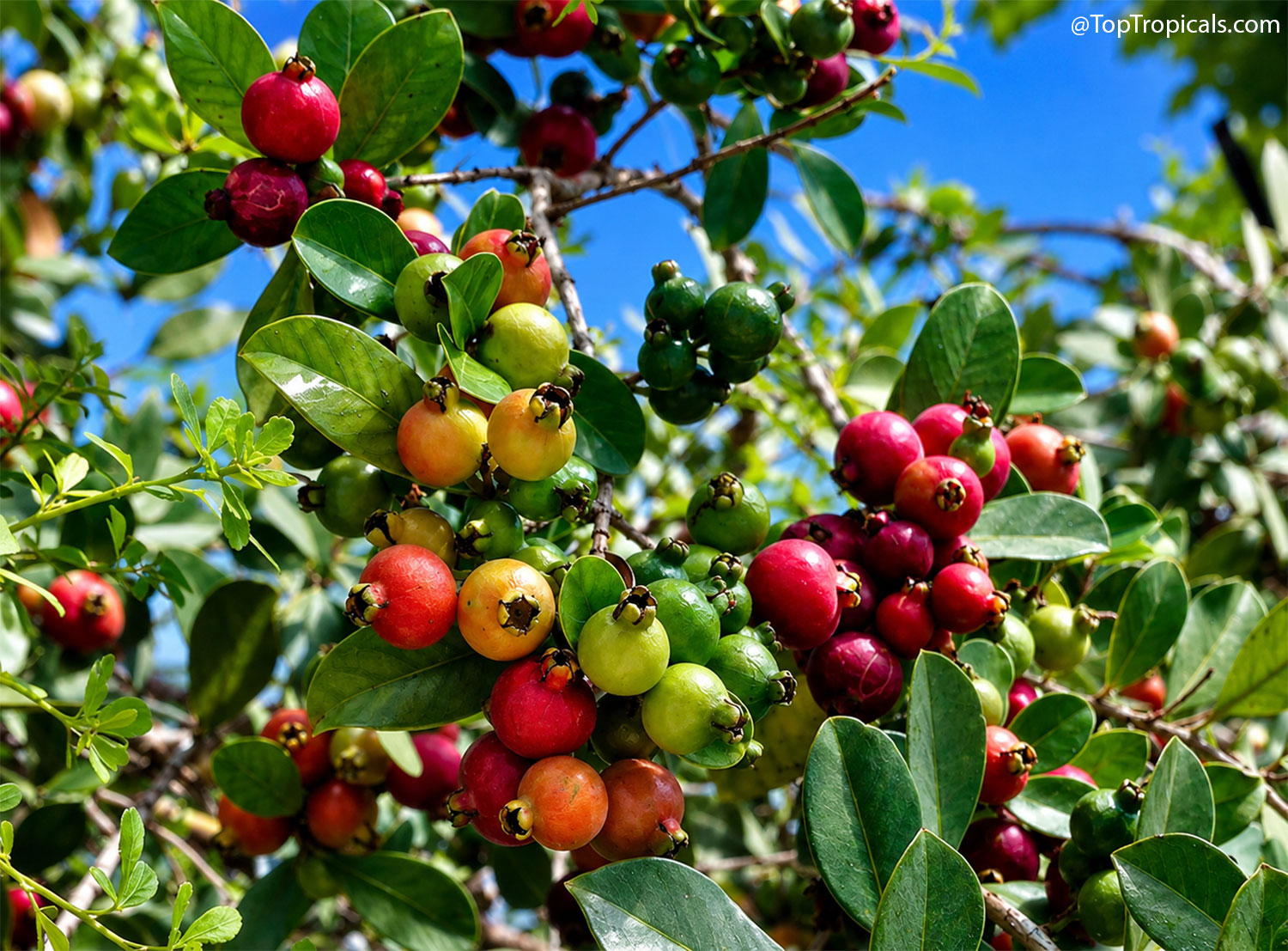
Strawberry Guava (Psidium littorale) brings glossy foliage and sweet, perfumed fruit that tastes something like its namesake crossed with a guava.

Close-up  of  a  strawberry  guava  branch  loaded  with  fruit  in  different 
 stages  of  ripening,  from  green  and  yellow  to  bright  pink-red.  Glossy 
 evergreen  leaves  surround  the  colorful  clusters  against  a  clear  blue 
 sky.

Strawberry Guava (Psidium littorale, or cattleianum) often carries fruit in multiple stages of ripening at once, creating a colorful display of green, golden, and ruby-red berries. The sweet, aromatic fruit is prized for fresh eating and attracts birds and wildlife to the garden.

🍓 Strawberry Dragon Fruit

Dragon Fruit Vietnamese Jaina Strawberry White (Hylocereus undatus ) produces bright pink fruit with refreshing white flesh and a flavor often described as a blend of strawberry, melon, and kiwi. Its enormous night-blooming flowers are every bit as impressive as the fruit, turning this vigorous climbing cactus into a spectacular summer showpiece.

Plate  of  Vietnamese  Jaina  Strawberry  White  dragon  fruit  showing  several
    whole  pink-skinned  fruits  alongside  sliced  fruit  revealing  bright  white 
 flesh  speckled  with  tiny  black 
 seeds.

Vietnamese Jaina Strawberry White Dragon Fruit is prized for its refreshing white flesh and mild sweet flavor with hints of strawberry, melon, and kiwi. The vivid pink skin and striking black-speckled interior make it as beautiful on the table as it is delicious to eat.

🍓 Strawberry Ginger

Coral Ginger Borneo Strawberry Pink (Riedelia coralina) is one of the rarest gingers in cultivation, producing unusual strawberry-pink flower spikes that seem almost too exotic to be real. The edible blooms have a pleasant spicy fragrance and flavor, making this New Guinea treasure as interesting to taste as it is to admire.

Whether you came for the moon or the plants, we hope you discovered something interesting. They just happen to share a name with the moon overhead this June, and that felt like reason enough to give them a little spotlight.

Close-up  of  Riedelia  coralina  (Coral  Ginger)  showing  an  unusual 
 strawberry-pink  flower  spike  emerging  among  large  glossy  tropical  leaves, 
 with  the  curved  tubular  flowers  standing  out  against  a  lush  green  jungle 
 background.

Riedelia coralina, known as Coral Ginger or Borneo Strawberry Pink, produces one of the most unusual flower displays in the ginger family. Its striking strawberry-pink blooms rise above lush foliage, creating a tropical focal point rarely seen outside specialized collections.

🍓🌱 How to Grow Them

If you live in a frost-free climate (USDA Zones 10+), simply plant these strawberry gems in the ground and enjoy. Strawberry Guava can tolerate occasional frosts down to about 28F once established.

Not so lucky? Many gardeners successfully grow Strawberry Guava, Strawberry Dragon Fruit, and Strawberry Tree in containers, moving them indoors or to a protected location during winter. You don't need a tropical climate to enjoy tropical fruit.

🏡 See You Outside

Whether you believe in moon gardening or not, June 29 is a good night to step outside, find an open view of the southeastern sky, and watch the Strawberry Moon rise. Bring a cup of tea, walk the garden beds while there's still light, pull a few weeds, and let the evening settle in around you.

And that may be the real lesson of the Strawberry Moon.

Sunshine: The Strawberry Moon is out. Time for gardening.
Smokey: What does the moon calendar recommend?
Sunshine: I have no idea. I left it on the kitchen table. Both hands are full.
Smokey: Of course they are. Coffee and donuts. Let's start with the weeds.

👉Start your Strawberry Moon Collection

Date: 18 Jun 2026

Smokey,  Sunshine,  and  their  mini-me  kittens  arrive  at  the  Top  Tropicals
    Father's  Day  Plant  Market.
Smokey: The best Father's Day gift is a plant.
Sunshine: Because it grows?
Smokey: Because every garden is a promise to the future.
Sunshine: Then we'd better choose carefully. We brought our future with us.

Father's Day Belongs in the Garden

Some gifts are forgotten by next month.

A plant is different.

A fruit tree planted today may provide fruit for decades. A flowering tree may bloom every spring long after the holiday is over. The best gardens aren't built in a single afternoon - they're built one season at a time, one generation at a time.

This Father's Day weekend, come spend the day the way it was meant to be spent: outdoors, unhurried, surrounded by growing things.

Top Tropicals is hosting our Summer Solstice Plant Market, and this is one of the best times of the year to visit the nursery. The longest days of summer bring out the flowers, the fragrance, and the fruit. Thousands of plants at their peak, in the kind of Florida light that makes everything look like it belongs on a postcard.

📅 Saturday, June 20, 2026
⏰ 9:00 AM - 4:00 PM
📍 13890 Orange River Blvd, Ft Myers, FL 33905
Phone: 239-689-5745, 866-897-7957
📍 9100 McRoy Rd, Sebring, FL 33875
Phone: 863-401-4004, 866-897-7957

You'll find rare fruit trees, flowering trees, fragrant plants, and collector varieties rarely available elsewhere. There will be event specials, raffle prizes, free plants with qualifying purchases, tropical music, and cold drinks. And somewhere in the shade, King, Snitch, and the rest of the PeopleCats will be doing what they always do - making themselves at home and pretending to supervise.

But the real reason to come isn't the event. It's the reminder.

Whether you're planting your first fruit tree or adding one more chapter to a garden that's been growing for years, Father's Day is a good day to remember what we're really building. Not just a yard. Something that keeps giving long after the I love you, Dad card is forgotten.

Plant something today.

Every garden is a promise to the future.

👉SEE FULL FATHER'S DAY EVENT DETAILS

Date: 16 Jun 2026

💜 The Tree Everyone Stops to Take Pictures Of

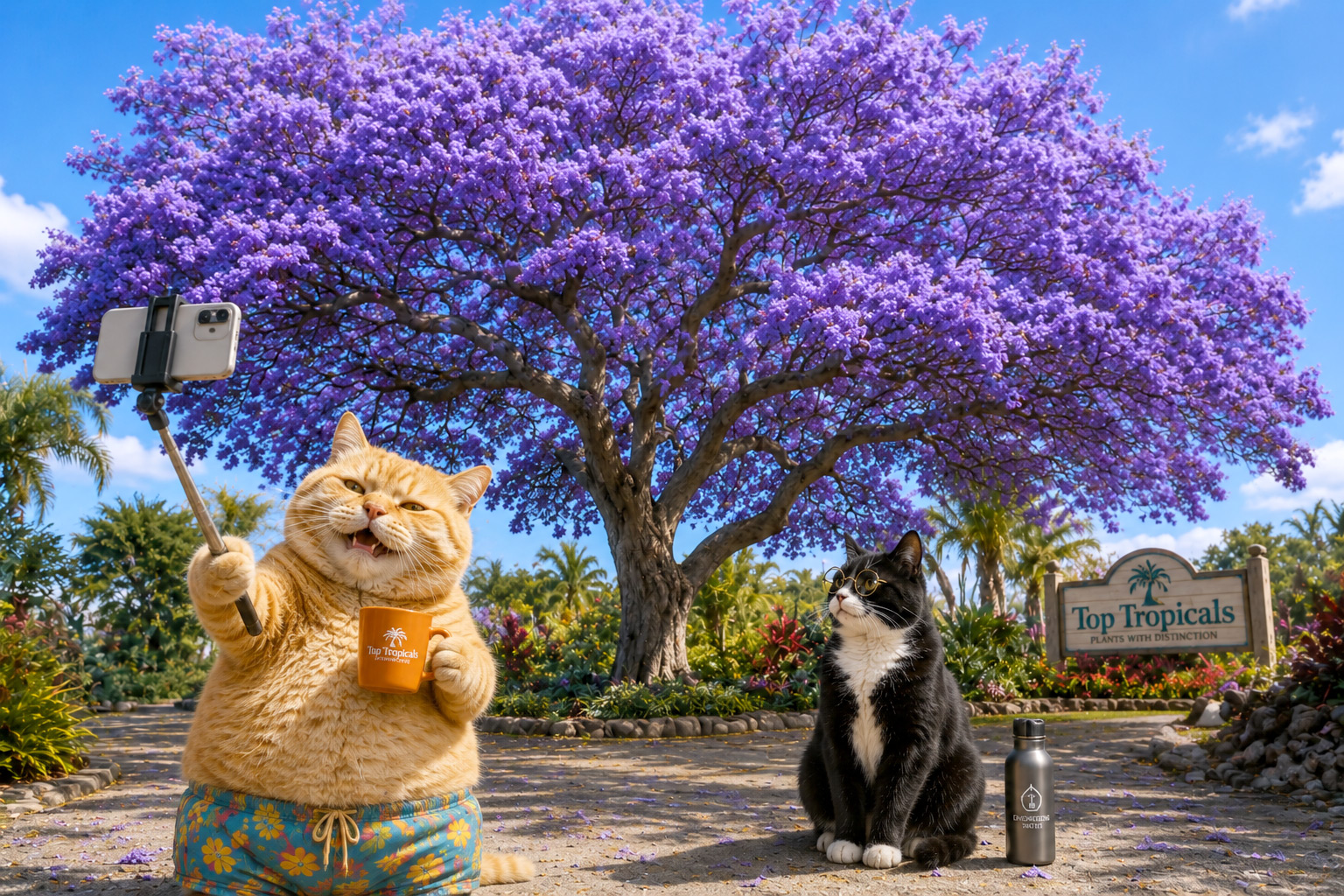
Sunshine,  an  orange  tabby  cat,  takes  a  selfie  beneath  a  blooming  purple
    jacaranda  tree  while  Smokey,  a  tuxedo  cat  wearing  glasses,  watches  nearby 
 at  Top 
 Tropicals.
Sunshine: Every angle looks good.
Smokey: That's because you're photographing a Jacaranda at peak bloom.
Sunshine: I think the purple brings out my orange.
Smokey:The Jacaranda makes everything look better.

There's a moment, if you've never seen a mature Jacaranda in full bloom, that stops you completely.

You're driving down a street, or walking through a neighborhood you've passed through a hundred times, and suddenly there it is — a tree that looks like someone painted it from memory rather than from life. The canopy spreads wide and low, covered so thoroughly in lavender-blue flower clusters that you can barely see the branches beneath. People are already stopped on the sidewalk. Someone has their phone out. A couple is standing beneath it, looking up.

You understand immediately why they stopped. You stop too.

That first encounter with a Jacaranda mimosifolia in bloom is the kind of thing gardeners remember for years. It's also, for many of them, the moment they decided they needed one.

👉Plant Your Purple Jacaranda

💜 The Tree That Turns Cities Purple

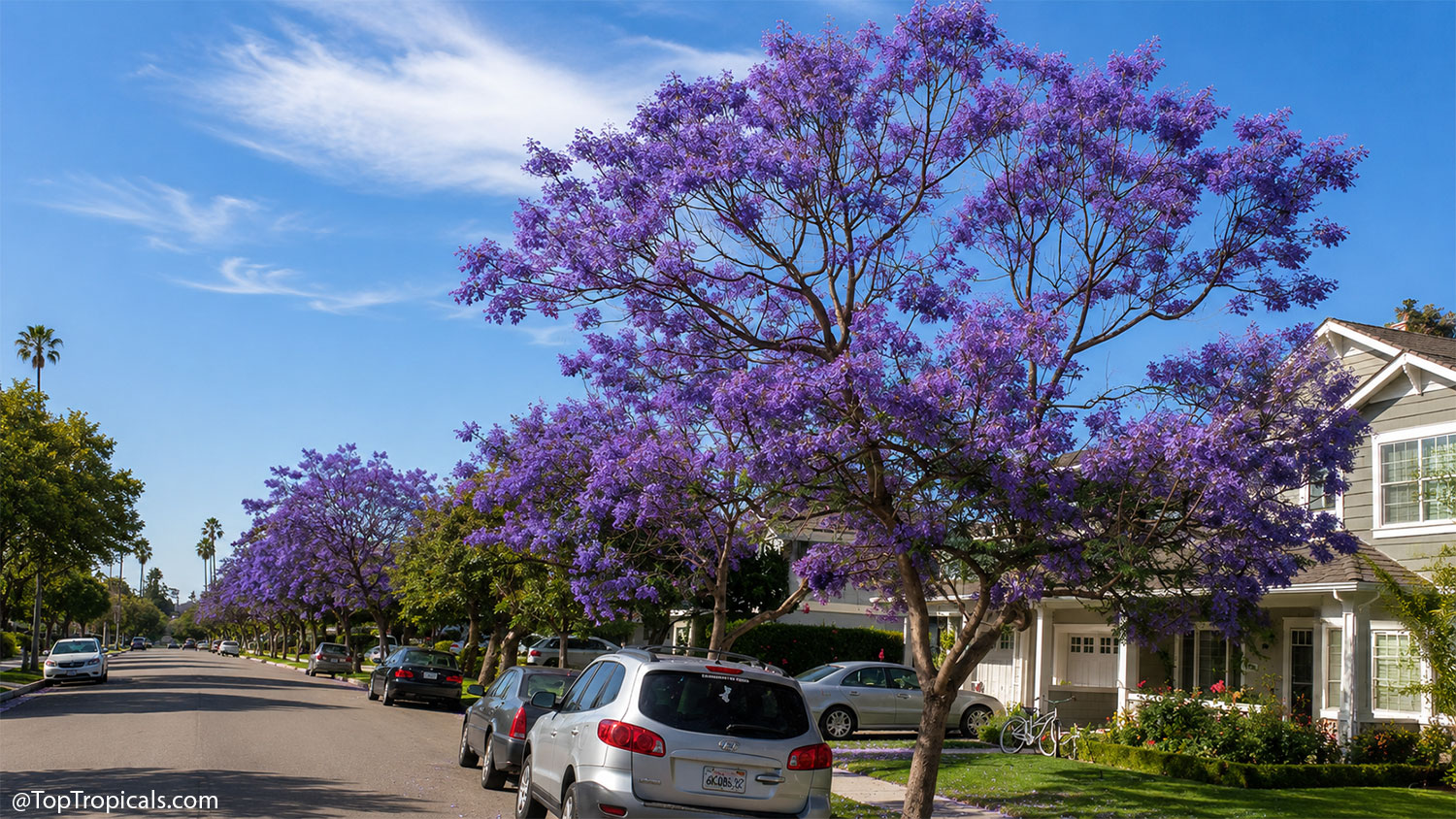
Residential  street  lined  with  blooming  jacaranda  trees  covered  in 
 vibrant  purple  flowers.  A  large  jacaranda  shades  parked  cars  and  front 
 yards,  while  additional  flowering  trees  create  a  stunning  purple  avenue 
 beneath  a  bright  blue 
 sky.

When jacarandas bloom, entire neighborhoods are transformed into rivers of purple. Their spectacular floral display turns ordinary streets into some of the most photographed landscapes of spring and early summer.

Most flowering trees get admired. Jacarandas become events.

Pretoria, South Africa is known worldwide as "Jacaranda City." During bloom season, entire neighborhoods seem to disappear beneath a haze of lavender-blue flowers.

Buenos Aires, Sydney and Brisbane have their own Jacaranda traditions. In Southern California, mature Jacarandas are so anticipated that bloom season regularly fills social media with photos of purple-lined streets and neighborhoods.

People don't merely grow Jacarandas. They wait for Jacaranda season. There's something unusual about a tree that generates that kind of anticipation. Most ornamental trees are appreciated in passing. Jacaranda creates a ritual.

💜 A Tree Surrounded by Legends


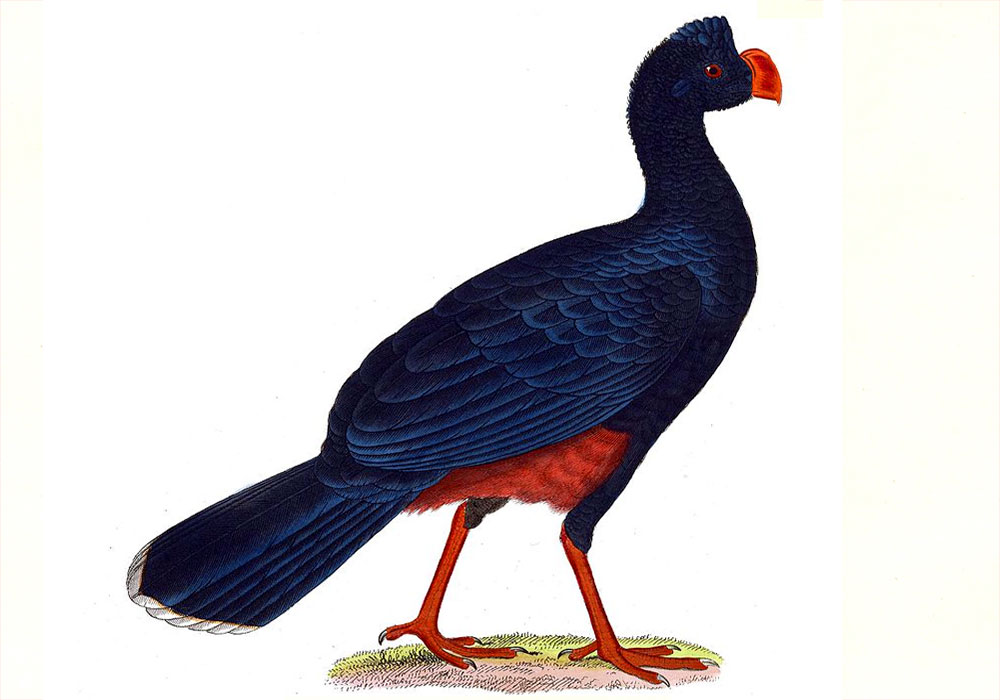
Mitu  mitu  bird  (Alagoas  Curassow)  -  adult  male.  Illustration  from 
 Nouveau  recueil  de  planches  coloriées 
 d'oiseaux,  1838

Mitu mitu — the bird of the Tupi-Guarani legend (Wikimedia Commons)

In Tupi-Guarani tradition, Mitu, a great forest bird, carried the Daughter of the Moon from the heavens and placed her in a flowering Jacaranda tree. She descended among the people, bringing wisdom and knowledge before returning to the sky.

Few trees become part of local folklore. Fewer still become part of everyday life across multiple continents.

💜 Beautiful Beyond Bloom

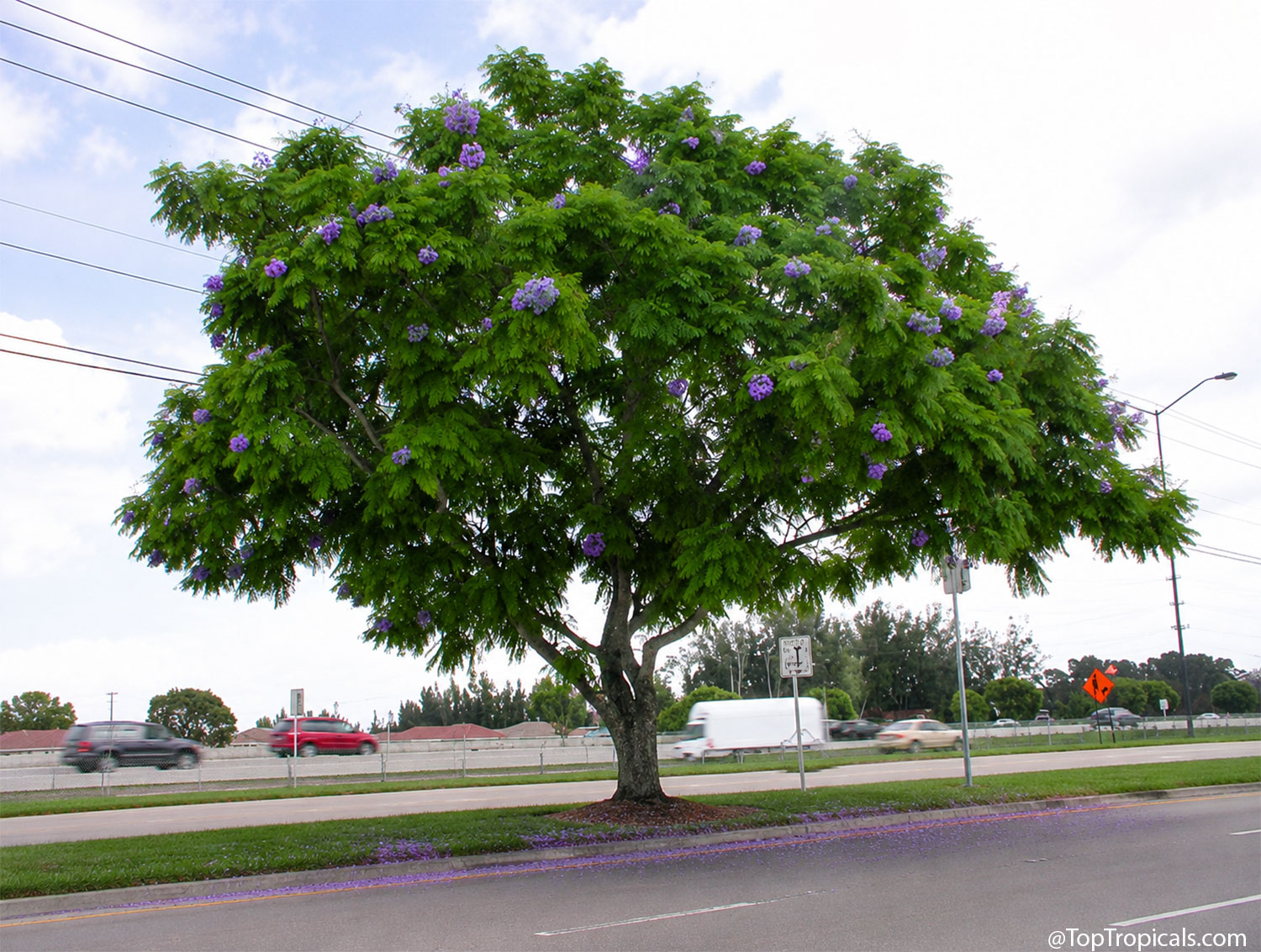
Young  jacaranda  tree  with  lush  fern-like  green  foliage  and  scattered 
 clusters  of  purple  flowers  growing  along  a  roadside.  The  broad  canopy  forms 
 a  graceful  umbrella  shape,  showing  the 
 tree's  attractive  structure  even  when  not  in  peak  bloom.

Jacaranda is beautiful even outside its main flowering season. Its finely divided, fern-like foliage creates a soft tropical canopy, while occasional clusters of purple blooms offer a preview of the spectacular display that transforms the tree into a cloud of lavender each year.

Here's what surprises people who plant their first Jacaranda: they love it even when it isn't flowering.

The foliage is finely divided and fern-like, giving the tree a delicate, airy texture that softens any landscape. The branching structure is naturally graceful, spreading wide with a canopy shape that looks considered rather than accidental. The light that comes through the leaves is gentle and dappled — the kind of shade that doesn't feel heavy, that lets enough brightness in to make the space beneath feel pleasant rather than dim.

💜 Mature Size

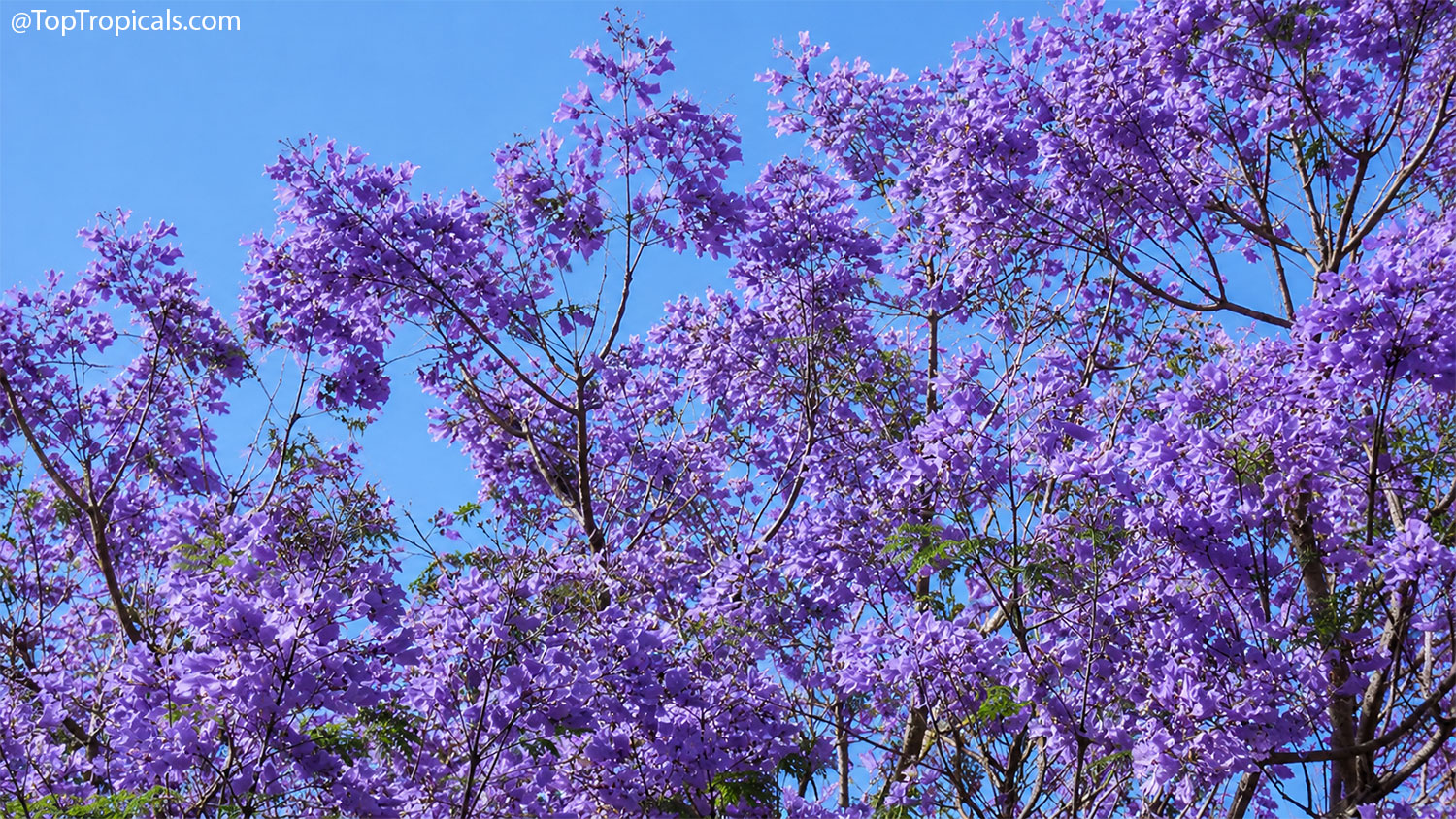
Upper  canopy  of  a  blooming  jacaranda  tree  filled  with  thousands  of 
 lavender-purple  flowers  against  a  clear  blue  sky.  The  delicate 
 trumpet-shaped  blossoms  create  a  soft,  cloud-like  effect  among  the 
 tree's  fine  branches  and  sparse  fern-like  foliage.

At peak bloom, jacaranda trees appear draped in purple clouds. The airy canopy of lavender blossoms creates a breathtaking display that has made this tree famous in gardens, parks, and city streets around the world.

A mature Jacaranda typically reaches 25 to 30 feet tall with a broad, spreading canopy of similar width. Given room to grow, it becomes a true focal point in the landscape.

That size is the point. A Jacaranda works beautifully as a specimen tree where you have room to let it express itself fully. It makes an excellent lawn tree, its canopy casting light shade over a wide area. Planted where it can be seen from a distance, it becomes a focal point in any season and a spectacle during bloom.

If you want a tree that will grow into something people notice — something that will still be there and still be blooming long after you've finished planting the rest of the garden — Jacaranda delivers.

How to Grow Jacaranda

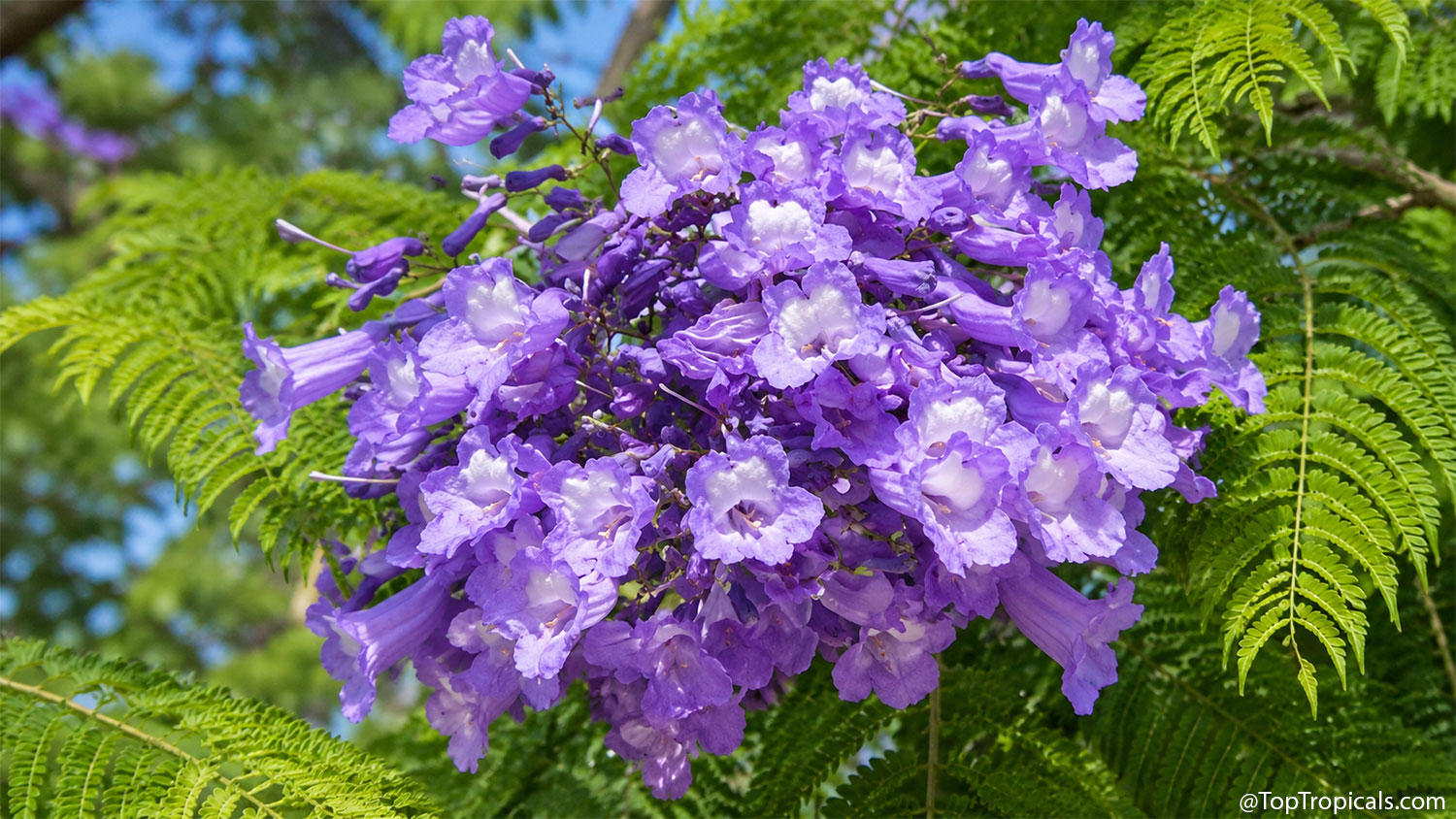
Dense  cluster  of  lavender-purple  jacaranda  flowers  surrounded  by 
 delicate  fern-like  green  foliage.  The  trumpet-shaped  blooms  are  packed 
 tightly  together,  with  pale  white  throats  creating  a  striking  contrast 
 against  the  vibrant  purple 
 petals.

The beauty of jacaranda is not only in its massive floral display but also in the individual flower clusters. Each bouquet combines dozens of delicate trumpet-shaped blooms framed by soft, fern-like foliage, creating a perfect balance of texture and color.

For best results, provide:

  • Full sun
  • Best planted away from sidewalks and driveways
  • Well-drained, sandy loam; highly sensitive to waterlogged or heavy clay soils
  • Regular watering while establishing
  • Moderate watering once mature
  • A balanced fertilizer during the growing season
  • USDA Zones: 9B – 11. Can tolerate brief, light frosts once mature. Protect from cold while young

Bloom season: Late Spring to Early Summer (Main flush), occasional light scattered bloom in Fall. As the flowers fall, they often create a colorful purple carpet beneath the canopy, extending the display from the branches to the ground below.

In warm climates such as South Florida, coastal Southern California, and Hawaii, Jacaranda can become a long-lived landscape tree that provides shade, beauty, and spectacular seasonal blooms for decades.

Top Tropicals Tip:
To help young trees get established quickly, consider using Sunshine Boosters Green Magic when planting or transplanting. During the growing season, regular feeding with Sunshine Boosters Megaflor can help support vigorous growth and a healthy canopy.
To maximize the bloom density for next season, ensure the tree receives consistent micronutrients during the late summer growth surge.

Read Top Tropicals Guide to Sunshine Boosters™

Jacaranda can also be grown in large containers, where its size may be managed through container culture and occasional pruning. This is a useful option for gardeners in colder climates or for those who wish to enjoy the tree on patios and terraces.

📚 More About Jacaranda on the Top Tropicals Garden Blog

💜 Why Gardeners Fall in Love With Jacaranda

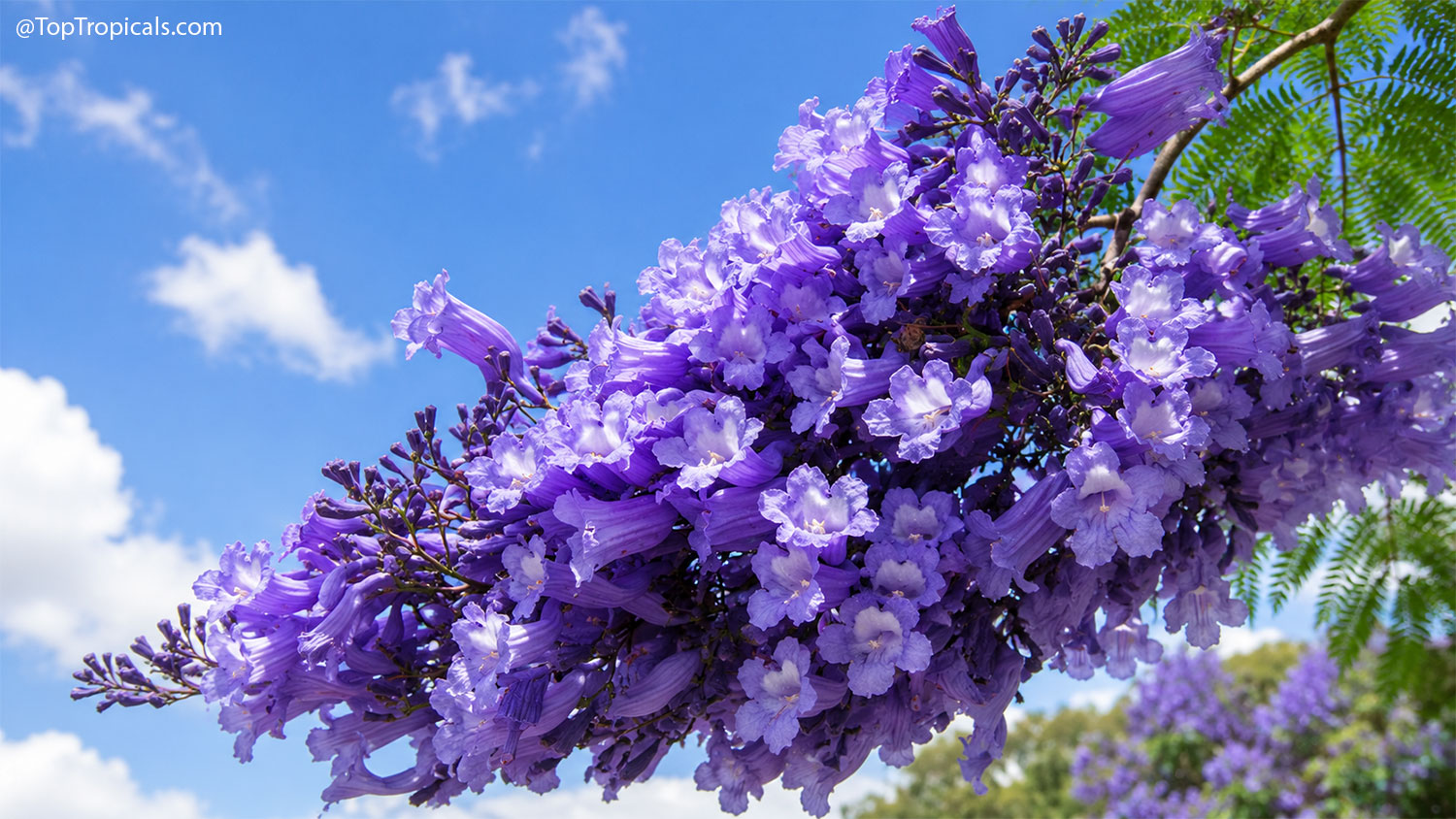
Large  cluster  of  lavender-purple  jacaranda  flowers  hanging  from  a 
 branch  against  a  bright  blue  sky  with  white  clouds.  The  trumpet-shaped 
 blooms  are  packed  tightly  together,  creating  a  spectacular  display  of  color,
    while  delicate  fern-like  foliage  frames  the 
 scene.

Jacaranda flowers bloom in dense clusters of lavender-purple trumpets, creating one of the most spectacular floral displays in the tree world. Against a clear blue sky, the blossoms seem to glow, giving the tree its famous "purple cloud" appearance.

Ask someone with a mature Jacaranda in their yard what it's like when it blooms, and they'll usually smile before they answer.

There's a particular pleasure in seasonal anticipation - in knowing that something beautiful is coming, in watching for the first flower clusters to appear, in the morning you walk outside and realize the tree has finally opened. Jacaranda delivers that pleasure reliably, year after year.

Mature trees become landmarks. "Turn left at the purple tree" is a surprisingly common way to find a house during Jacaranda season. They become the reason people slow down while driving past your house. They become the tree your kids remember.

Few landscape trees combine beauty, shade, elegance, and seasonal drama quite the way a Jacaranda does. Long after the flowers fade, the tree remains a graceful presence in the garden. And when bloom season returns, it reminds you exactly why you planted it.

Some trees provide shade. Others provide flowers. Jacaranda provides both.

That's a rare thing in a garden, and it's worth planting.

Sunshine: What happens when the flowers are gone?
Smokey: Then you enjoy the tree.
Sunshine: And when the flowers come back?
Smokey: Then you remember why you planted it.

👉Shop Jacaranda Trees

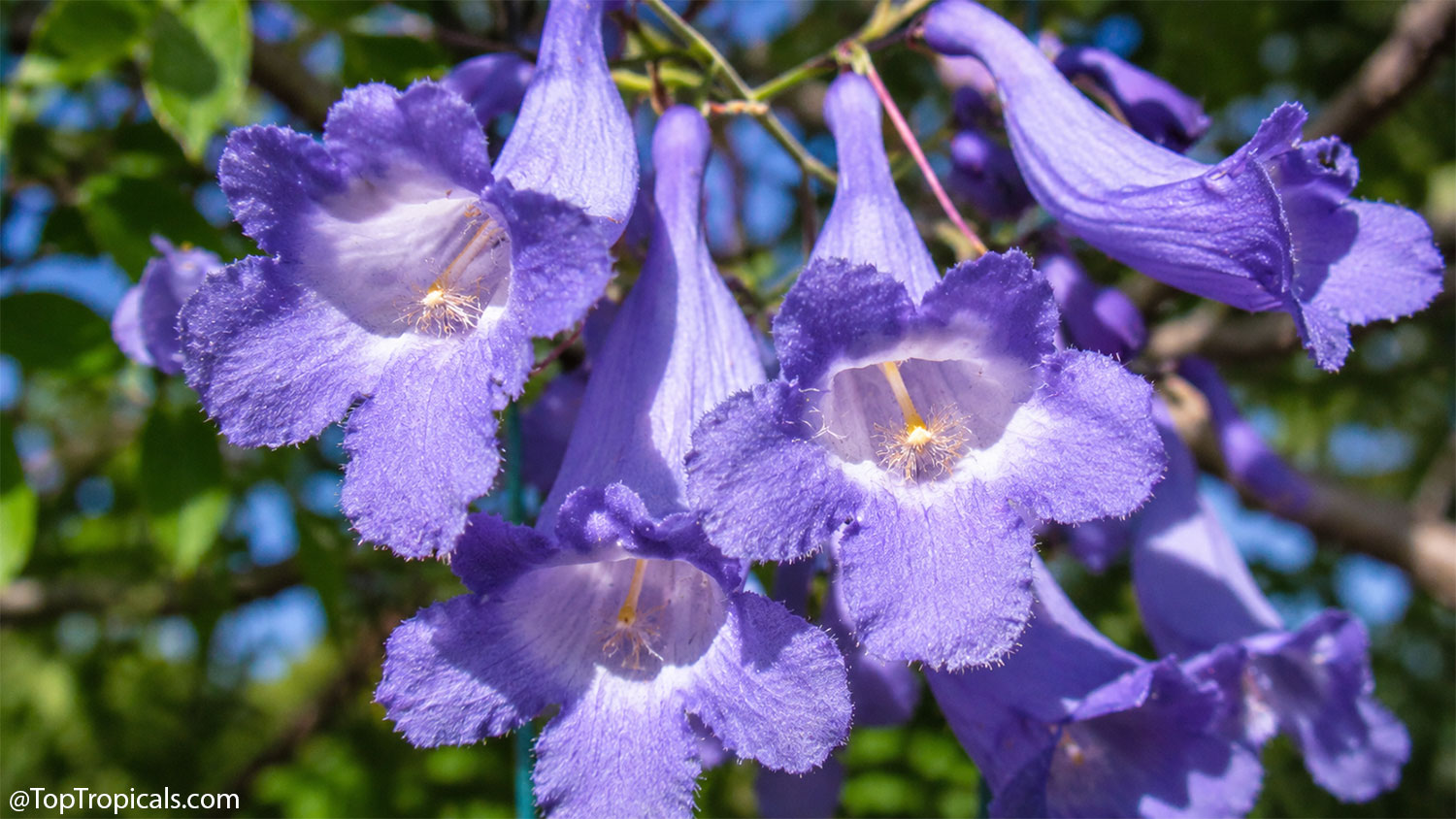
Close-up  of  pale  lavender  jacaranda  flowers  showing  the  distinctive 
 trumpet-shaped  blooms  with  soft,  velvety  petals  and  fuzzy  white  throats. 
 Sunlight  highlights  the  delicate  flower  texture  against  a  softly  blurred 
 background  of  green 
 foliage.

A close-up look at the intricate flowers of the Jacaranda tree (Jacaranda mimosifolia). Each velvety trumpet-shaped bloom combines soft lavender tones with delicate textures that make this tree one of the most recognizable flowering trees in the world.

Date: 7 Jun 2026

🌿 The Vanilla Plant That Outgrew Its 100-Gallon Container.

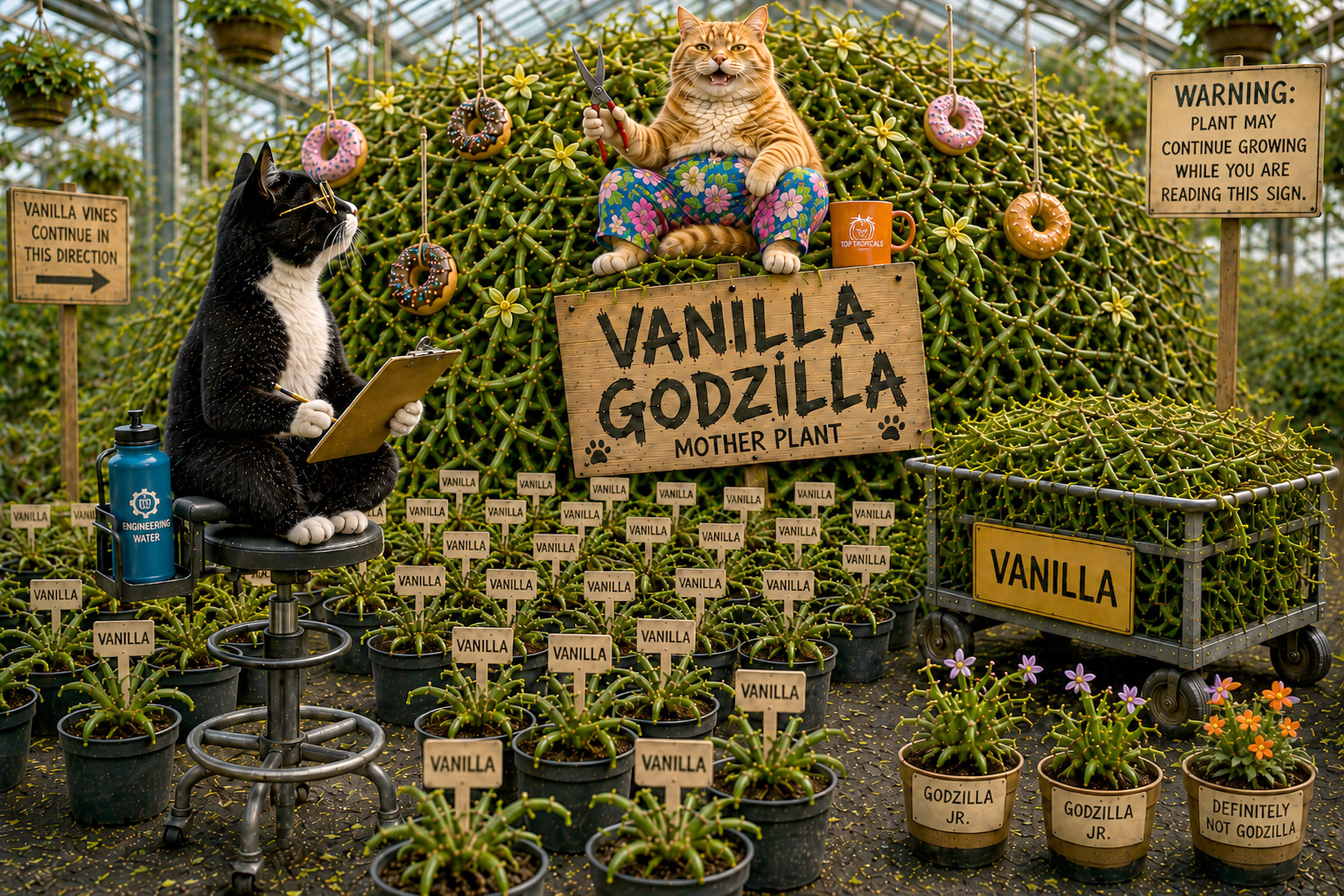
Smokey  the  tuxedo  cat  and  Sunshine  the  orange  cat  inspect  a  giant 
 Vanilla  Godzilla  mother  plant  in  a  greenhouse.  Sunshine  sits  atop  a  massive 
 mound  of  leafless  vanilla  vines  holding  pruning  shears,  while  Smokey  takes 
 notes  among  dozens  of  young  vanilla  plants  propagated  from  the  giant 
 specimen.
Smokey: Is that really the entire mother plant?
Sunshine: Most of it.
Smokey: What do you mean "most of it"? And why are there donuts hanging from the plant?
Sunshine: We still haven't found the other end. The donuts attract pollinators.
Smokey: Donuts do not attract pollinators.
Sunshine: Then explain why I keep visiting the plant.
Smokey: You work here.
Sunshine: That's what the plant wants you to think. It's called "Intelligent Design" for a reason.

The plant Sunshine is perched on is not a hedge. It is not a wall. It is a single specimen of Vanilla dilloniana, Dillon's Vanilla, and it has a name: Intelligent Design. Unlike the familiar Vanilla planifolia — the commercial vanilla of ice cream and extract — dilloniana produces no leaves. The plant is essentially a green vine, photosynthesizing entirely through its stems. It is an unusual and striking grower, and in good conditions it can develop into an impressive, multi-branched specimen. It is classified as rare, and is considered vulnerable or endangered across portions of its native range.

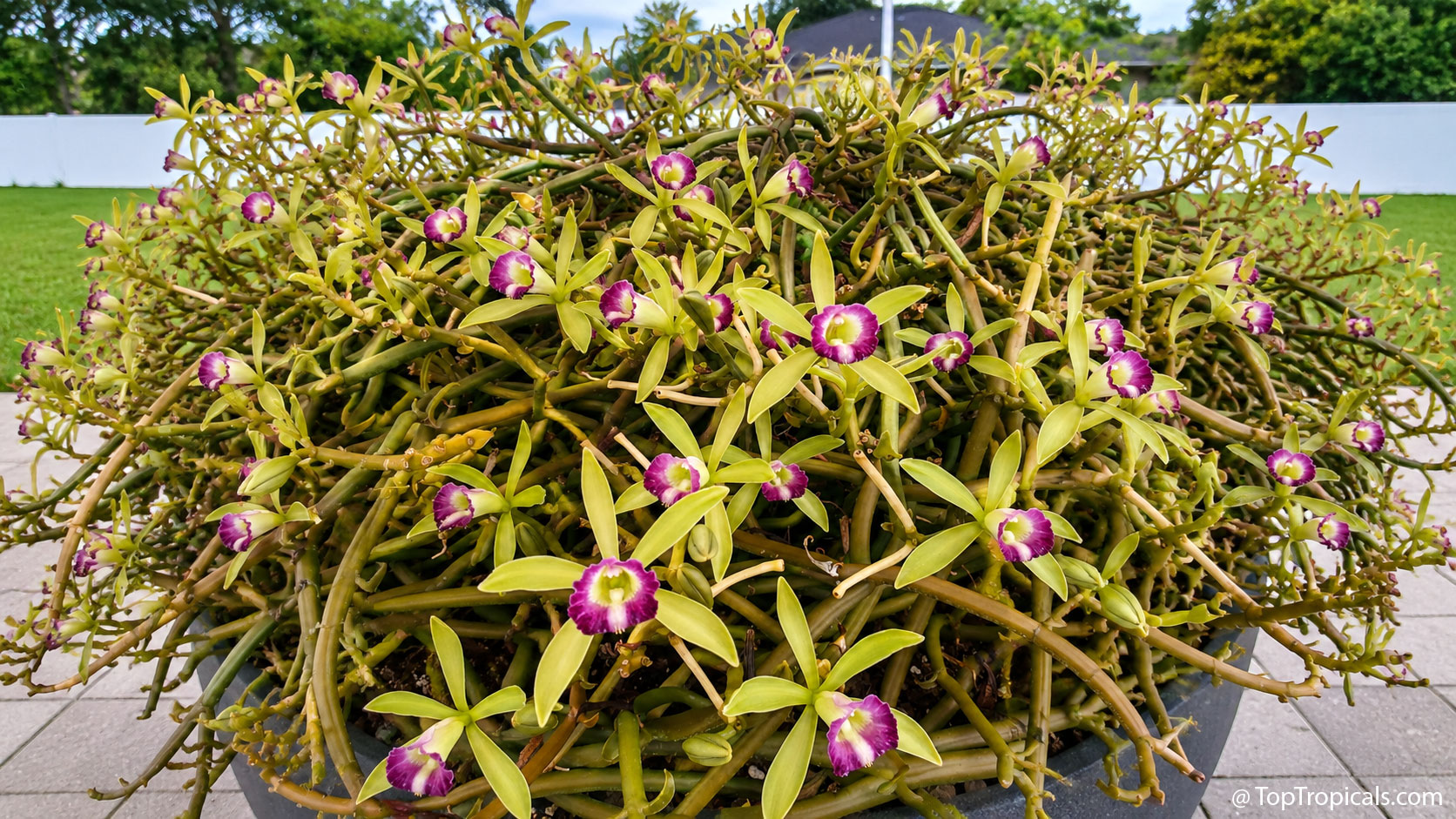
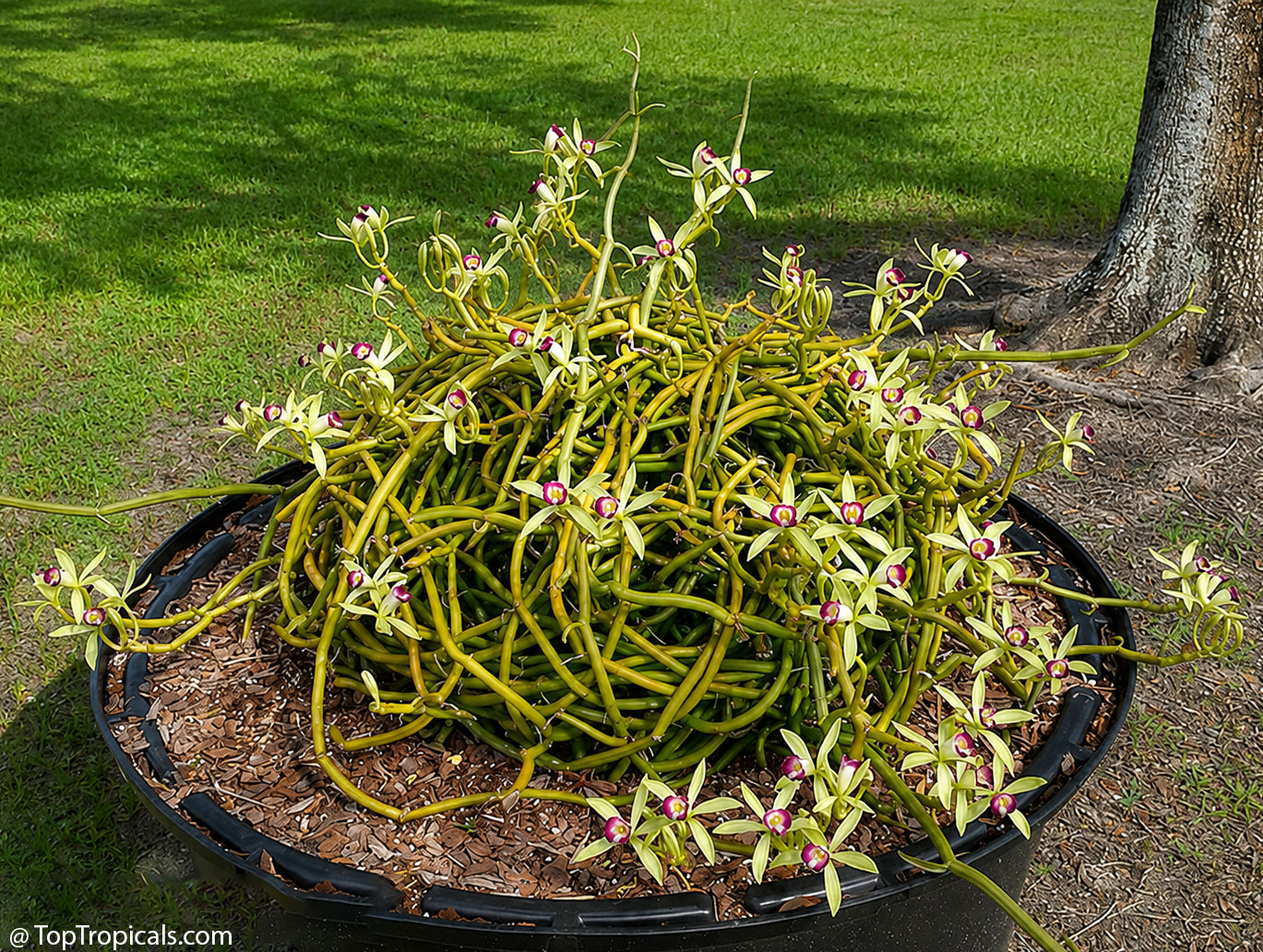
Close-up  of  the  Vanilla  dilloniana  mother  plant,  Intelligent  Design, 
 growing  in  a  100-gallon  container.  Hundreds  of  leafless  green  stems  weave 
 together  into  a  dense  mound  covered  with  pale  green  orchid  flowers  featuring
    vivid  purple  and  white 
 centers.

Vanilla dilloniana in full bloom before its next major upgrade.

Intelligent Design was grown and lovingly tended for years by Robert Riefer, a grower who is both a good friend of Top Tropicals and one of the most dedicated orchid collectors we know. The mother plant of this specimen traces its origins back to 1927 - nearly a century of continuous cultivation.

In 2011, the American Orchid Society recognized this remarkable plant with a Certificate of Horticultural Merit (CHM), one of the society's formal awards for plants of exceptional quality.

By 2017, the plant had already become well known in the orchid and tropical plant community, appearing in a video that documented Robert moving it into a 100-gallon container. That video became something of a legend among collectors.

🎥 Video: the biggest Vanilla Orchid in the world moving to 100 gal pot

Then the plant kept growing.

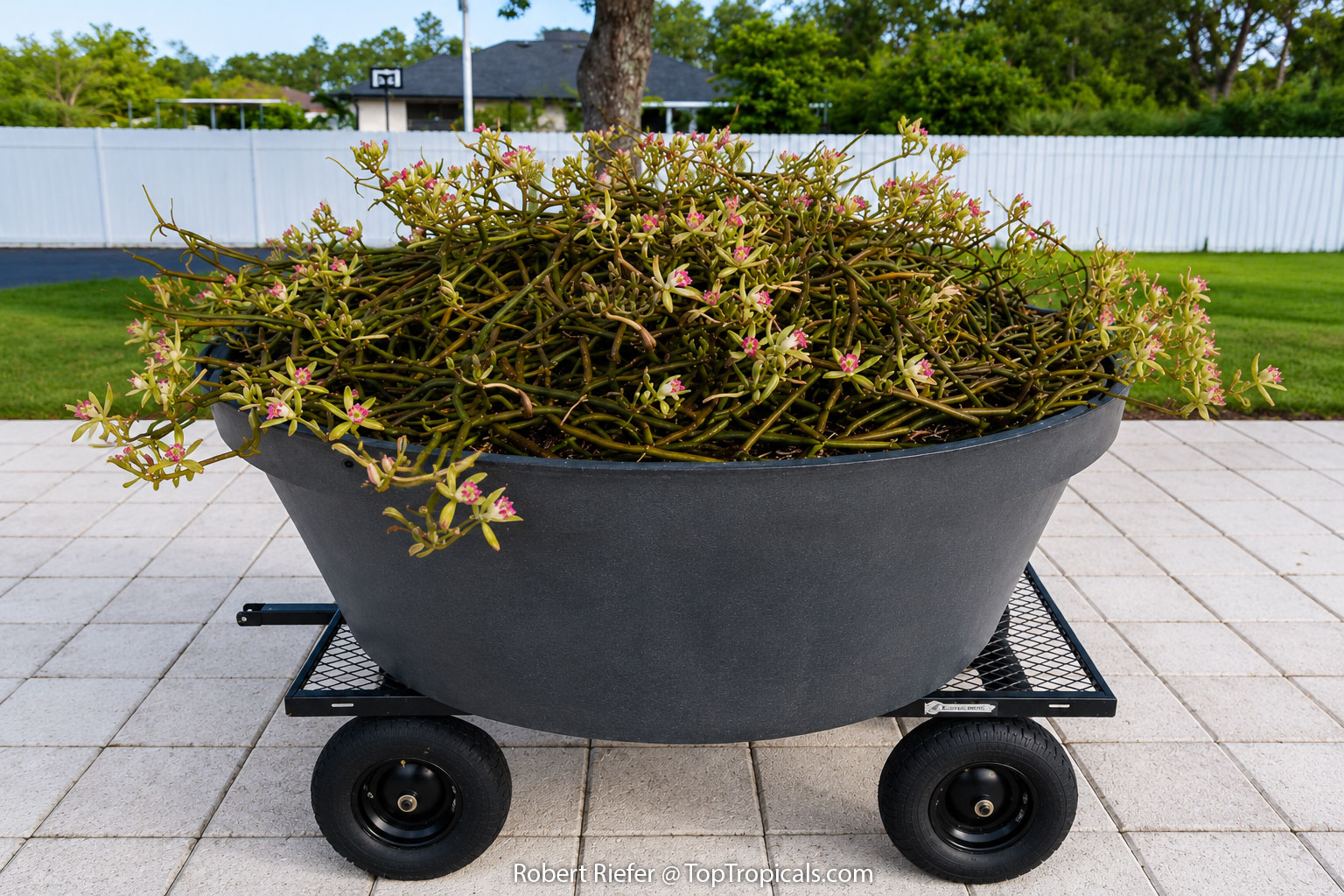
It outgrew the 100-gallon container. Robert eventually moved it into a 250-gallon pool on wheels - because when a plant refuses to stop, you give it room.

The  Vanilla  dilloniana  mother  plant,  Intelligent  Design,  growing  in  a 
 massive  250-gallon  container  on  wheels,  with  thousands  of  leafless  green 
 stems  forming  a  dense  mound  covered  in  small  orchid 
 flowers.

The move to a custom 250-gallon container allowed continued growth and flowering.

The plant is currently on display at Edison Ford Winter Estates museum and botanical garden in Ft Myers, Florida, during the month of June, where recent photographs show it larger and more floriferous than ever. It is, as best anyone can determine, the largest known cultivated specimen of Vanilla dilloniana in the world. If you are local or visiting Florida, don't miss the chance to see this world-famous orchid in person. It is expected to continue blooming through June.

And here's the remarkable part: the Vanilla dilloniana plants available from Top Tropicals are propagated directly from this exact plant - Intelligent Design itself.

🛒 Add Intelligent Design Vanilla to your collection

👉 A Piece of Living History - Direct from the Source

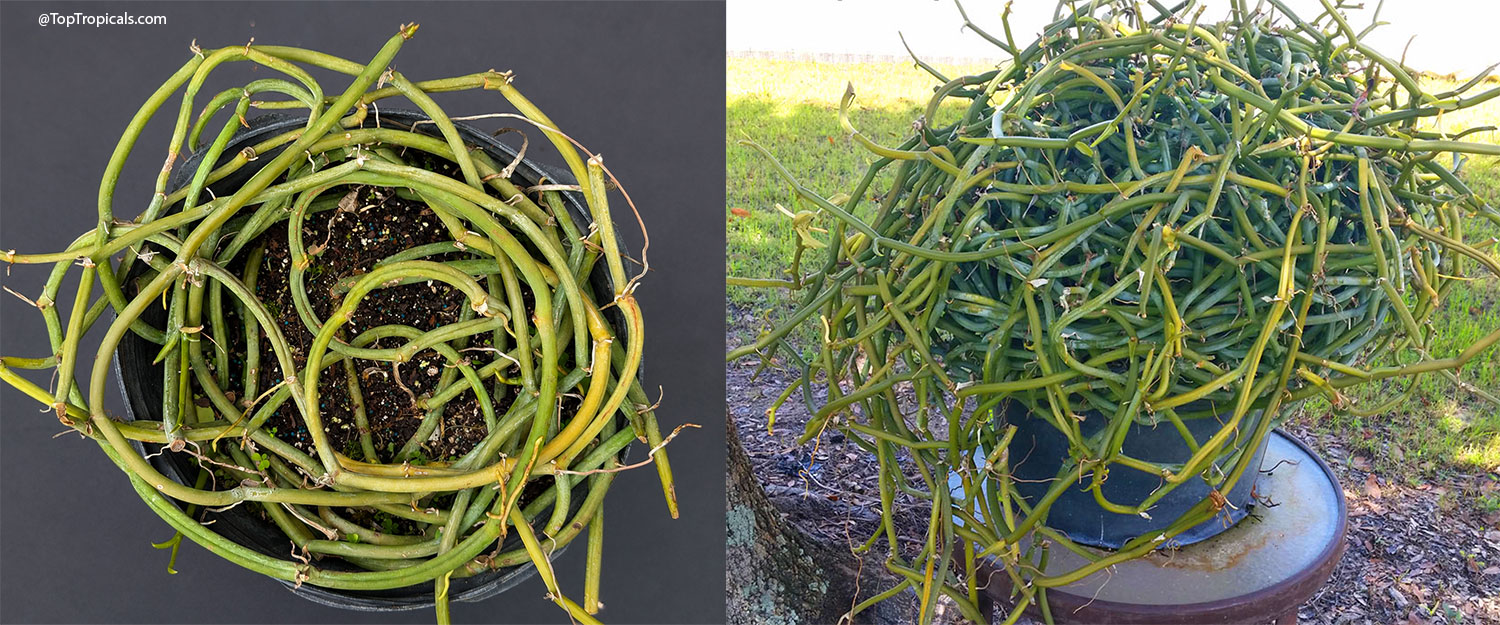
Young  Vanilla  dilloniana  plants  at  different  stages  of  growth,  showing 
 rooted  cuttings  trained  on  bamboo  stakes  in  1-gallon  pots  alongside  a  larger
    wrap-around  specimen  filling  a  7-gallon  container  with  thick  leafless 
 vines.

Every legendary Vanilla dilloniana starts somewhere. On the left are young Vanilla dilloniana plants. On the right is a more mature specimen in a 7-gallon pot beginning the characteristic wrap-around growth habit that eventually transforms this unusual orchid into a sprawling, sculptural giant.

Vanilla dilloniana is a rare species, considered vulnerable to endangered across parts of its native Caribbean range. Plants with documented provenance - especially provenance tied to a named, award-winning, century-old specimen - are genuinely uncommon in cultivation.

What you would be growing is a direct descendant of the famous Intelligent Design mother plant, carrying the same historic lineage recognized by the American Orchid Society.

For collectors, opportunities to acquire plants with this kind of documented history are exceptionally rare.

🛒 Start your own Vanilla Godzilla

Growing Leafless Vanilla

Large  specimen  of  Vanilla  dilloniana  growing  in  a  wide  container 
 beneath  a  tree,  with  a  dense  mass  of  leafless  green  vines  covered  in  unusual
    pale  green  flowers  with  purple 
 centers.

This is how the legendary Vanilla dilloniana mother plant, Intelligent Design, started its world-famous "Godzilla" journey in 50-gallon container. It's in full bloom, and its leafless stems form a living sculpture, dotted with dozens of striking orchid flowers that make this rare vanilla one of the most unusual cultivated orchids in the world.
  • Light: Bright filtered light is ideal. Morning sun is generally well tolerated. Avoid intense afternoon sun, especially during summer.
    Ideal: Dappled shade, eastern exposure, greenhouse conditions, or 30-50% shade cloth.
  • Temperature: Warm-growing tropical species.
    Best: 70-95F
    Protect below: 40F
    Not frost tolerant.
  • Cold Protection: In USDA Zones below 10, grow in a container and move indoors or to a protected greenhouse before temperatures drop below 40F.
  • Humidity: Prefers moderate to high humidity with good air circulation. Avoid cold, stagnant, damp conditions.
  • Watering: Water thoroughly, then allow the potting mix to partially dry before watering again. Do not keep constantly wet. In cool weather and winter, keep the soil on the drier side. Overwatering when temperatures are low is the most common mistake.
  • Potting Mix: Plant in a very fast-draining medium.
    Recommended: Top Tropicals Abundance Mix.
    The open structure allows excellent root aeration while retaining enough moisture for healthy growth.
  • Support & Growth Habit: Unlike most vanilla orchids that are trained vertically on posts or trellises, Vanilla dilloniana can be grown using the "Intelligent Design" method. Start with a sturdy support while the plant is young, then allow the stems to wrap around themselves in wide circles. As new growth emerges, continue guiding the vines around the container. Over time, the plant forms an impressive sculptural mound of intertwined stems.
  • Container Growing: Excellent for wide containers. The larger the mass of stems becomes, the more impressive the display and the greater the flowering potential. Unlike traditional vanilla culture, extensive vertical space is not required.
  • Repotting: Move to progressively larger containers as needed. Rather than growing upward indefinitely, the plant can continue expanding into a larger circular mass, making it well suited for long-term container culture.
  • Fertilizing: Feed lightly but consistently during active growth.
    Recommended: Sunshine Booster™ Orchidasm.
    Apply according to label directions every 2-4 weeks during warm growing weather. Reduce feeding during cool periods or when growth slows. Read our Guide to Sunshine Boosters™
  • Growth Rate: Moderate to fast under warm conditions. Established plants can branch freely and become surprisingly large over time.
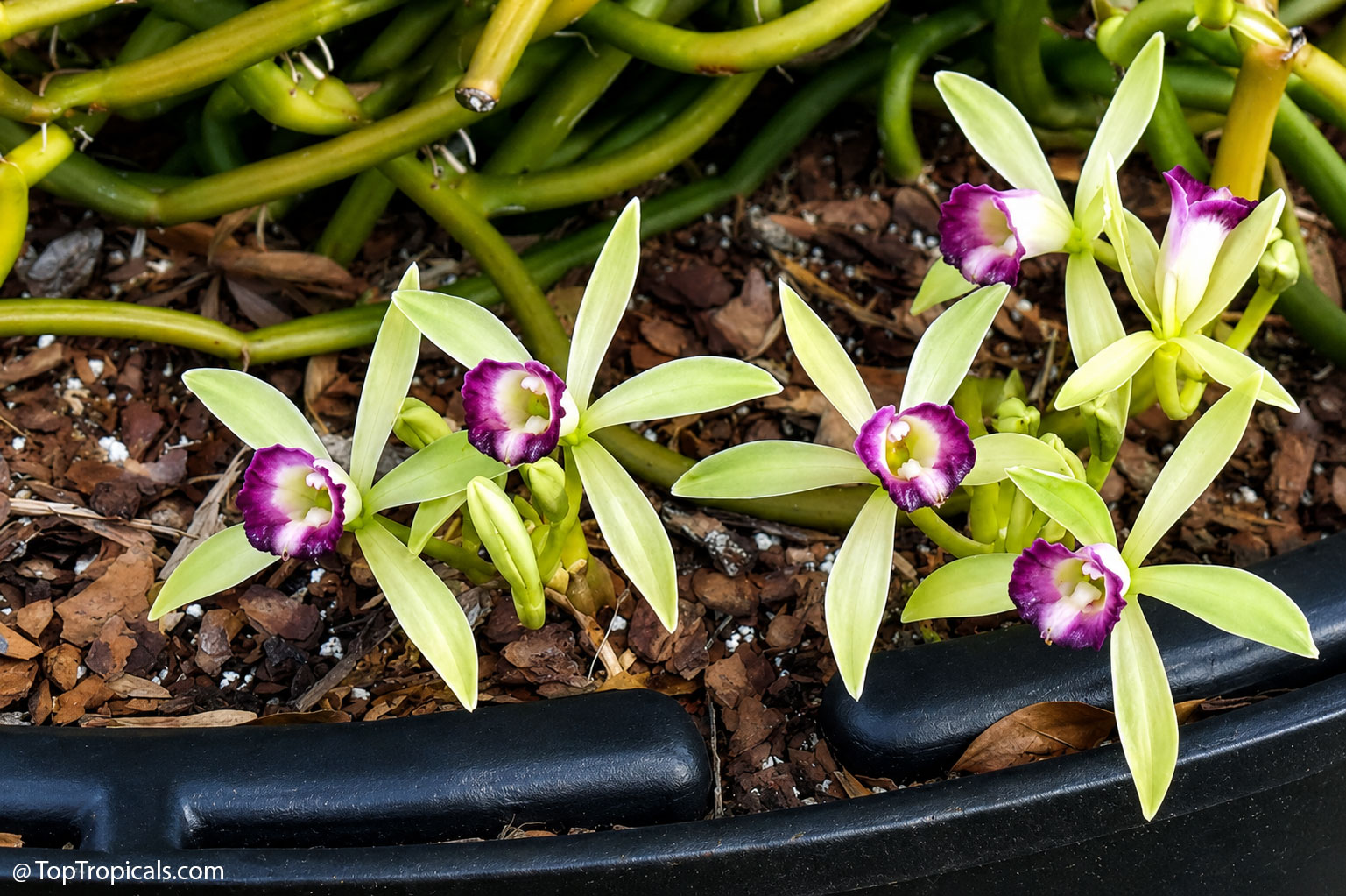
  • The Flowers: Pale green to yellow-green flowers with a deeply fluted reddish-purple lip and yellow crest. Mature plants in bloom are highly prized by orchid collectors.
  • Collector Appeal: Unusual leafless growth habit. Historic provenance. Highly desirable among orchid collectors.

Why Is It Called "Intelligent Design"?

Side-by-side  comparison  of  a  young  Vanilla  dilloniana  in  a  7-gallon 
 pot.  The  left  image  shows  the  plant  beginning  to  wrap  around  the  container, 
 while  the  right  image  shows  the  same  plant  later  forming  a  dense  ball  of 
 leafless  green  vines  as  it  continues  its  characteristic  growth 
 habit.

The making of Intelligent Design. As Vanilla dilloniana grows, its long leafless stems naturally wrap around themselves, creating a dense sculptural mass of living vines. Even in a 7-gallon pot, the plant is already beginning to develop the unusual growth pattern that would eventually make its famous mother plant one of the largest cultivated specimens of its species.

The famous mother plant was named Intelligent Design by its grower, Robert Riefer. After decades of growth, countless blooms, container upgrades, and an apparent determination to occupy every available square foot of greenhouse space, the name seemed increasingly appropriate.

Unlike commercial vanilla, Vanilla dilloniana is grown primarily as a collector's orchid. Its leafless, sculptural stems create a living tangle of green architecture unlike almost any other cultivated vanilla species.

Ready to grow this remarkable Vanilla dilloniana? Start your own chapter in the story of Intelligent Design.

📚 Learn more from our Blog

🛒 Order Legendary Leafless Vanilla Dilloniana

Close-up  of  Vanilla  dilloniana  flowers  blooming  along  the  edge  of  a 
 large  container,  showing  pale  green  star-shaped  petals  with  striking  purple 
 and  white  centers  against  a  tangle  of  leafless  green 
 vines.

The unusual flowers of Vanilla dilloniana emerge directly from its leafless stems, creating a stunning contrast of pale green petals and vibrant purple throats.
Smokey: We cannot guarantee that your plant will eventually require a 250-gallon pool on wheels.
Sunshine: We also cannot rule it out.
Smokey: Officially, we cannot confirm that the plant possesses intelligence.
Sunshine: The evidence is mounting.
Smokey: What evidence?
Sunshine: It convinced humans to build larger containers, move it into a 250-gallon pool on wheels, transport it to museum exhibitions, and place its agents in collections across the country.
Smokey: That's called excellent horticulture.
Sunshine: That's exactly what the Intelligent Design plant wants you to think.