Plumeria sp. 'Baby Bird' ('Baby Bird' Plumeria)
Botanical name: Plumeria sp.
Common name: 'Baby Bird' Plumeria
Cultivar: Baby Bird
Family: Apocynaceae
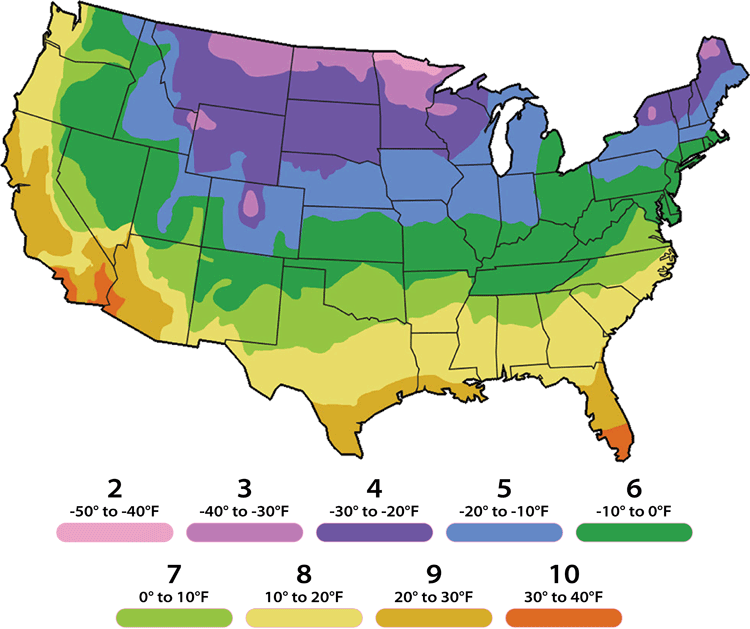
USDA Zone: 9b-11

 Plant form: Large bush or small tree
 Mature height: 10-20 ft
 Sun exposure: Full sun or bright light indoor
 Cold tolerance: Frost sensitive. Protect from freezing.
 Watering: Moderate
 Flower color: White and off-white; yellow, orange
 Suitable for: Outdoors in the suitable USDA zone; small gardens, containers, and indoor growing
 Foliage: Deciduous
 Fragrance: Fragrant; perfume plant
 Wildlife: Attracts butterflies and hummingbirds
Plumeria is a genus of tropical and subtropical shrubs and small trees in the Apocynaceae family, native to the Americas from Mexico and the Caribbean through Central America to northern South America. Named in honor of the 17th-century French botanist Charles Plumier, Plumerias are famous for their showy, strongly fragrant flowers, which occur in shades of white, yellow, pink, red, and numerous multicolored combinations. Plants have thick, fleshy branches and large leaves and may reach about 30 feet (9 m), although many cultivated forms remain considerably smaller. Most Plumerias grown in gardens are cultivars and hybrids selected for flower color, size, fragrance, and growth habit.
Flower clusters are produced at the ends of branches and may bloom for many months in warm climates. Many species and cultivars become partly or completely deciduous during the cooler or drier season. Plumerias grow best in full sun and sharply drained soil and are remarkably drought tolerant once established, while prolonged waterlogging can quickly damage the roots. Their broken stems and leaves exude a milky latex that can irritate skin and should not be ingested. Fruits, when produced, consist of paired elongated follicles containing winged seeds, although many cultivated plants set fruit only occasionally. Hardy in USDA Zones 10-12, Plumerias can also be grown in warm parts of Zone 9b in sheltered locations with protection from frost and freezing temperatures. They are excellent landscape and container plants and can be kept relatively compact through pruning.
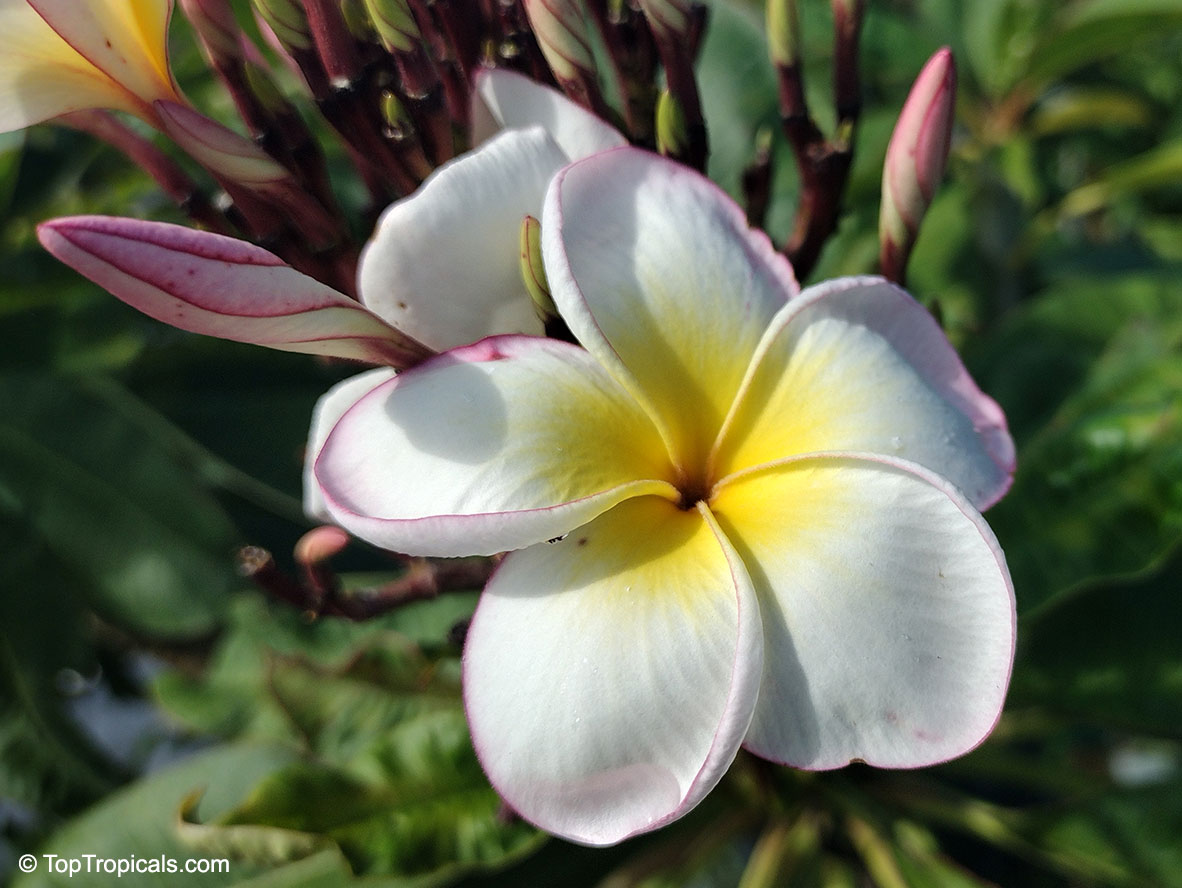
Plumeria 'Baby Bird' features creamy white petals with a soft yellow center and delicate pink edging, creating a light, airy appearance.
Related cultivars: Plumeria sp. 'Baby Bird' ('Baby Bird' Plumeria)
- Plumeria sp. ''Candy Stripe'' ('Intense Rainbow' Plumeria)
- Plumeria sp. ''Chompoo Orathai'' ('Chompoo Orathai' Plumeria)
- Plumeria sp. ''Elsee'' ('Elsee' Plumeria)
- Plumeria sp. ''First Kiss'' ('First Kiss' Plumeria)
- Plumeria sp. ''Golden Leaf'' ('Golden Leaf' Plumeria)
- Plumeria sp. ''Jeena Red'' ('Jeena Red' Plumeria)
- Plumeria sp. ''Kimo'' ('Kimo' Plumeria)
- Plumeria sp. ''Lai Namtan'' ('Lai Namtan' Plumeria)
- Plumeria sp. ''Lani's Beauty'' ('Lani's Beauty' Plumeria)
- Plumeria sp. ''Lueng Kob Chompoo'' ('Lueng Kob Chompoo' Plumeria)
- Plumeria sp. ''Moonlight'' ('Moonlight' Plumeria)
- Plumeria sp. ''Pink Border Leaf'' ('Pink Border Leaf' Plumeria)
- Plumeria sp. ''Poung Roi Hom'' ('Poung Roi Hom' Plumeria)
- Plumeria sp. ''Purple Toffy'' ('Purple Toffy' Plumeria )
- Plumeria sp. ''Sao Muangnon'' ('Sao Muangnon' Plumeria)
- Plumeria sp. 'Plumeria 'Sang Aroon'' ('Sang Aroon' Plumeria)
- Plumeria sp. 'Plumeria 'Thong Taweekun'' ('Thong Taweekun' Plumeria)
Similar plants: Plumeria sp. 'Baby Bird' ('Baby Bird' Plumeria)
- Plumeria alba (Dwarf Plumeria)
- Plumeria cubensis (Plumeria )
- Plumeria montana (Whita Plumeria)
- Plumeria obtusa (Singapore Plumeria)
- Plumeria pudica (Bridal Bouquet)
- Plumeria rubra 'Pink' (Frangipani)
- Plumeria rubra 'Yellow' (Frangipani)
- Plumeria sp. (Plumeria)
- Plumeria stenophylla (Frangipani)
- Plumeria tuberculata (Plumeria)