Garden Blog - Top Tropicals

Date: 24 Jun 2018

Growing Bougainvillea and Plumeria in Florida

Q: I have recently moved from New Jersey to Florida (Orlando area) and I am so excited to start my own Tropical Paradise Garden! A few years ago I visited Hawaii and saw many beautiful colorful Bougainvilleas as well as fragrant Frangipani. Do they grow well in Florida? These are flowers of my dream!

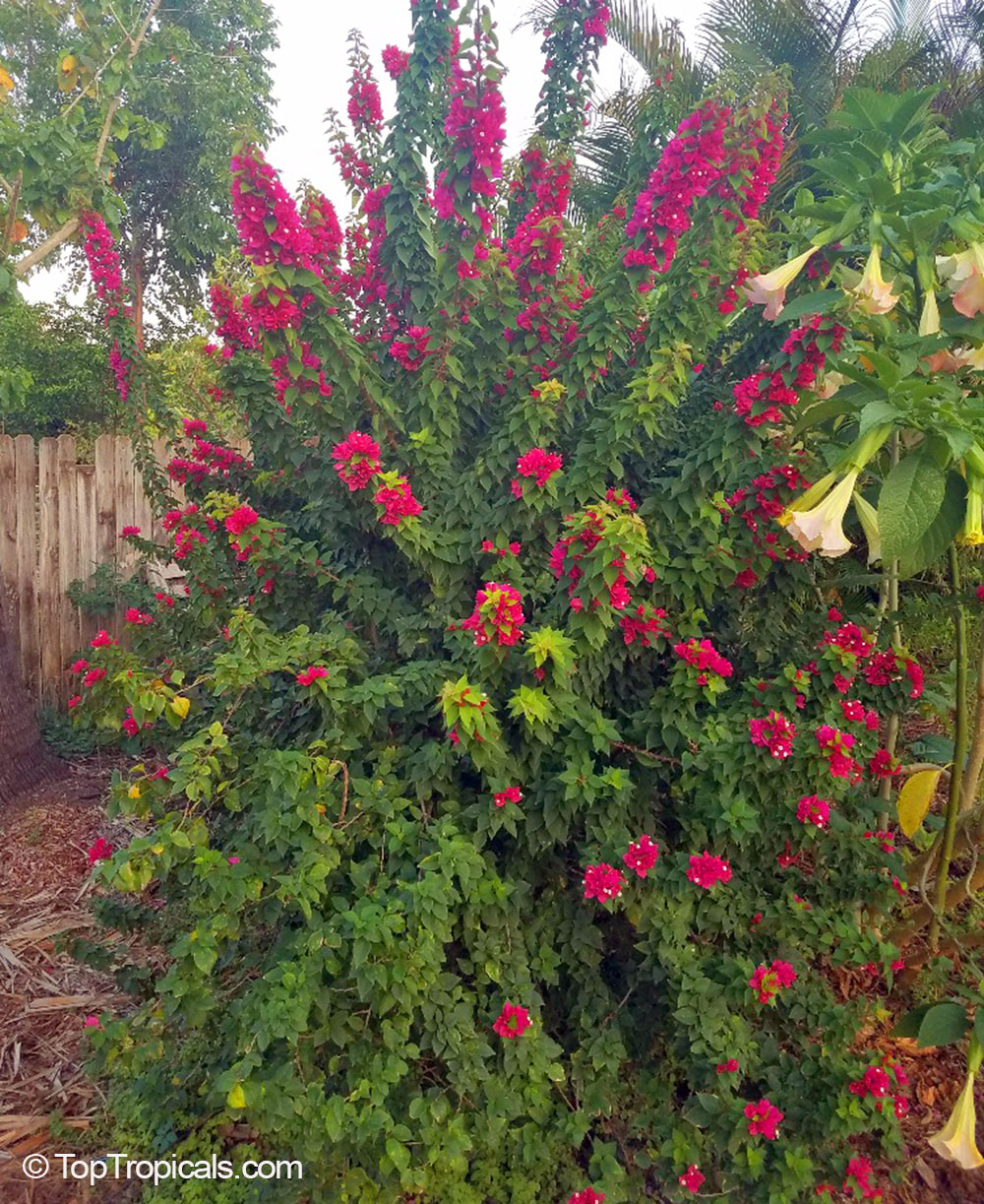
A: Both Bougainvillea and Plumeria grow well in most parts of Florida, especially South and Southwest. Bougainvillea can tolerate some light freeze and can be seen in the streets of Central Florida (young plants require some cold protection for the first year), so it is a very good candidate for your new garden. Keep in mind that unlike in Hawaii, where they bloom year around, Bougainvilleas tend to have a distinctive flowering season which in Florida is winter time - these plants enjoy dry weather that triggers their bloom. To enjoy Bright bougainvillea flowers for a long time, apply balanced fertilizer, prune regularly (this promotes flowering on new growth) and keep established plants on a dry side. Dwarf cultivar Pixie is super compact and can be grown in pots or in a small garden without any pruning! See photo of Pixie on the left.
Plumerias, all-time perfume favorites and symbols of Hawaii, are also residents of many gardens and collections throughout state of Florida. Their cold hardiness is close to the one of Bougainvillea, however keep young plants protected from frost. There are also many new exciting cultivars including multiple "rainbow" colors, and several dwarf varieties, some of them are evergreen - Plumeria obtusa. Plumerias are very undemanding and can stay happy and blooming in a pot and without regular watering. Give them as much sun as possible, and enjoy the fragrance for many months!
Date: 10 Apr 2016

Growing by the sea

Q: Please recommend me some interesting plants that can grow on my waterfront property and can withstand some salt wind. All my neighbors have Sea Grape trees and bougainvilleas, and I want something different and special. I would love to have some colorful or fragrant flowers, or fruit around my paradise home.

Q: Considering your neighbors successfully grow Sea Grape (Coccoloba), and Bougainvilleas, you have a mild, frost free climate. There is a number of spectacular and useful tropical plants that are salt tolerant. Orchid Trees - Bauhinias, Poincettia - Delonix, and Geiger trees - Cordias, are very showy flowering trees. For large size bushes, try Dwarf Poincianas - Caesalpinias, and Scarlet-Coral Erythrinas. Frangipani - Plumeria, come in different colors and bring you perfume fragrance from Hawaii. And of course, Desert Roses - Adeniums, can be grown and showy specimens anywhere in your yard, both in the ground or as potted bonsai.

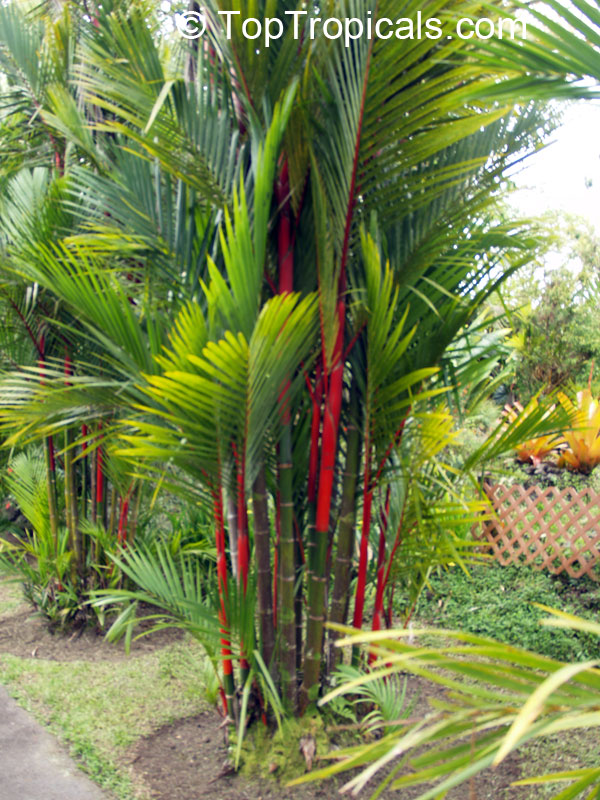
Most palms, especially popular Coconut Palm, source of tasty fruit and drink, are highly tolerant to salt breeze. If you are looking for something that nobody has, Lipstick palm, or Sealing wax palm - Cyrtostachys lakka, is definitely the most spectacular palm you can find. It is a stunning feather palm that develops a brilliantly red trunk. Palm is originally from Malaysia, but has been introduced to Costa Rica and other tropical areas of the world. Sealing Wax Palm seeds are very slow to germinate, up to a year, and large specimens are very rare and hard to find even in rare tropical plant nurseries. This palm will require a good overhead light, and constant warmth (above temperature 55F). It is definitely worth an effort to grow this beauty.

You may add more tropical accents to your landscape by the sea with many varieties of showy heliconias.

See full list of salt tolerant trees.

Date: 13 Jun 2017

NEW VIDEO!

This video is about Cananga odorata (Chanel No5 or Ylang-Ylang tree), history of the plant, legends, cultural meaning, perfume production, aromatherapy, cultivation. Everyone should own their own Chanel No5, and it's easy as 1-2-3 - just check out our Ylang-Ylang selection!

Stay updated with TopTropicals Videos by subscribing to our channel at YouTube.com/TopTropicals and get our latest video news of what's fruiting and blooming!

Date: 18 Jan 2017

10 plants that can make you happy.
3D garden ideas.

3D garden ideas.
Q:
Can you make my yard bigger and prevent it from freezing?

A: Yes, we can make your backyard bigger by adding a 3rd dimension - trees as a upper level, shrubs as a second level, vines in between, low growing perennials below them. Add ground covers and potted plants as separate specimens in between in-ground planted trees and shrubs. One more separate dimension is orchids and other epiphytes that happily grow on the trees. This multi-level structure will allow you not only collect so many plants, but also maintain them in a natural environment, similar to how they grow in a wild.

As far as preventing from freezing - it depends. You can use greenhouse, cover plants, create microclimate under large canopies, etc. Some tropical plants are tolerant to light frost, once established. If it gets below freezing in your area for more than a few hours, and especially if you have numerous nights with frost throughout winter, we recommend to keep plants in pots (BTW, this way you save space and can collect even more!). Pots can be moved to protected area during cold nights. The more established the tree, the more chances to survive colder temperatures. You may also use propane heaters during cold nights.
We also use plant booster SUNSHINE boosters to increase plants cold tolerance.
Cold protection is a lengthy subject. Here is some more information on cold protection. Also, we recommend to check out our magazine Tropical Treasures (about pushing the limits of tropical gardening) for a detailed article on cold protection.
These are specific articles on Zone-Pushing in different issue #s regarding dealing with cold. See downloadable issues:
(#1) Growing Tropicals in Nontropical Climate, Three Freezing Nights in Southwest Florida
(#2) Temperature drops - an alert or a rehearsal?
(#5) Dealing with cold snaps, Cold hardy beauties
(#7) When winter is around the corner, Growing exotic Cordyline in colder climate
(#8) When the weather outside is frightful
(#9) Winter champions
(#11) Ready-for-winter checklist for in-ground plants
(#13) Winter checklist
(#18) Dealing with cold damaged plants
You may also order hard copies.
If temperatures drop below freezing in your area, remember to add Heat Pack to your order!


10 plants that will make you happy.

Everyone wants to be happy. Did you know that growing plants is not only fun but can also make you happy? In our new series we will introduce to you 10 plants for your tropical collection that will make you happy.
Visit our Facebook, YouTube Channel and stay happy!

Check out this video: 10 plants that will make you happy. Plant # 1 - Rose Apple.

Stay updated with TopTropicals Videos by subscribing to our channel at YouTube.com/TopTropicals and get our latest video news of what's fruiting and blooming!

Date: 24 Oct 2016

Overwintering Adeniums outside of tropics

Q: We bought several adenium plants from you. We are moving to the Denver area of Colorado. How can we make sure the plants survive? Should we use a green house?

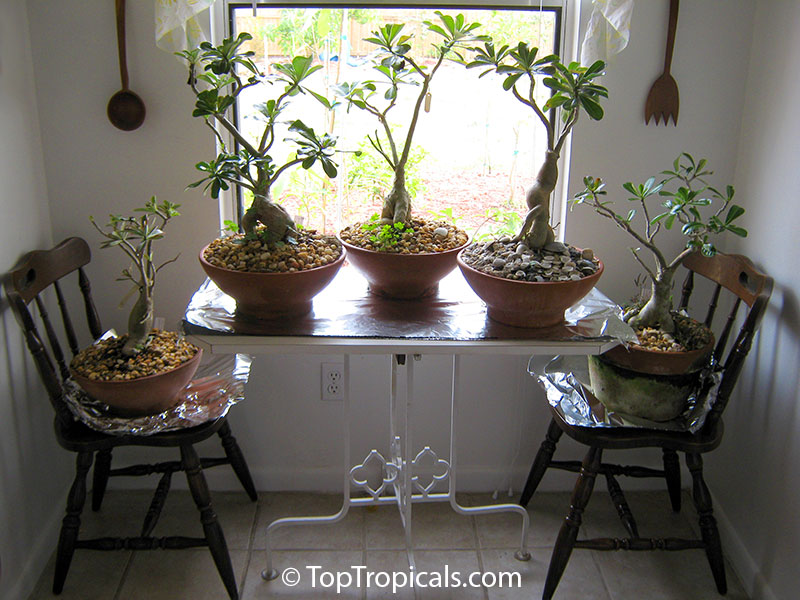
A: Adeniums are perfect container plants, and house plants. They can be easily grown outside of tropical climate. During winter, Adeniums drop leaves and go into dormancy which makes it easy to keep these plants in a dormant stage in a warm location of your house, or possibly even in well-lit spot of garage (with a window), with temperatures above 50-60F.
Here in South Florida, during time of cold, when chances of freeze are high, we move our own Adenium collection into lanai, with plastic sheet protection around lanai.

In colder climates, Adeniums can be kept indoors as house plants during winter. There are some requirements/tips for you:

  • Temperature. Move Adeniums indoors when temperature starts dropping below 45F.
  • SUNSHINE. Use SUNSHINE boosters to improve cold resistance of Adeniums, and essure healthy plant throughout winter. SUNSHINE-BC formula is specifically designed for plants with caudex, and bonsai.
  • Water. Reduce watering to minimum, especially when plants drop leaves - this means they went into dormancy. Once a week light watering is enough. Water very carefully during cooler months. When it is hot (85-100F), excessive water usually won't harm adeniums: it will be partially used by a plant, and partially will evaporate. Especially be careful with water when temperatures drop below 65F - then tropical plants simply stop growing process and go dormant. Once adeniums start losing leaves, this is a sign to reduce watering to once a week to once a month, and in very small quantity (couple tablespoons per pot).
  • Light. Bright light is not necessary, but do not keep them in dark either, even if all leaves dropped. Good light is necessary to maintain healthy stems and caudex. Keep in mind, the less light, the less watering too. Ideal spot is a windowsill, however if your space is limited and all windows occupied by other "leafy" plants, location close to window will be enough as long as watering is reduced, to avoid rot. We keep our big collection specimens on a roofed porch during winter, where level of light is very low. Last winter we haven't lost a single plant due to low light. They take shade pretty well considering minimum or no water. However bright light is always better - it creates healthier environment for a plant. We all know about space limitations for our large collections, especially in winter. So if you can afford a bright spot for adenium during winter - the plant will be lucky!
  • Soil. Use only well drained mix with much higher content of perlite than you would use for most tropical plants. For adeniums, we use mix with 30-40% of perlite in it, while regular mix has 10-15%. Adeniums like alkaline soil, unlike most of tropical plants (hard to say what else likes alkaline... Ficus for sure!). This means, regular mix with high content of peat moss may cause root rot. To increase alkalinity, you may add dolomite. Here in Florida where we have natural supply of shell rock handy, it is easy to add some shell to a potting mix (shell sand, rather than quartz sand). We always add a few large shells on top of a pots with a big specimen. Besides increasing soil pH (making it more alkaline), shells look very decorative.
  • Fertilizer. No fertilizer until Spring when plants start showing new growth and new leaves.
  • Move your Adeniums outside in Spring, when chances of freeze are zero. More sunlight and air circulation is beneficial for breaking the dormancy and providing plants with a quick growth start.