Garden Blog - Top Tropicals

Date: 19 May 2016

Care of mail-order plants during hot summer
Q: I live in California and about a month ago ordered several plants from you, including fruit trees (Carambola, Mango, Avocado) and flowering trees (Xanthostemon, Adeniums, Champaca, Ylang Ylang). They were all doing well until I tried to move them into full sun, when they got leaf burn immediately. Ylang Ylang was doing great in a shade, but I repotted it from 1 gal into 3 gal and it is drooping leaves now. It has been very hot (over 100F) and dry (humidity is less than 25%). Any suggestions?

A: Hot summer can be pretty challenging time for establishing new plants. These are some guidelines to make your summer gardening more successful and rewarding.

1. You can order plants at any time, but keep your eye on your local weather forecast and try to chose cooler periods to schedule your plant shipments. Here at TopTropcals we monitor weather at destinations, and we can also delay shipment per your request until more favorable conditions.

2. During hot Summer months, many plants are still OK to ship, and to be planted, many species are heat tolerant. It's usually safe to ship most succulents, including Desert roses and Euphorbias. Some fruit trees are pretty easy too, like Loquats, Mango, Eugenias. Many flowering trees can take heat: Acacias, Clusias, Jatropha, Sausage Tree, Plumerias and many others. Check our full list of plants suitable for hot and dry conditions. Most jasmines, including Jasmine Sambac and Trachelospermum make also a safe choice for hot weather planting.

3. Use shade cloth or simply white sheets to protect young plants and new plantings from hot sun.

4. When establishing mail ordered plants during hot weather, keep them in shade for longer period of time than average recommended 1-2 weeks. Give them a chance to establish really well. In areas with low air humidity, try to create a simple mist system. It can be purchased in your local Home Depot for only $20 and set up takes only 10 minutes! It makes a big difference and can help you save many plants from hot weather stress.

5. Although it may seem that during hot weather plants need more water due to high evaporation, be careful with watering, and check soil with your finger before watering - don't water if it is still wet. Combination of "hot and wet" can be as harmful for the root system as "cold and wet" during winter. Protect root systems from overheating: covering black pots with white cloth will work. Remember when temperature is above 90F, most of plants slow down their metabolism, which means roots slow down or even stop pumping water and become more vulnerable to overwatering. For the same reason, do not hurry to step up into bigger container if roots haven't filled yet the existing pot.
Date: 18 Oct 2016

Checklist - preparing for winter in subtropical areas.
Watering. Start reducing the amount you water your plants in early fall, once the temperature drops below 65 °F. Avoid watering your plants during cool nights, as this may cause serious root rot.
Mulch. When a plant is protected by a thick layer of mulch, the root system stays healthy.
No Pruning. Avoid pruning, trimming, or pinching branch tips altogether during the fall and winter which encourages new shoots that are soft, tender, and very cold sensitive.
No Fertilizer. Avoid fertilizers during the winter. The main reason being the same as above for pruning: fertilizing promotes growth of the upper plant parts which should be avoided during the winter months.

Time to clean your yard!
In the South. It's getting cooler in subtropical areas, and garden work becomes even more enjoyable. Your garden now is in the most perfect shape after summer vigorous growth. It is the best time now to run the last trim before winter, as well as last fertilizer application. Clean up your yard without sweating off, add mulch to help plants to survive through possible winter chills. Don't forget to start reducing watering! Remember once temperatures drop below 65F, tropical plants slow down or stop growing and go into winter dormancy sleep.

Up North. When temperatures drop below 45 °F, start bringing sensitive plants indoors or into protected areas. Prepare/cover greenhouse, check availability of covers (sheets, plastic) and condition of heaters. Plants indoors will experience environment change, may drop leaves, and need different care than out in the sun. Reduce watering, check for insects once a week, and stop fertilizing until spring. Remember to pick the brightest spots for overwintering your tropical plants!

Enjoy cooler weather, fresh air, and thank yourself for a wonderful work you have done in your yard!

Date: 19 Aug 2016

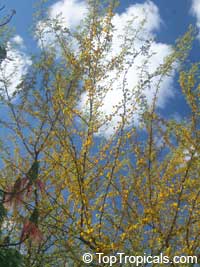
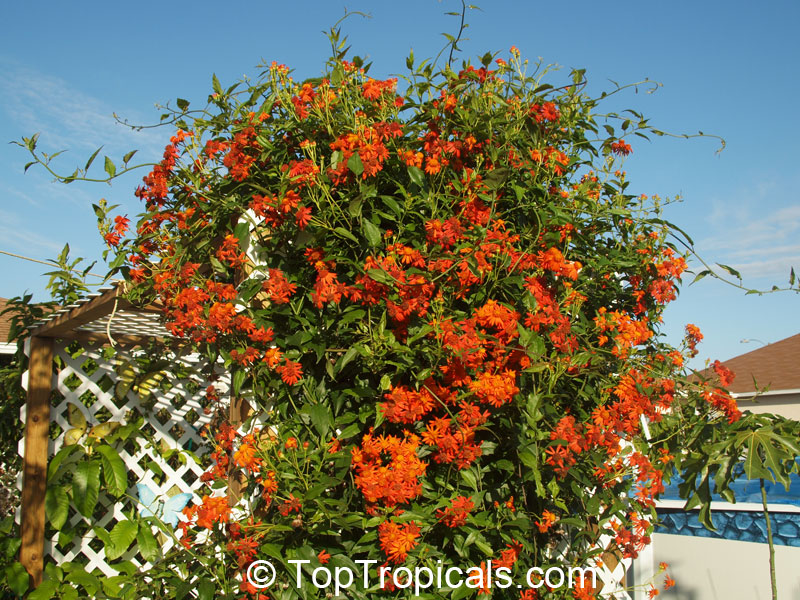
Growing Mexican Flame Vine as an annual

Q: While down in Fort Myers a few years ago, I saw this plant - Senecio confusus or Mexican Flame Vine, growing over chain-link fencing. At any rate, I fell in love with the plant then and there, only to later see it up here in Wisconsin, albeit down in Madison at The Centennial House, a noted botanical garden. This has led me to believe it may be possible to use this plant up here in the north as an annual. I could really use the orange coloration in mixed containers, etc. What I would like to try to find out is, will it grow and flower sufficiently within one of our growing seasons up here to make the choice worthwhile? Again, seeing it at Centennial House at least leads me to believe it may be possible. China where the flower was admired for its beauty and believed to have medicinal properties that promoted good health and long life. The Japanese Emperor was so smitten with the kiku flower that he adopted it as his personal crest, and it remains the insignia of the imperial family today. The art of growing and displaying Kiku for the Emperor's garden represented by amazing Imperial styles: Ozukuri, Ogiku, Kengai... Imagine growing out of one stem a single chrysanthemum trained to produce hundreds of simultaneous blossoms in a massive, dome-shaped array.

A: Mexican Flame vine is a good candidate to be grown as annual, thanks to these features:
- extremely fast growing
- it flowers in small size and young age
- long flowering period (2-3 months depending on conditions), throughout early Spring into Summer, sometimes it has a second blooming season by end of Summer.
- we keep large mature plants in stock year round, so you can have blooming size specimen as early as spring once your temperatures reach 65F so the plant will feel comfortable and develop quickly.
- easy to propagate - more plants can be made for next year season.

In winter, a potted plant can be cut back and kept in semi-dormant state indoors - garage, enclosed patio, with temperatures around 50F and above. Some gardeners from North prefer to plant a tropical specimen with a pot into the ground (make sure to add extra drainage holes), and when winter comes, it makes it easier to dig it out and save till warm season.

Date: 14 May 2016

Top Tropicals Video: Ambarella - delicious June Plum

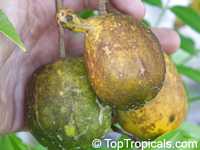
Golden Apple, or June Plum - Spondias cytherea.

This exciting fruiting plant will amaze you with its ability to flower and fruit at a young age. It fruits in winter and holds the fruit up to 6-8 months, long after the leaves have dropped. The fruit appears in pairs and will turn a brushed-golden color as it ripens. Its feel and juiciness resembles that of a mango but with completely different flavor. The Golden apple is used both in sweet and savory dishes depending on its ripeness. When green, the fruit is commonly eaten as is (with or without skin just like green mangoes) with salt and other salty/spicy dips, made into salsas, chutneys, and into juices and smoothies. When fully ripe, the Golden Apple will be deep yellowish-orange in color. When yellow, the fruit is eaten just like an apple or stewed with sugar to make an applesauce-like dessert.

Check out this video: Ambarella - delicious June Plum...

Stay updated with TopTropicals Videos by subscribing to our channel at YouTube.com/TopTropicals and get our latest video news of what's fruiting and blooming!

Date: 5 Apr 2016

Jungle on Windowsill 101

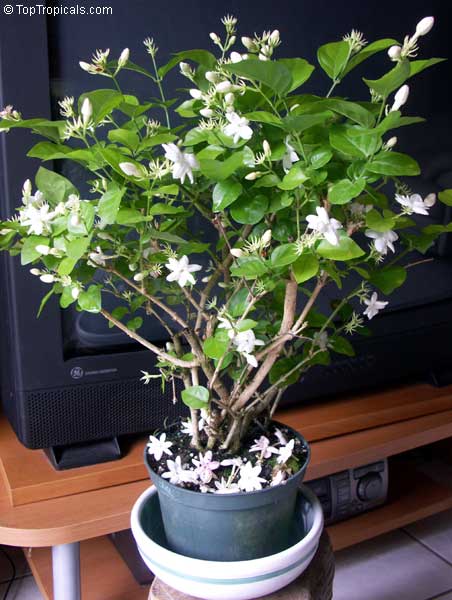
Q: I got a Jasmine Sambac and a Tahitian gardenia as presents, they are very cute plants with flowers and flower buds. I would like to be able to keep them alive and hopefully happy for a long time, but I don't know much about growing tropical plants, and I am not sure if my thumb is green enough to make everything right. What do they need? How much sun? How much water? What kind of soil? Sorry for all these (maybe silly) questions, but I want to keep them alive, please help! I live in Wisconsin and we had some snow again last week.

A: Growing tropicals is not a hard work, it is a lot of fun! These plants are actually a good starters for a beginner who wants to try growing tropical plants, no matter if you live in a mild frost-free climate, or up North where you can have these beauties as houseplants. Below are a few simple steps for you:

1. Read. Follow planting instructions included with your plants. Check plant names on the tags and learn more about them from our online catalog.

2. Soil. Plant in quality potting mix - it must be porous and well-drained, never use heavy soils (top soil or garden soil are no-no), in a pot exactly the size of the root system. You can step up your plants in the next size container once you notice vigorous new growth. Next size means: 4" pot can go into 6" pot, 6" pot into 10" pot, etc. Too big of a pot may create rotting environment, root system must fill the entire container to use all the moisture from the soil. Container must have good hole(s) for excess water to drain through. Put the pot in a saucer and get rid of excess water every time after watering.

3. Light. Most tropical plants require lots of light in order to produce flowers. If you ever visited Florida, remember the bright sun? - these are ideal light conditions for tropicals. Up North, provide as much light as possible: a bright spot on a windowsill of Southern or Western exposure would work the best. If the sun gets too hot in summer afternoon, you may shade the window a little bit with a sheet of white paper to avoid leaf burn.

4. Water. Keep soil slightly moist but not soggy. The best way is to wait until the top of the soil feels dry to touch - this is time to water again. Jasmines prefer to stay on a dry side; gardenias do not like soil to dry out - keep them slightly moist as long as soil is very porous and well-drained. The main reason of most problems with potted indoor plants is over watering. With experience, you will feel the right balance of moisture in the soil: the brighter the light, the more water is consumed by a plant; the less light, the less frequent you should water.

5. Trimming. In low light conditions, plants tend to become leggy. Trim branches as they become too long: the more you trim, the busier the plant gets. New growth promotes more profuse blooming in many species.

6. Fertilizing. Fertilize indoor plants with slow-release granulated fertilizer from march to November.

7. Insects. Check for insects at least once a month, especially underneath the leaf. If notice any problems (deformed leaves, residue, holes, or tiny insects) - clean the leaves/stems with a solution of warm water (1 cup), vegetable oil (2 table spoons), and a few drops of a dish soap.

8. Fresh air and air humidity. As soon as air temperature gets above 65F, bring your tropicals outside in the sun and fresh air: porch, balcony, outside in the yard. Air circulation is essential for your plant health. Bright light and high air humidity will promote vigorous growth, and lots of flowers for you to enjoy!

For more information on growing Tropical Plants 101, see Problem solving with potted plants - how can we help them?.