Garden Blog - Top Tropicals

Date: 28 Jul 2016

Musings of a butterfly gardener about the milkweed bug

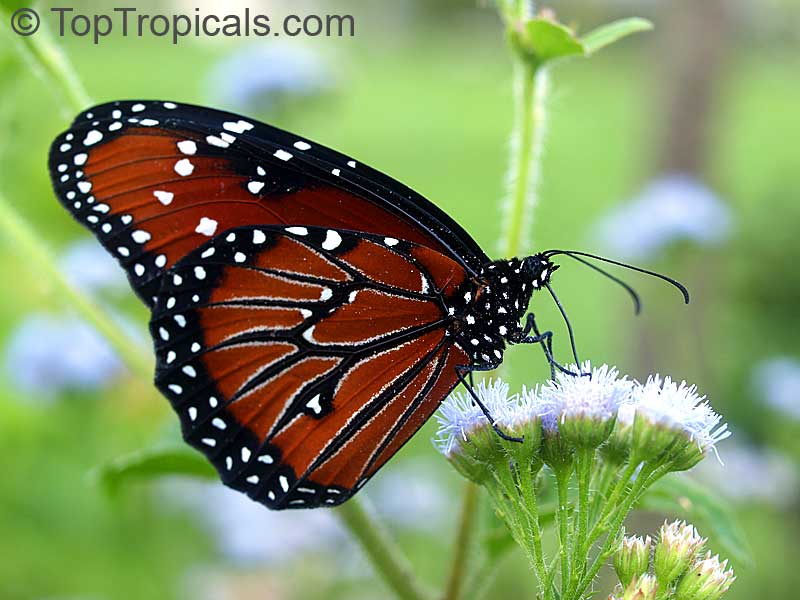
By Kevin Piotrowicz, FL. This spring I was excited! My milkweed was blooming and going to seed. I have 3 healthy clumps of it, each one with seed pods. I counted the seed pods at one time... 22... I had 22 seed pods on 3 plants! Could it be possible? Could I finally have reached the point that I had a sustainable amount of milkweed growing that  would not be decimated by monarch caterpillars?

I was telling my friends, "My milkweed is growing great! I may be able to support a population of monarchs!" There were even a couple of them flying around the yard, landing on the milkweed, and frolicking amount the wax myrtle.

With great joy I watched 3 monarch caterpillars munch on my milkweed. The small plant colony even survived as the caterpillars pupated. Not only survived, it expanded! More shoots came out from the bases of the plants! More flowers! More seed pods! All was right with my garden. The zebra longwings and gulf fritillaries had new friends to play with... But what's this??? ... Continue reading...

Click here to see for full list of butterfly attractors currently available for sale, with 15% OFF! See also Complete Alphabetical list of plants that attract butterflies and hummingbirds (very long list).

Date: 23 Jul 2016

Leo Zodiac lucky plants

Leo - 7/23-8/22. Naturally, Leo is a FIRE sign ruled by the brilliant Sun. Leo's plants are usually large and gold or orange in color, have heart-shaped leaves or a radiating shape, or have association with victory (like the Bay Leaf). Leo loves this colorful and special spice, which is known for amplifying prosperity and abundance.

The part of the body ruled by Leo the Lion is the heart. Plants related to Leo are primarily associated with the cardiac system, but also with the spine, the thymus gland, and the eyes. They strengthen and tone the heart, regulate blood pressure, raise the spirits and have an uplifting effect. Keep in mind that all cardio-active medicinal herbs should be used only in consultation with a qualified professional.

Leo Zodiac lucky plants: Sunflower tree, Delonix, Hibiscus, Abutilon, Mahoe, Hawaiin Sunset Vine (Stictocardia), Campsis, Passion flower, Calendula, Mexican Flame Vine, Bay Leaf, Safflower, Mint, Rosemary, Ruda - Ruta graveolens, Marigolds, Sunflowers, Palm trees, Lemon and orange trees, Grapefruit, Dieffenbachia , Croton, Lemon Balm, Chamomile, Tarragon, Kaligottu (Stereospermum chelonoides), Bel Fruit, White Madaar, Peppers, Pineapple, Coconut, Anise, Heliotrope, Gingers, Lavender, Ashoka Tree, Dombeya, Jacquemontia, Lychee, Mulberry, Philodendrons, Macaranga, Anthuriums, Aphelandra, Orchid trees, Leonotis.

For other signs information, see full Plant Horoscope.

Date: 20 Jul 2016

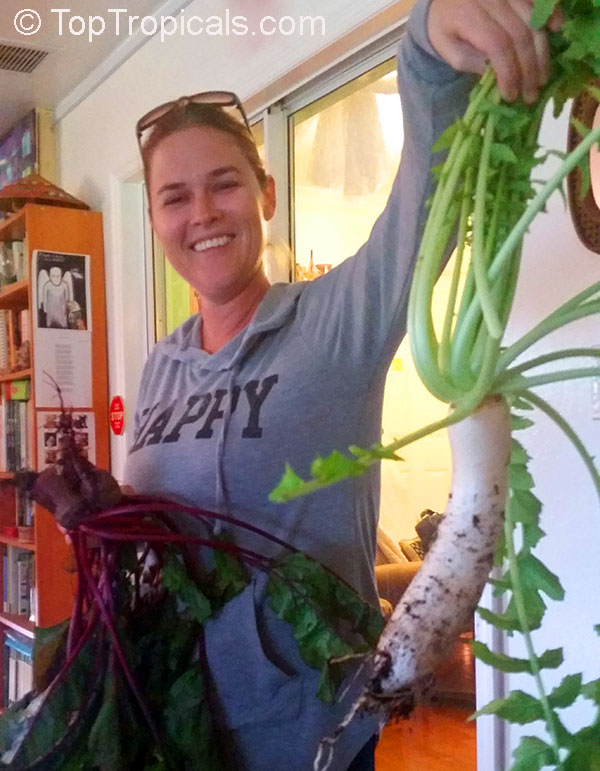
Forget the gym and get to gardening?
Calories Burned Gardening
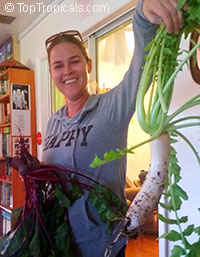
Fun workout? We never have enough time to go to the gym or do an exercise so it's good to know that just doing something that you love can give you a workout. We all know that when we are out in the garden it gives us a bit of exercise but we do not realize how much exactly. Working out in the yard is a healthy hobby for many reasons, the high number of calories burned gardening being one of them. When you do this kind of physical labor, you carry out a wide variety of movements that most definitely burn calories, and may even tone. The best part about it in terms of physical activity is that if you enjoy yard work at all, you aren't watching the clock or counting down the minutes until you are done (the way that many people do while they are on a treadmill). You can easily spend a whole afternoon or an entire day working without feeling as though you are putting yourself through a mentally grueling workout. Finding physical activities that you enjoy are key to maintaining a healthy weight throughout your lifetime, and this hobby is a perfect example of that scenario for many people.

Research says that three hours of gardening can have the same effect as an intense 1-hour gym session. The study was carried out with a group of 100 gardeners who were asked to monitor the amount of time spent doing a series of common gardening tasks over a four week period. Gardening tasks that were monitored included weeding, digging, mowing the lawn, hedge trimming, trimming shrubs and trees, raking, planting shrubs, and moving garden waste using a wheel barrow. Here are some facts and numbers:
- Just doing half an hour weeding can burn up to 150 calories and tasks that handle heavy electrical equipment such as hedge trimming will give you a good workout burning 400 calories per hour.
- Spending a day or five hours each week in the garden will burn up to around 700 calories
- Over a gardening season that works out at 18,772 calories per year, equivalent to running seven marathons
- The gardening hobby could help burn a million calories over a lifetime.

Calories burned with only 1 hour of:
340 cal - Chopping wood, splitting logs, gardening with heavy power tools, tilling a garden, chain saw. Mowing lawn, walk, hand mower. Shoveling by hand.
272 cal - Carrying, loading or stacking wood, loading/unloading or carrying lumber, digging, spading, filling garden, composting, laying crushed rock or sod. Clearing land, hauling branches, wheelbarrow chores.
238 cal - Operating blower, walking. Planting seedlings, shrubs, trees, trimming shrubs or trees, manual cutter. Weeding, cultivating garden.
224 cal - Raking lawn, sacking grass and leaves
136 cal - Picking fruit off trees, picking up yard, picking flowers or vegetables. Walking, gathering gardening tools.
102 cal - Walking, applying fertilizer or seeding a lawn
34 cal - Watering lawn or garden, standing or walking

Sources: DailyMail, CalorieLab, FitnessBlender.
Date: 12 Jul 2016

RARE AFRICAN GINGERS

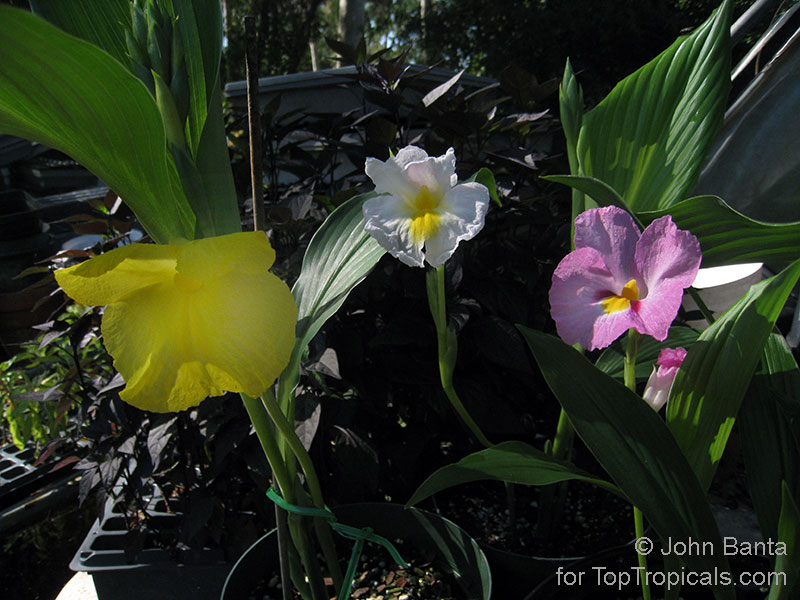
By John Banta. The rarity of African gingers is only matched by their beauty. The rarest, and most costly is the remarkable blue flowered, Siphonchilus beachystemon. It was discovered in Kenya in 1957 by an English tourist. It reminded her of the beautiful blue Himalayan poppy, Meconopsis grandis, she often admired at the Edinburgh Botanical Garden so she had her guide collect a plant or two that she took back to Edinburgh. The few plants available in horticulture today come from that original collection over 50 years ago. Fortunately there are about 15 species of Siphonchilus found in Africa and some of most outstanding ones make grand additions to our gardens. Listed in order of their vigor and availability they are:
Siphonochilus decorus. The large butter yellow flowers only last for a day but they continue to develop for weeks. In Zimbabwe it is considered one of the outstanding native plants. It is closely related to the next ginger and forms hybrids with it that are usually sterile. Read more...

Date: 7 Jul 2016

Growing fruit trees in containers

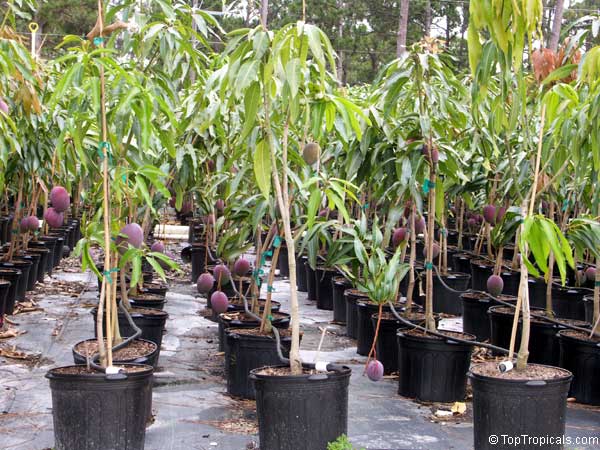
Will it fruit in a pot? YES! Many tropical fruit trees can be grown in a pot. We get many calls from customers in cooler climates asking if our tropical trees can grow and fruit in a pot. The answer is yes!

Several plants fruit well in pots. Blackberries and raspberries, barbados cherries, blueberries and many more start fruiting even in their 1 gallon containers. We are especially excited about our new Pixie grapes, which are heavily laden with grapes even at only a foot long!

While some plants are small and will fruit easily in a container, others are large trees. For the tree type fruits, we recommend growing only non-seedling plants for pot culture. We have cuttings, air layers and grafted plants that are great options. These have the ability to fruit right away, as they are the same age as the parent tree. Some horticulturists recommend removing the first year fruit to allow the plant to focus on growth and establishing. If the plant is being kept in a pot, this is not necessary.

We also have several dwarf varieties of fruit trees that will thrive in a pot. For avocados, we carry the Wurtz variety which is a dwarf tree... read more...