Garden Blog - Top Tropicals

Date: 22 Apr 2026

Secrets of Real Mango Flavor

Top-down  view  of  a  white  tray  filled  with  assorted  mango  varieties  in 
 different  shapes  and  colors,  including  green,  yellow,  red,  and  orange, 
 arranged  outdoors  on  a  textured  surface.

A colorful mix of mango varieties - different shapes, colors, and flavors all in one harvest.

Mango Plant Facts

Botanical name: Mangifera indica
Also known as: Mango
USDA Zone: 9 - 11
Highligths Large tree taller than 20 ftSmall tree 10-20 ftFull sunWatering: Moderate. Water when top soil feels dryYellow, orange flowersPink flowersEdible plantSeaside, salt tolerant plant
Get personalized tips for your region

Mango Practical Growing Tips (Keep It Simple)

  • Sun: Full sun is key. 6–8+ hours daily for best growth and fruiting.
  • Soil: Excellent drainage is critical. In pots, use well-draining mix with added perlite or sand. Mango does not like wet roots.
  • Watering: Water deeply, then let soil dry slightly before watering again. Avoid constantly wet soil.
  • Containers: Excellent for pots. Condo mango varieties stay compact and are easy to manage on patios.
  • Feeding: Light but consistent feeding during active growth makes a big difference. Use controlled-release Green Magic for steady nutrition, and supplement with liquid Sunshine Boosters Mango Tango during warm months to push growth and fruiting.
  • USDA Zones: Best suited for Zones 9b–11. In Zone 9b, choose a warm, protected microclimate (south-facing wall, patio, or near structures) and be prepared to protect during cold snaps. In Zones 10–11, mango grows reliably in-ground. If you live in colder zones, grow in a pot so you can move the tree indoors or protect it during cold weather.
  • Cold Protection: Protect young trees during cold nights. Use cover or place near a wall or warm microclimate. Mature trees are more tolerant.
  • Airflow: Good airflow helps prevent disease and keeps growth clean.
  • Spacing: Give the tree room for light and airflow. Even compact trees benefit from space.
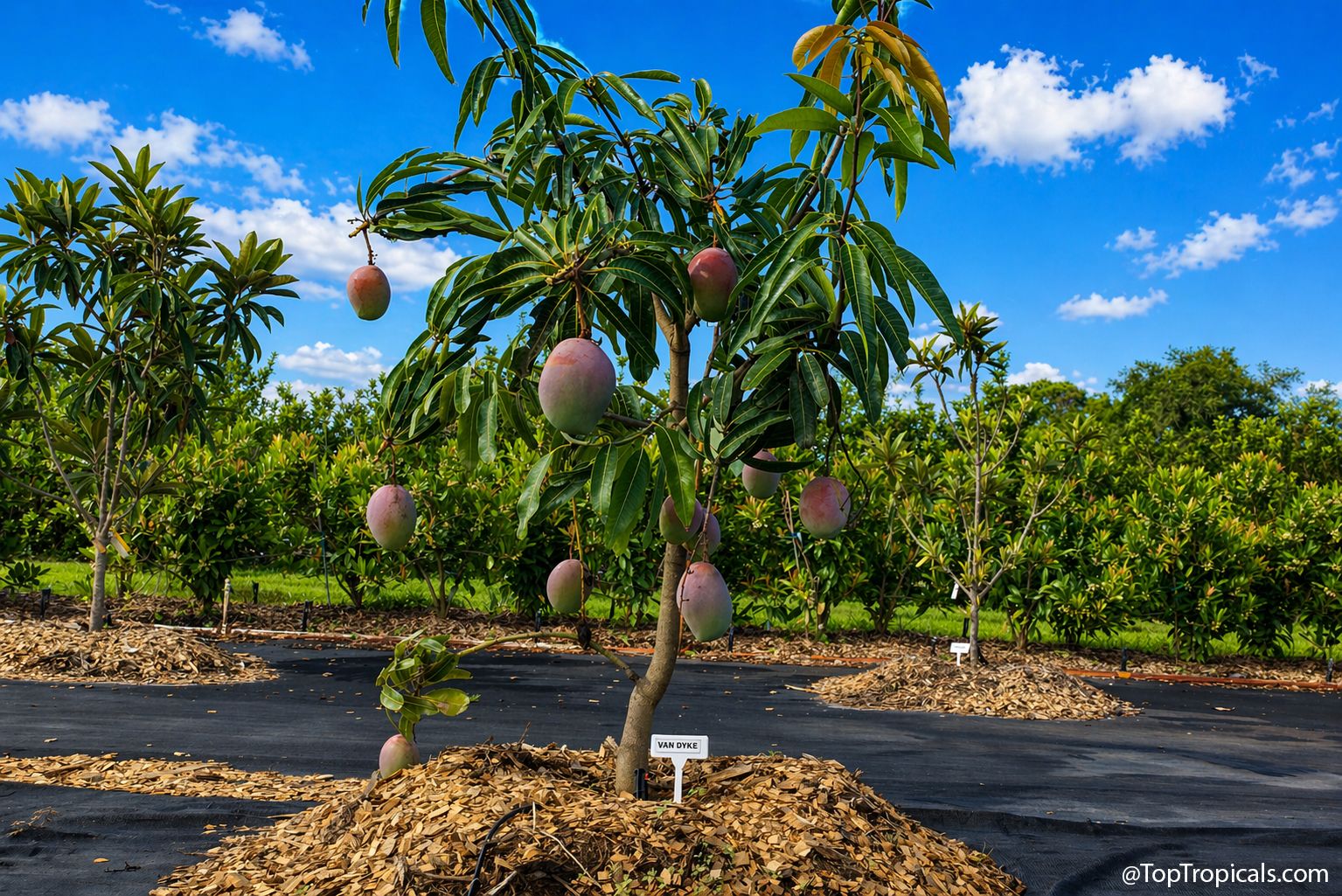
Mango  tree  Van  Dyke  growing  in  an  orchard,  loaded  with  ripening  mango 
 fruits,  surrounded  by  mulch  and  irrigation,  under  a  bright  blue  sky  with 
 scattered  clouds.

A fruiting mango tree Van Dyke in the grove, heavy with developing mangoes and enjoying full sun.

Mango Winter Care (Very Important)

Mango is not a truly cold-hardy plant. It performs best in USDA Zone 9b and warmer, where freezes are rare and short. In borderline areas, winter protection becomes part of the routine. Mango trees should be covered during cold nights, and planting near a south-facing wall helps protect from cold winds. That small microclimate can make a real difference. If your winters are less predictable, growing mango in a container becomes the simplest solution. It gives you full control — you can move the tree to a protected space when temperatures drop, and bring it back into the sun when conditions improve.

That is where condo mango varieties make the most sense. They are naturally compact, easier to manage in pots, and still produce full-size, high-quality fruit. You get all the benefits of a mango tree without needing a large yard or perfect climate — just sun, a container, and a bit of seasonal movement when needed.

📚 Mango tips from our Blog

Growing Mango in a Pot (Condo Mango Made Easy)
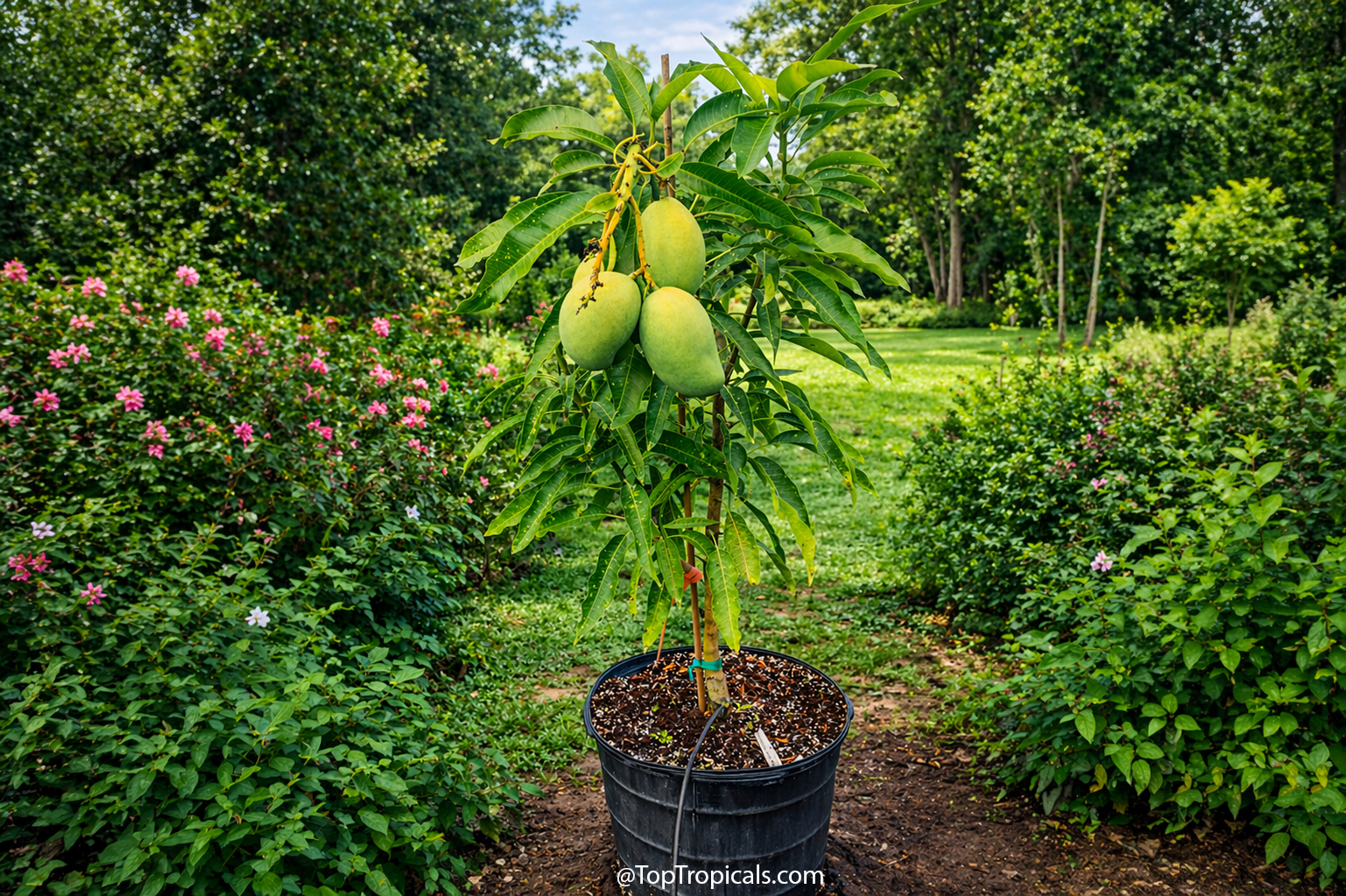
Young  mango  tree  growing  in  a  large  black  nursery  pot,  supported  with 
 stakes  and  drip  irrigation,  bearing  several  green  mango  fruits,  set  in  a 
 lush  garden  with  flowering  shrubs  and  a  sunny  lawn  in  the  background.

Young mango tree in a container, already holding fruit and thriving in a sunny garden setting.

Growing mango in a container is one of the easiest ways to control size, soil, and winter protection. Condo mango varieties stay naturally compact and adapt well to pots, making them ideal for patios, small spaces, or colder climates. You get full flexibility — move the tree when needed, manage its growth, and still enjoy real tree-ripened fruit.

  • Pot size: Start with 3–7 gallon, move up to 15–25 gallon as the tree grows.
  • Soil: Use fast-draining mix such as Abundance soilles mix.
  • Sun: Place in full sun. More light = better growth and fruiting.
  • Watering: Water deeply, then let soil dry slightly before next watering.
  • Feeding: Use controlled-release Green Magic for steady nutrition, plus liquid Sunshine Boosters Mango Tango during active growth.
  • Climate Flexibility: Can be grown in any USDA zone when kept in a container. Simply move indoors or to a protected area during cold weather to keep the tree safe.
  • Pruning: Light pruning keeps the tree compact and productive.

Once you taste a real mango from your own tree, everything changes. It is no longer something you buy — it is something you grow, wait for, and look forward to every season. What felt like hype suddenly makes sense. The passion people have for mango is not exaggerated — it just comes from a completely different experience.

And for people who have never tasted a fresh, juicy mango warmed by the sun, that moment comes as a surprise — the first time they realize what mango is actually supposed to taste like.

As Smokey quietly puts it: Now you know.

📚 More about Condo Mango

🛒 Shop Condo Mango

Landscape  infographic  showing  how  to  cut  a  mango  in  five  steps.  Step  1 
 -  slicing  along  each  side  of  the  pit.  Step  2  -  separating  the  two  cheeks  and
   the  pit.  Step  3  -  scoring  the  mango  flesh  in  a  grid  pattern.  Step  4  - 
 turning  the  cheek  inside  out  to  create  cubes.  Step  5  -  scooping  or  slicing 
 the  cubes  to  eat.  Bright  yellow  background  with  whole  and  cut  mangoes  and 
 green  leaves  decorating  the  layout.

Simple step-by-step guide to cutting a mango into clean, easy cubes - from slicing off the cheeks to popping and scooping the fruit.

🎥 Watch Mango videos

🛒 Shop Mango Trees

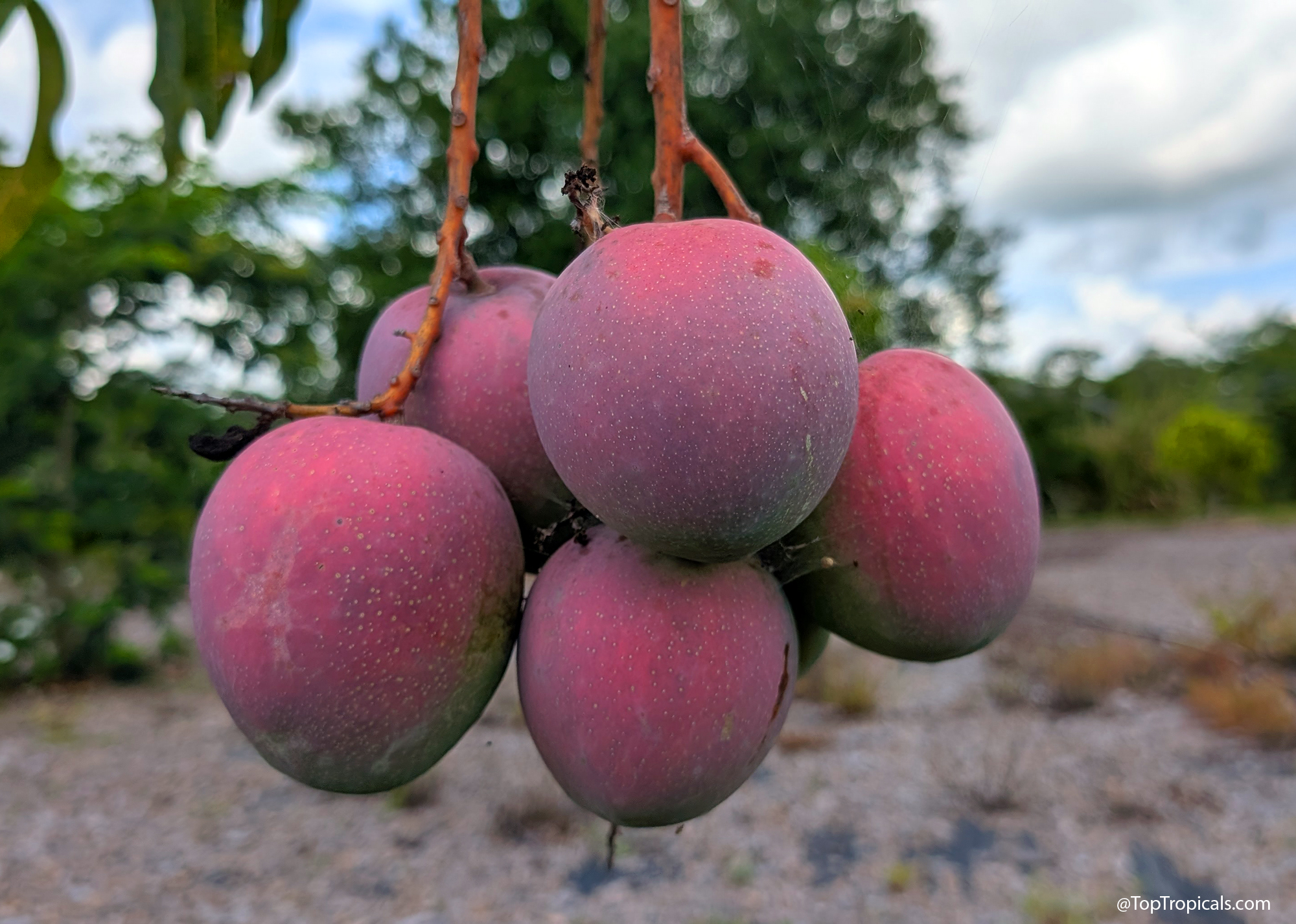
Close-up  of  a  cluster  of  ripening  mangoes  hanging  from  a  branch, 
 showing  red  and  purple  blush  tones  against  a  blurred  outdoor  background.

Cluster of ripening mangoes developing rich color on the tree just before harvest.

Taste the Mango Difference - Save 10%

Once you taste a real mango from your own tree, everything changes. Now you know. Get 10% off with coupon code MANGO2026 on 3 gal mango trees.
Offer valid through 04/28/2026.
Discount applies to 3 gal plants only. Not valid on previous purchases and cannot be combined with other promotions or discounts. Offer subject to change without notice.

Date: 2 Apr 2026

Stop Fixing Your Soil: 15 Bulletproof Fruit Trees for Tough Ground

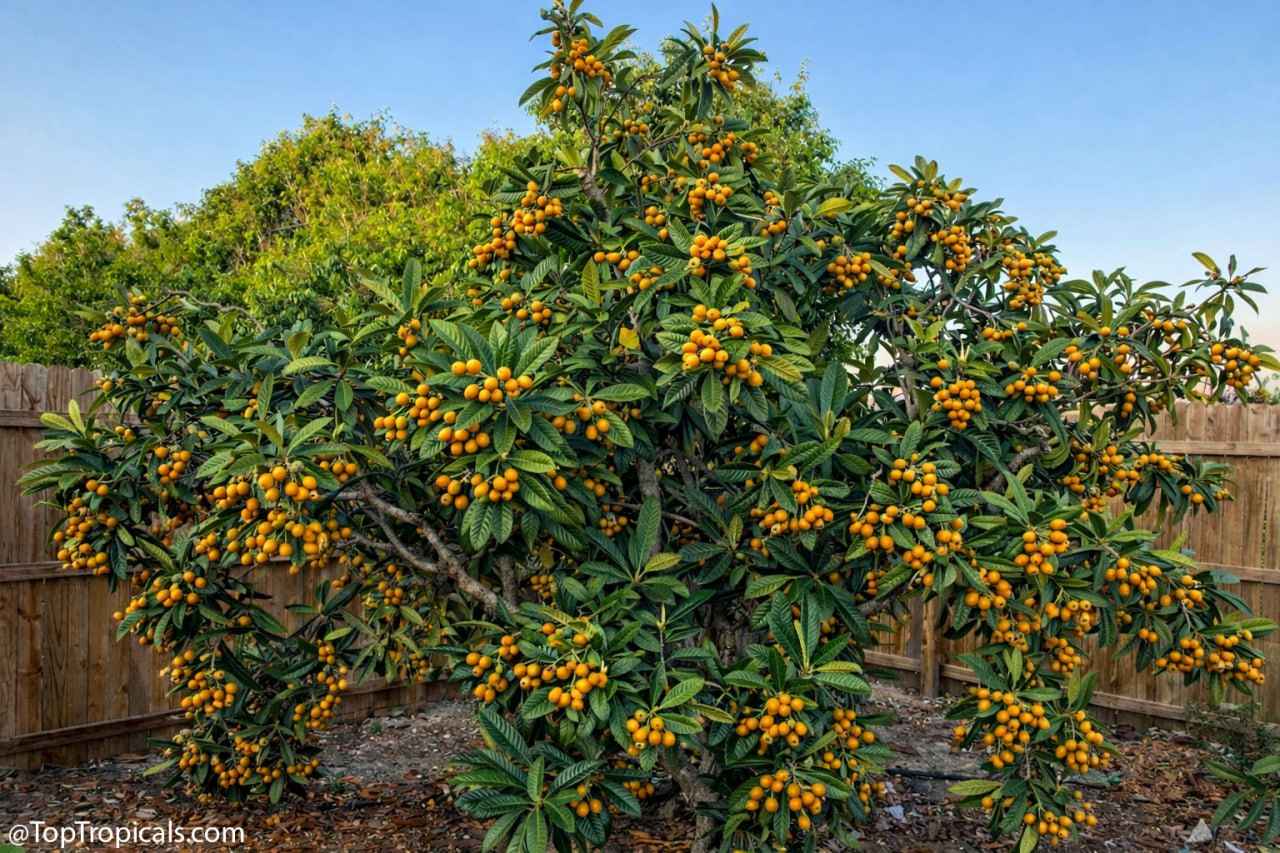
Loquat (Eriobotrya japonica) fruiting

Loquat (Eriobotrya japonica) fruiting

Stop Fixing Your Soil: 15 "Bulletproof" Fruit Trees for Tough Ground 💩

Not everyone starts with a lush, loamy paradise. In many parts of Florida and the South, "soil" is just a polite word for sand, limestone rock, or depleted clay.
The biggest mistake new gardeners make? Spending hundreds of dollars on soil amendments before they ever put a tree in the ground.
The secret the pros know: You don't need to change your land to fit your plants; you need to choose plants that love your land. Some of the most delicious fruits actually thrive on neglect - and a few even produce better fruit when the soil is "poor."


🌳 The "Big 5" Toughest Fruit Trees


If your yard is a dry, sandy lot or a rocky outcrop, start with these. They are the ultimate "survivors."

Jujube, Chinese Date (Ziziphus jujuba): Arguably the toughest fruit tree on earth. It laughs at drought, poor soil, and neglect. The fruit is crisp like an apple when fresh and sweet like a date when dried.

Loquat (Eriobotrya japonica): A Southern staple. It’s evergreen, beautiful, and produces honey-sweet fruit in early spring when nothing else is ripe.

Mulberry (Morus alba): If you can’t grow a Mulberry, you might be gardening on the moon. It grows in sand, clay, or sidewalk cracks with equal enthusiasm.

Fig (Ficus carica): Figs actually prefer not to be pampered. In overly rich soil, they grow lots of leaves but little fruit. Give them well-drained, mediocre soil and they’ll thrive.

Pomegranate (Punica granatum): These trees are "stress-lovers." Rocky, alkaline soil is no problem, and a bit of soil stress often results in a higher sugar content in the fruit.

Pomegranate Plant Facts

Botanical name: Punica granatum
Also known as: Pomegranate, Granada, Grenade, Pomegranate, Granada, Anar, Granaatappel, Pomo Granato, Romeira, Melo Grano
USDA Zone: 8 - 11
Highligths Large shrub 5-10 ft tallSmall tree 10-20 ftFull sunWatering: Moderate. Water when top soil feels dryRed, crimson, vinous flowersThorny or spinyEdible plantDeciduous plantEthnomedical plant.
Plants marked as ethnomedical and/or described as medicinal, are not offered as medicine but rather as ornamentals or plant collectibles.
Ethnomedical statements / products have not been evaluated by the FDA and are not intended to diagnose, treat, cure, or prevent any disease. We urge all customers to consult a physician before using any supplements, herbals or medicines advertised here or elsewhere.Subtropical plant. Mature plant cold hardy at least to 30s F for a short timeSeaside, salt tolerant plant
Get personalized tips for your region


🌳 Tropical Flavors That Don't Need "Perfect" Dirt


You don’t need a rainforest to grow tropical treats. These species are surprisingly resilient once they get their roots established.

🌟 The Sand-Lovers:

Mango (Mangifera indica): While young trees need a little babying, a mature Mango is incredibly drought-tolerant and handles Florida’s sandy "sugar sand" like a champ.

Mango Plant Facts

Botanical name: Mangifera indica
Also known as: Mango
USDA Zone: 9 - 11
Highligths Large tree taller than 20 ftSmall tree 10-20 ftFull sunWatering: Moderate. Water when top soil feels dryYellow, orange flowersPink flowersEdible plantSeaside, salt tolerant plant
Get personalized tips for your region


Sapodilla (Manilkara sapota): A rugged, wind-resistant tree that produces fruit tasting like brown sugar and pear. It is a top-tier choice for coastal or sandy areas.

Tamarind (Tamarindus indica): It’s slow-growing but patient. Once it’s in, it’s there for a century, regardless of soil quality.

🌟 The Low-Maintenance Stars


Longan (Euphoria longana): If you’ve struggled with finicky Lychee trees, try Longan. It’s more cold-hardy and much less picky about its soil.

Citrus: While they need regular feeding (fertilizer), Citrus trees are naturally adapted to the sandy ridges of the South.

🌟 The "Quick-Win" Berry & Shrub Layer


If you want fruit this year, don’t wait for a tree to mature. Add these hardy producers to your edges. And here is why it works:

Dragon Fruit (Hylocereus undatus). It’s a cactus! It literally prefers poor, fast-draining soil over rich potting mixes.

Barbados Cherry (Malpighia glabra). A vitamin C powerhouse that handles low-nutrient soil with ease.

Grumichama (Eugenia brasiliensis). Slower grower, but steady and tolerant once established.

Surinam Cherry (Eugenia uniflora). Virtually indestructible. Often used as a hedge because it grows so vigorously in poor soil.

Pineapple Guava (Feijoa sellowiana). A beautiful silver-leafed shrub that is salt-tolerant and drought-resistant.

Pineapple Plant Facts

Botanical name: Ananas comosus
Also known as: Pineapple, Pina
USDA Zone: 9 - 11
Highligths Small plant 2-5 ftSemi-shadeFull sunWatering: Moderate. Water when top soil feels dryOrnamental foliageThorny or spinyEdible plantSubtropical plant. Mature plant cold hardy at least to 30s F for a short time
Get personalized tips for your region


🌳 The Strategy: "Plant First, Improve Later"


In the South, the "dig a $100 hole for a $10 tree" rule doesn't always apply. Trying to completely re-engineer your soil often leads to drainage issues (the "bathtub effect").

Try this instead:
1. Select a species naturally adapted to your pH and texture.
2. Plant it at the correct height (never too deep!).
3. Mulch heavily with wood chips. This improves the soil from the top down over time, mimicking a natural forest floor.

🛒 Shop Fruit Trees and Mango

📚 Learn more:


· Loquat, Sapodilla, Mulberry, Eugenia, Tamarind - in Plant Encyclopedia
· 10 best fruit trees to grow in Florida and Southern landscapes

#Food_Forest #How_to #Discover

🟢 Join 👉 TopTropicals

Date: 12 Mar 2026

How to learn the secret meanings behind Thai flower names

Cats Smokey and Sunshine in Thai Adenoium garden

Cats Smokey and Sunshine in Thai Adenoium garden

How to learn the secret meanings behind Thai flower names 🔮

If you have ever looked at names of Adeniums or Plumerias from Thailand, you may have noticed something interesting. Many of them sound poetic, mysterious, or even magical. That is not accidental.

Adenium Plant Facts

Botanical name: Adenium sp.
Also known as: Adenium, Desert Rose, Impala Lily
USDA Zone: 9 - 10
Highligths Plant with caudexLarge shrub 5-10 ft tallSmall tree 10-20 ftFull sunWater Requirement: Low. Allow soil to dry out between wateringsWatering: Moderate. Water when top soil feels dryYellow, orange flowersRed, crimson, vinous flowersUnusual colorBlue, lavender, purple flowersWhite, off-white flowersPink flowersToxic or Poisonous
Get personalized tips for your region

Plumeria Plant Facts

Botanical name: Plumeria sp.
Also known as: Plumeria, Frangipani
USDA Zone: 9 - 11
Highligths Large shrub 5-10 ft tallSmall tree 10-20 ftFull sunWatering: Moderate. Water when top soil feels dryYellow, orange flowersRed, crimson, vinous flowersWhite, off-white flowersPink flowersPlant attracts butterflies, hummingbirdsDeciduous plantFragrant plantSeaside, salt tolerant plant
Get personalized tips for your region

Thai plant breeders often give their hybrids meaningful names connected to jewels, wealth, beauty, and mythology. Instead of simple numbers or codes, the plants receive names that sound like something from a legend - Jade Swan, Golden Lotus, Rainbow Diamond.

Once you learn a few common Thai words, these names suddenly start to make sense. It is almost like decoding a secret language of flowers.
Below are some of the most common words you will see in Thai plant names.

🔠 Glossary of common Thai words used in plant names


Gems and precious stones 💎

Anyamanee - precious jewel or rare gem.
Gaew / Kaew - crystal or glass-like jewel.
Manee - jewel or gemstone. A classic word in elegant Thai names.
Noppakao - nine gems, a symbol of royal power and prosperity.
Petch - diamond. Symbol of brilliance and beauty.
Ploy - gem or precious stone. Often used for plants considered rare or jewel-like.
Yok - jade.

Wealth, luck, and prosperity 💰

Boon - merit, blessing, good karma.
Chok - luck or good fortune.
Kanjana / Kanjamapon - golden or noble.
Mongkol - auspicious or lucky.
Paruay / Pa Ruay - to become wealthy or prosperous.
Ramruay - to become rich or prosperous.
Sap / Sab - wealth or treasure.
Sedthee - wealthy person.
Tawee / Taweechok - to increase or multiply.
Thong - gold.
Yod - the best, the peak, or the finest.

Mythology and cultural symbolism 🐉

Bua - lotus.
Chai / Chai Lai - victory or triumph.
Hassadee - derived from the mythical Hatsadiling, an elephant-bird creature in Thai mythology.
Hong - mythical swan or phoenix.
Jai - heart or spirit.
Maha - great or grand.
Moradok - heritage, treasure, or legacy.
Orathai - heart of Thailand or beloved Thai.
Pratum / Pratuma - lotus blossom.
Siam - Thailand, the historic name of the country.

Colors and visual descriptions 🎨

Chompoo - pink color.
Lai - patterned or striped.
Lueng - yellow.
Moung / Muang - purple color.

Nature and poetic imagery

Chaba - hibiscus flower.
Dao - star.
Doung - heart, soul, or central essence.
Fah - sky. Example: Sai Fah - sky-colored.
Nam - water.
Namwhan - sweet water or sweetness.
Natee - river or flowing water.
Sai - thread, line, or ray.
Sairung - rainbow.
Sang Aroon - dawn or sunrise.
Suree - sun or sunlight.

🌸 Examples of plant names built from these words


Once you know the meanings, the names start to read like short poems.

Hong Yok - Jade Swan
Ploy Nappan - Celestial Jewel
Thong Hassadee - Golden Mythical Elephant
Ped Sairung - Rainbow Diamond
Som Paruay - Golden Prosperity
Sai Fah - Sky Blue
Pratum Thong - Golden Lotus
Ramruay - Becoming Rich
Chok Dee - Good Luck
Thong Yod - Peak of Gold

You will see these words frequently in the names of Thai-bred Adeniums, Plumerias, Orchids, and other tropical flowers. Once you recognize them, plant names become much easier - and more fun - to understand.

🛒 Explore Exotic Thai Adeniums

📚 Learn more:


· About #Adenium Rainbow - fantastic varieties
· How to grow a happy Adenium
· The First Video of Exotic Adenium Hybrids

#Container_Garden #Adeniums #Horoscope #How_to #Discover

🟢 Join 👉 TopTropicals

Date: 2 Mar 2026

Eugenia Cherries 🍒

By Tatiana Anderson, Horticulture Expert at Top Tropicals with Smokey & Sunshine help

Eugenia brasiliensis - Grumichama fruit on the branch

Growing Eugenia Cherries (Cherry of the Rio Grande & Grumichama)

Cherry of the Rio Grande and Grumichama are compact, adaptable tropical fruit trees well suited to Southern landscapes. While forgiving, they perform best when planted correctly from the beginning.

Site and Planting

  • Drainage is essential. Avoid low areas where water collects. Plant on a slight mound if soil is heavy or clay-like.
  • Choose full sun for best flowering and fruit production. Partial shade is tolerated.
  • A south or southeast exposure near a wall improves cold resilience and reduces wind stress.
  • Dig a hole twice as wide as the container, but no deeper than the root ball.
  • Set the tree level with surrounding soil. Do not bury the trunk.

Water and Feeding

  • Water regularly during the first few months while roots establish.
  • Once established, trees tolerate short dry periods but fruit best with moderate, consistent moisture.
  • Feed lightly and consistenly. SUNSHINE Boosters Robusta liquid fertilizer is safe to use with with every watering. During hot season you may add controlled release Green Magic every 6 months. It is essential to apply micro elements: Sunshine Superfood micro nutrients complex

Cold Tolerance

  • Protect young trees during hard freezes.
  • Established Cherry of the Rio Grande can tolerate brief drops into the low 20s.
  • Established Grumichama tolerates temperatures into the upper 20s.

Harvest and Production

  • Cherry of the Rio Grande fruits from late spring into summer. Pick when fully dark and slightly soft.
  • Grumichama ripens quickly, often within four weeks after flowering. Pick when glossy and deep purple-black.
  • Both trees often begin fruiting within 2–3 years and increase production steadily with maturity.

Growing in Containers

  • Use at least a 10–20 gallon pot for long-term growth.
  • Ensure multiple drainage holes.
  • Use a high-quality, well-draining container mix. Avoid heavy garden soil. Top Tropicals Abundance soil-less mix is specially formulated for pot growing
  • Place in full sun for best fruiting.
  • Water deeply, then allow the top layer to dry slightly before watering again.
  • Move containers to a protected area during hard freezes.
  • Prune lightly to maintain shape and airflow.

Common Mistakes

  • Planting in poorly drained soil.
  • Overwatering and keeping soil constantly saturated.
  • Over-fertilizing with excessive nitrogen.
  • Planting too deep and burying the trunk.
  • Expecting heavy crops immediately instead of allowing time for maturity.
  • Skipping cold protection for young plants.

Learn more: Tropical Cherries – Eugenias

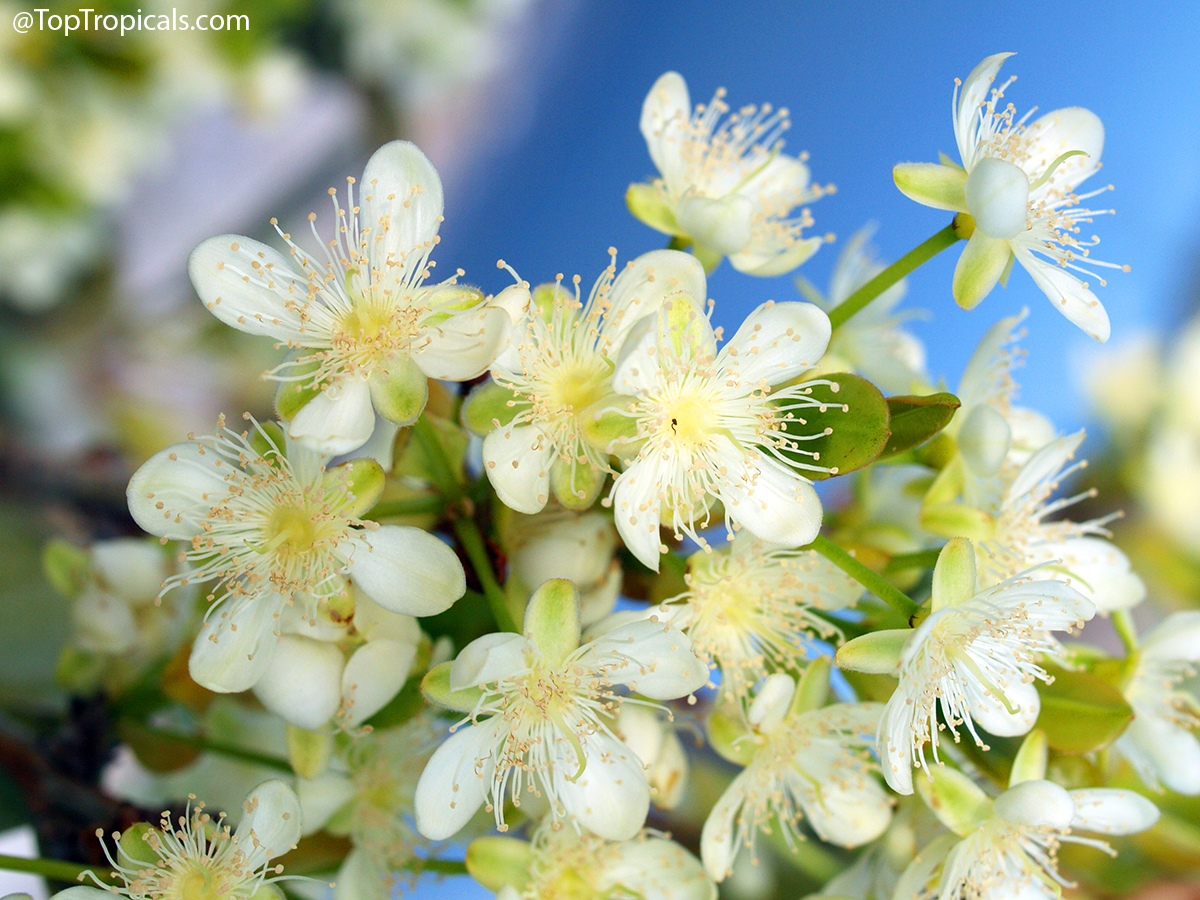
EGrumichama  flowers  (Eugenia  brasiliensis)  in  close-up  showing  white 
 petals  and  long 
 stamens

Eugenia brasiliensis - Grumichama flowers

❓Frequently Asked Questions: Eugenia cherries (FAQ)

  • Which one tastes better – Cherry of the Rio Grande or Grumichama?
    Cherry of the Rio Grande has a deeper, classic “sweet cherry” flavor with slight richness. Grumichama is softer, juicier, and often described as cherry with hints of grape and plum. Both are excellent fresh; Grumichama is especially popular for jam.
  • Which tree produces more fruit?
    Grumichama typically produces heavier crops once mature and can carry hundreds of fruits in a season. Cherry of the Rio Grande produces consistently but in slightly smaller volumes.
  • Do birds take all the fruit?
    Birds are attracted to both trees, especially Grumichama. Netting during peak ripening or harvesting promptly usually solves the issue.
  • Are these true "tropical" trees or subtropical?
    They are best described as subtropical tropicals. Unlike ultra-tender tropical fruits, Eugenia cherries tolerate occasional frost once established, making them more reliable in Southern landscapes.
  • Do they drop fruit messily?
    Fruit will fall if overripe, but the trees are compact and manageable. Regular harvesting prevents ground drop and keeps the area clean.
  • Can they be used for hedging or screening?
    Yes. Their dense evergreen foliage and upright growth make them suitable for edible hedges or privacy screens while still producing fruit.

Choosing between them is not about survival — both have proven resilient. It is about flavor preference, crop volume, and how you want to use the fruit in your kitchen and landscape.

Eugenia brasiliensis - Grumichama fruit close up

Eugenia aggregata (cv. Calycina), Cherry of the Rio Grande

🛒 Add Eugenia cherries to your garden

✍️ Top Ten Fruit Tree Winners of Florida 2026 Record Freeze

Date: 26 Feb 2026

Stop Sugar Crashes: 5 Tropical Fruit Hacks for Healthy Dessert

Exotic Tropical Fruits for Blood Sugar Management. Stop the sugar crash cycle. Learn how to manage glucose levels and insulin spikes using tropical fruits, healthy fats, and metabolic hacks for healthy dessert.

Exotic Tropical Fruits for Blood Sugar Management. Stop the sugar crash cycle. Learn how to manage glucose levels and insulin spikes using tropical fruits, healthy fats, and metabolic hacks for healthy dessert.

🍨 Stop Sugar Crashes: 5 Tropical Fruit Hacks for Healthy Dessert


The smarter way to handle sugar cravings - no restriction required

Tired of the post-cookie slump? Sugar cravings are a physiological response to blood glucose fluctuations, not a lack of willpower. Refined sugars trigger an insulin spike followed by a hypoglycemic crash, trapping you in a cycle of fatigue and hunger.
The secret to metabolic health is managing glycemic load. By choosing nutrient-dense tropical fruits, you satisfy your sweet tooth while maintaining stable energy homeostasis.
The solution is not to give up dessert. It is to change what dessert means. Here is how to use tropical horticulture to hack your biology and regulate insulin:

🍭 1. Choose fruit that comes with fiber


Whole tropical fruits deliver sweetness wrapped in fiber, water, and nutrients. That slows sugar absorption and keeps energy steady.
Try:
· Mango, chilled and sliced

Mango Plant Facts

Botanical name: Mangifera indica
Also known as: Mango
USDA Zone: 9 - 11
Highligths Large tree taller than 20 ftSmall tree 10-20 ftFull sunWatering: Moderate. Water when top soil feels dryYellow, orange flowersPink flowersEdible plantSeaside, salt tolerant plant
Get personalized tips for your region

· Sapodilla - naturally caramel-sweet
· Mulberries by the handful
· Loquat halves straight from the fridge
· Dragon Fruit for light, clean sweetness Same pleasure. Less crash.

🍭 2. Pair sweet with fat to blunt the glucose spike


Healthy lipids are a biological hack for your metabolism. Fats slow gastric emptying, ensuring a steady glucose release rather than an inflammatory spike. Furthermore, lipids trigger cholecystokinin (CCK) - the hormone that signals satiety to the brain - effectively "turning off" cravings at the source.
· Avocado blended into a chocolate-style mousse: The monounsaturated fats create a creamy texture while blunting the sugar response.

Avocado Plant Facts

Botanical name: Persea americana, Persea gratissima
Also known as: Avocado, Alligator Pear, Aguacate, Abacate
USDA Zone: 9 - 11
Highligths Large tree taller than 20 ftSmall tree 10-20 ftFull sunWatering: Regular. Let topsoil dry slightlyEdible plantSubtropical plant. Mature plant cold hardy at least to 30s F for a short time
Get personalized tips for your region

· Banana with nut butter: Combining fast-acting fruit sugars with dense protein and fats.
· Pineapple with raw nuts: The bromelain in pineapple aids digestion, while the fats in nuts provide long-lasting satiety.

Pineapple Plant Facts

Botanical name: Ananas comosus
Also known as: Pineapple, Pina
USDA Zone: 9 - 11
Highligths Small plant 2-5 ftSemi-shadeFull sunWatering: Moderate. Water when top soil feels dryOrnamental foliageThorny or spinyEdible plantSubtropical plant. Mature plant cold hardy at least to 30s F for a short time
Get personalized tips for your region

· Mango mixed into full-fat yogurt: The combination of probiotics, protein, and lipids turns a simple fruit into a complete, low-glycemic snack. When fruit is balanced with fat, cravings calm down instead of escalating.

🍭 3. Use naturally rich fruits in place of sugar


Some tropical fruits taste like dessert already.
· Jackfruit has candy-like sweetness
· Sapote is creamy and custard-like
· Guava brings floral depth
· Cherries add brightness
· Mash Banana into baking instead of white sugar.
· Blend Mango into yogurt instead of syrup.
· Top oatmeal with Mulberry instead of brown sugar. Dessert stays. The crash disappears.

🍭 4. Balance sweet with tart


Adding contrast reduces the urge to overeat sweetness.
· Carambola adds crisp tang.
· Pineapple brightens the palate.
· Loquat gives gentle acidity. Balanced flavors satisfy faster.

🍭 5. Start the day right


Skipping breakfast increases late-day sugar cravings.
A morning smoothie with Avocado, Banana, and Mango prevents the afternoon energy dip. Hydration also matters - thirst often disguises itself as a sweet craving.

🍭 In essence


Dessert is not the enemy. Refined sugar is.
When sweetness comes from nature's bounty, it nourishes instead of draining energy.
You do not need to quit dessert.
You just need to let nature handle it.

Consult with a healthcare professional before making significant dietary changes, especially if you have diabetes or metabolic conditions

🛒 Start your tropical fruit journey

Annona · Guava · Mango · Sapodilla · Mulberry · Pineapple · Avocado · Banana · Loquat · Dragon fruit · Jackfruit · Sapote · Cherries · Carambola

📚 Learn more:


A leaf you grow, not a pill you buy: Insulin ginger - the plant people actually use
How to lose weight naturally with tropical fruit and plants
What's for breakfast? Guava versus Banana
11 tropical fruits to eat instead of taking a fiber supplement
How to make lots of Insulin Ginger plants quickly and get more health benefits
Truth about which fruit helps you lose weight faster: Mango or Papaya?
Five best tropical fruits to naturally boost your energy
Finally: a sugar that’s good for your health

#Food_Forest #Remedies #Discover

🟢 Join 👉 TopTropicals